
If Trump’s tariff war can be interpreted as the US flexing its economic power, it can also be seen as a tacit acknowledgment of the global shift towards a multipolar world: the vision of US hegemony is no longer expansive and global but is shrinking into entrenched interests and spheres of influence more suitable for dealing with a multipolar order. Yet, if Trump is accelerating this shift, he is neither the one who started it nor the only one to contribute to it.
Cracks in the US Global Order
The 2008 financial crisis marked a crucial inflection point in the world order. Faced with a global financial crisis, the US-led G7 countries were unable to mount a sufficient solution. Emerging out of the crisis required recruiting the efforts, resources, and cooperation of the rapidly emerging economies of the Global South, in particular, China. Thus, the moment called for a G2 composed of the United States and China and the G20, composed of the G7 and the locomotives of the Global South. It was the G20 with their stimulus spending, rejection of trade barriers, and financial reforms that “rescued a global financial system in free fall.” Yet, once the global economy was rescued, the global north soon returned to business as usual, recentering global governance on the G7. Nonetheless, the moment had exposed that the global north no longer dominated the global economy, sparking greater South-South cooperation, with China at its center.
China’s Return
Despite starting at the bottom of global value chains, China, through its strategic policies, accumulated trade surpluses and emerged as an alternative center of production. Since integrating into global capitalist value chains after its market reforms in the 1990s, China’s GDP has grown tenfold. Today, its manufacturing has supplanted Western manufacturing.
As the Global South witnessed the Global North’s inability to steer the global economy in 2008, various South-South cooperation initiatives emerged. BRICS, composed of Brazil, Russia, India, China, and South Africa, which had emerged in 2009, became BRICS+ in 2023 to include Iran, Saudi Arabia, the United Arab Emirates, Egypt, Ethiopia, and others. This enlargement increased its global economic weight, particularly in energy markets, and amplified its role as a counterbalance to Western-led institutions. Global South coalitions continue to carve out parallel systems of economic and financial governance that both hedge against and compete with longstanding US-led structures.
The Shanghai Cooperation Organization (SCO), a Eurasian political, economic, and security grouping led by China and Russia, had begun discussing ways to expand cooperation in trade, investment, and economic development in 2001. After the Russia-Ukraine war, the SCO strengthened, with members having “doubled down on the economic relationship with Russia.” Furthermore, with Russia selling its oil without denominating it in dollars, and Asian countries buying less US debt, the foundations of “globalization are shifting.”
The Last Pillar: US Military Power
The late Immanuel Wallerstein theorized that hegemony is lost in three stages: productively, financially, and militarily. First, the hollowing out of US production is best illustrated by the fate of Detroit, Michigan. The city that had once heralded the age of mass production with its Ford-T production lines is today a haunting example of US deindustrialization. The US began losing its manufacturing power from 1979, whilst China’s “Reform and Opening”, which began at around the same time, catapulted its economy forward. The US angst that had existed against the Soviet Union during the Cold War has now been redirected to China.
The US’s financial hegemony, long anchored by the dollar’s role as the global reserve currency and its dominance of the IMF, World Bank, and WTO, is increasingly under pressure. Initiatives such as BRICS+’s exploration of alternative payment systems and the AIIB’s infrastructure financing represent concrete steps to reduce dependence on US-controlled institutions. The expansion of BRICS+ to Saudi Arabia and the UAE challenges the dollar’s dominance, especially in oil markets: oil purchases denominated in the Chinese RMB are eroding the dominance of the petrodollar. While the US still dominates finance, collectively, these moves signal a gradual shift toward a more plural financial order.
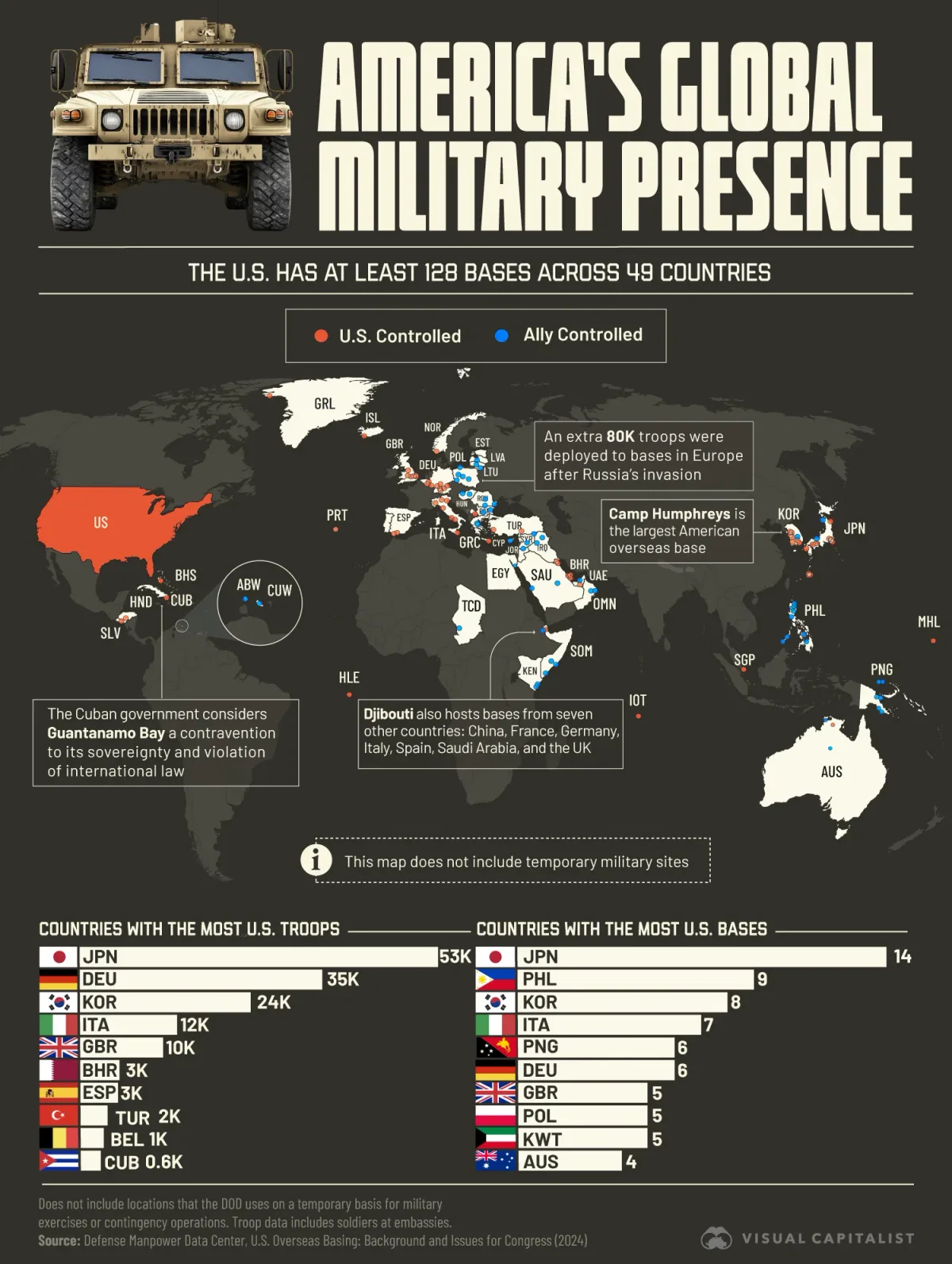
Despite the erosion of its productive and financial dominance, the US still retains overwhelming military power. Independent estimates place its military spending at over $1.5 trillion a year. Having lost its manufacturing and financial dominance, the US is now waging a New Cold War to retain its status and control. What the US accomplishes with a $1.5 trillion budget is an unparalleled ability to project military force globally. With carrier strike groups, airborne rapid-response brigades, and extensive forward basing around the globe, the US can deploy significant combat assets, including aircraft and troops, to crisis zones worldwide within a day.
Encirclement and Alliances
The US aggressively uses its military as leverage and to forcefully resolve its problems. Its tactics range from information (through the US-dominated global media) to hybrid warfare (through US-dominated global institutions) and to proxy wars, best reflected in the US overwhelming support for Ukraine against Russia, and former President Joe Biden’s remarks that Israel is “America’s most important ally in the Middle East and against Iran”.
The US’s strategy in Asia pushes for allies (i.e., South Korea, Japan, Philippines) to adopt policies and stances that encircle and pressure China. A notable example is the 2017 deployment of THAAD missile systems in South Korea, which Washington framed as protection against North Korea but whose radar capabilities extend deep into China. Agreeing to such a demand played into Washington’s hands by placing Seoul in confrontation with Beijing.
The economics of the new Cold War further demonstrate the continuity of this containment approach. While the US-China rivalry is often associated with Trump, Obama first initiated tariffs on Chinese goods and advanced the Trans-Pacific Partnership to exclude China. Biden later continued this trajectory with the Indo-Pacific Economic Framework and the CHIPS Act, which subsidized semiconductor production and supply chains with allies to re-industrialize the US while denying China access. Trump’s tariffs are simply intensifying the ongoing war against Chinese manufacturing.
For the Global South, the key struggle lies in defending sovereignty against Western interference. In South Korea, this involves greater sovereignty in peacebuilding efforts with North Korea, which have been repeatedly held hostage and sabotaged by the United States. This broader confrontation underscores the importance of international solidarity in resisting domination and asserting the right to chart independent paths toward peace in the face of a globalized new Cold War.
---
This article was produced by Globetrotter and the International Strategy Center (Seoul, South Korea). Giovani Vastida is a contents team member at the International Strategy Center and holds an MSc in International Politics from SOAS, University of London. His interests span philosophy and the various social sciences, where he is an avid reader and researcher. Steven Lee is a translation team member at the International Strategy Center and works as an interpreter and translator
Comments