
Profit expectations remain muted due to high cost increases, subdued sales: IIM-A survey

By A Representative 

The Indian Institute of Management-Ahmedabad's (IIM-A) latest Business Inflation Expectations Survey (BIES), which provides ways to examine the amount of slack in the economy by polling a panel of business leaders, has said that the cost perceptions data indicate "persistence of high-cost pressures."
Stating that over 66% of the participating firms in the survey perceive significant (over 6%) cost increase for the consecutive four months, the BIES report, however, states, "Percentage of firms perceiving over 10% cost increase y-o-y has been slowly declining. Over 34% of the firms in May 2022 round of the survey perceive those costs have increased very significantly (over 10%) – down from 39% recorded in February 2022."
Conducted by the Misra Centre for Financial Markets and Economy, IIM-A, on the basis of responses of around 1,000 companies, and claiming to be unique "in that it goes straight to businesses -- the price setters -- rather than to consumers or households, to understand their expectations", the latest round of survey says, "Firms’ sales expectations have moderated. Percentage of firms reporting ‘somewhat less than normal’ sales has increased sharply to 34% in May 2022 from 27% reported in April 2022."
Even as pointing out that "around 23% of the firms in May 2022 report that sales are ‘about normal’, down from 28% reported in April 2022", the survey, a monthly affair, says, "For the past five consecutive rounds, around 4/5th of the firms in the sample reported ‘much less than or somewhat less than normal’ profit. Profit expectations remained muted due to high cost increases and subdued sales expectations."
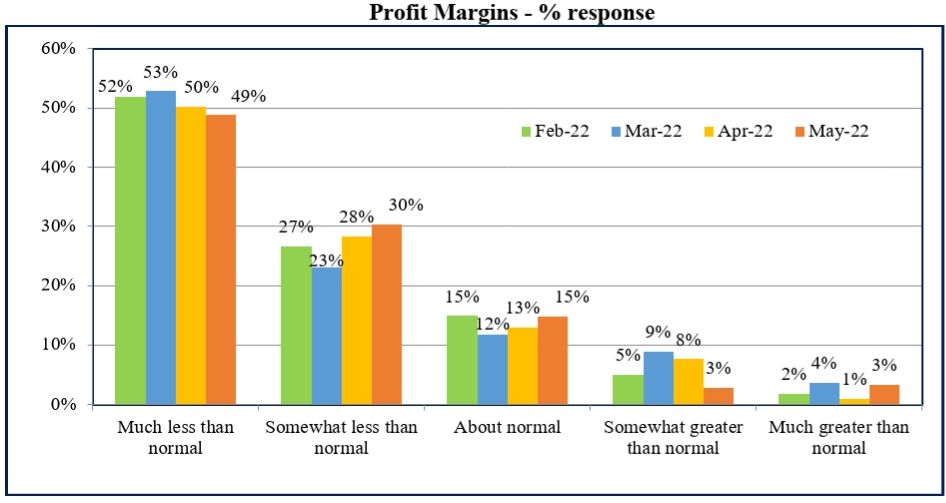
The survey also notes, "One year ahead business inflation expectations in May 2022 have declined sharply by 44 bps to 5.58% from 6.02% reported in April 2022. There are early signs of business inflation expectations tapering off, after remaining close to or above 6% during January-April 2022." However, "The uncertainty of business inflation expectations in May 2022 has remained around 2.1%, same as reported during February-April 2022."

Comments

TRENDING

Gujarat Sachivalaya blacklists, denies entry to woman social activist: Will NHRC probe?

By Kantilal Parmar*  I have approached the National Human Rights Commission (NHRC) seeking an independent, impartial, and transparent investigation into a serious incident that took place at the Gujarat Secretariat in Gandhinagar on August 18, 2026. The matter concerns social activist and women’s rights leader Chandrikaben Solanki, who, according to the information available to me, was denied an entry pass to the Secretariat when she went there to meet Gujarat’s Social Justice and Empowerment Minister, Dr. Manishaben Vakil, to raise an issue concerning social justice.

Tibetan activist’s self-immolation sparks fresh concerns over cultural rights

By Kumar Krishnan*  The question of Tibet has once again entered international discourse, raising difficult questions about human rights, religious freedom, cultural identity, language, and the relationship between political power and the rights of indigenous communities. On 20 August 2026, the Kashag and the Tibetan Parliament-in-Exile jointly organised a solidarity prayer service and peace march to mark the 49th day since the death of Lobga Rangzen, a Tibetan activist who died after self-immolating on 2 July in front of the United Nations Headquarters in New York.

IMF's policies 'stabilise' external creditors' balance sheets, 'generate' crisis in Africa

By Grieve Chelwa, Vijay Prashad   Across Africa, the International Monetary Fund (IMF) presents itself as the custodian of macroeconomic stability. Its latest Article IV staff reports on Ethiopia . Malawi , Nigeria , South Africa , and Zambia are written for economies with very different histories and institutions. Yet they converge on a familiar prescription: fiscal consolidation, tighter monetary policy, market-determined exchange rates, subsidy reform, deregulation and ‘private-sector-led growth’. No serious economist can dismiss macroeconomic stability.