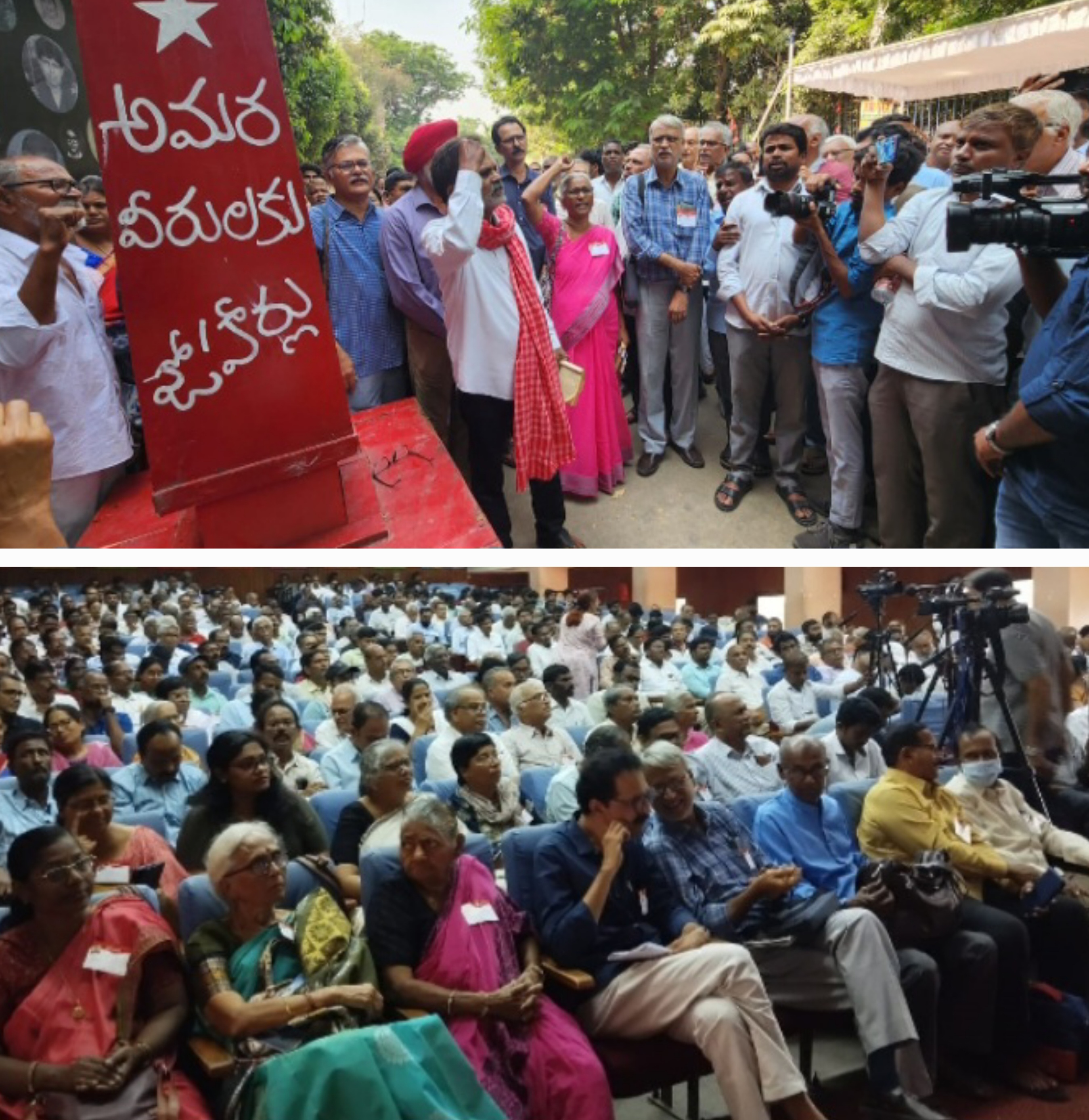
History is something we constantly remember and reflect upon, but certain moments and events bring it back to our memory in a special way. For the Telugu people, and Telangana in particular, the memorial seminar held on February 20–21 was a significant occasion to recall the glorious events, transformations, leaders, and heroes of past struggles. Thousands of students rewrote the history of people's movements in Andhra Pradesh, carrying revolutionary zeal and the spirit of self-sacrifice to levels comparable to the Russian and Chinese Revolutions.
History was resurrected with the two-day seminar at the Sundara Vignyan Kendra auditorium in Hyderabad, rekindling memories of the spark lit 50 years ago by students. The event was held heroically, defying the iron grip of state repression and the venom of Hindutva forces. From the depths of despair, a virtual festival of the masses was created.
The Andhra Pradesh Radical Students Union’s dedication to inculcating social awareness among students and the people represents an unparalleled legacy of sacrifice. Many leaders and activists gave up their studies or joined the revolutionary movement after completing their education, with more than 300 of them falling victim to fake encounters by the state.
Although the organization, formed 50 years ago, did not survive beyond 25 years, it remains deeply rooted in the collective memory of the people. The lives, work, and sacrifices of Radical Students shimmer like an inextinguishable flame. The Radical student movement is an inseparable and glorious part of Telugu society’s history. It followed the model of the Chinese Revolution in a way that few student organizations ever have.
As the memories of many martyrs resurfaced, family members, relatives, friends, and comrades were moved to tears, reliving the heart-wrenching past. In this context, former student activists and union leaders who once worked in revolutionary student organizations united to organize this conference on February 20 and 21.
Bhagat Singh's nephew, Professor Jag Mohan Singh, narrated how today's rulers have robbed the people of the rights won through struggles during the independence movement. Speaking at the conference on the 50th anniversary of the revolutionary student movement at Sundarayya Vignana Kendra in Baglingampalli, he delivered an impactful speech as the chief guest. He emphasized how robbery and violence are on the rise and called for united movements to resist them. He also noted that Bhagat Singh’s analysis of India's economic crisis in the 1920s remains relevant today.
Professor Haragopal expressed that, in the current crisis, human survival itself has become a struggle. He stressed the need to revive the student struggles of the 1970s and 1980s.
Siva Reddy, one of the founding leaders of RSU, lamented that Varavara Rao, a beacon of consciousness for students, remains imprisoned. He explained how, in the context of the Indian revolutionary movement, the struggle in Telangana could pave the way for revolution. He detailed how the Radical Students Union was formed to crystallize the revolutionary movement.
Dr. Gopinath analyzed how, after globalization, national states were weakened. He observed that, while students in the 1970s and 1980s were naturally drawn to movements, today’s situation is vastly different. He argued that globalization has made it necessary to devise new forms of student struggle.
Former PDSU leader Pradeep recalled that in the 1970s, universities were centers of revolution, whereas today, campuses have been paralyzed. With democratic and secular values under attack, he emphasized the urgent need to ignite united movements and defeat fascism.
Mohan Rao, brother of martyr Surapaneni Janardhan, urged students to resurrect the struggles of the 1970s and 1980s.
Professor Katyayani Vidmahe shared that she studied Marxism primarily to answer the challenging questions posed by RSU students. He described how, in today’s academic climate, meaningful debates between students and professors have faded. He questioned how human values could be upheld in a society that increasingly promotes beastly instincts.
Other speakers, including Ravi Narla, N. Venugopal, and Pani, reflected on different historical periods of the student movement. They analyzed key turning points, setbacks, and the systematic approach of the organization, highlighting its clarity of purpose and deep penetration into the masses.
Vivek, a Tamil Nadu activist, recounted how the Radical Students Union of Andhra Pradesh served as a model for student struggles in Tamil Nadu. He described "go to village" campaigns that stirred peasant movements in Dharmapuri and highlighted the influence of APRSU’s work methods. He also spoke about the Tamil Nadu student movement’s role in supporting the Eelam Struggle.
A student leader from the Bhagat Singh Ekta Manch in Delhi underlined how Hindutva fascism and Brahmanical forces today obstruct organized student agitations. She cited examples of students heroically resisting repression in Lalgarh and organizing pro-Dalit and anti-Brahmanical fascist agitations on campuses. She asserted that APRSU remains a model for student movements.
A former leader from Pragathipira Vidhyarti Kendra in Karnataka expressed reservations about duplicating the Radical movement today, noting that the socio-political landscape has undergone dramatic changes. He argued that capitalism has deeply penetrated society, rendering feudalism no longer the principal contradiction. However, he still provided a detailed analysis of the fascist assault on the student community and the dominant mode of production, emphasizing the role of cultural imperialism.
The seminar also featured the release of important books documenting the 50-year history of the Radical Students Union and the lives of its martyrs. These publications covered the historical aspects of the movement in depth.
In my opinion, what was not adequately addressed were key aspects such as the ideological preconditions of Maoism in a student organization, the reasons behind APRSU's decline, and the methods required to resurrect the movement today. No space was dedicated to strategizing the formation of a powerful revolutionary student movement or critically evaluating past errors.
---
*Freelance journalist
Prof. Katyayani Vidmahe is SHE, not HE.
ReplyDeleteCorrected
ReplyDelete