Nagas being subjected to untold trauma, 'heavy' mental burden: Global rights group

Counterview Desk 

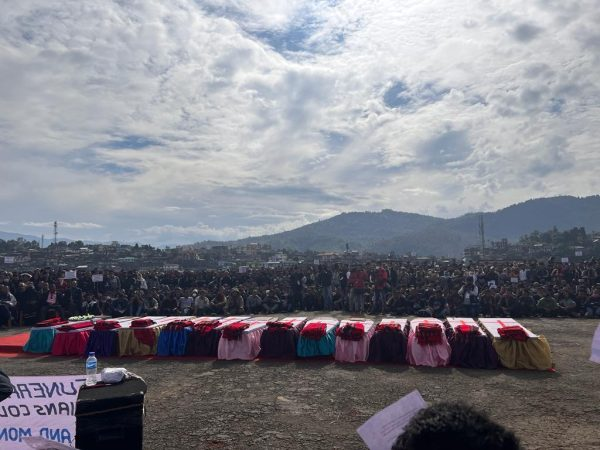
The International League of Peoples' Struggle (ILPS), with presence in 40 countries, even as strongly condemning the "murder" of 15 coal miners and injuring 11 more by the Indian army in Mon district, Nagaland, has said it is "joining" its network, Naga Peoples Movement for Human Rights (NPMHR), adding, it supports the Naga peoples, the people of India’s north east and all lovers of peace and freedom in calling for the immediate repeal of the Armed Forces Special Powers Act (AFSPA), 1958.
Releasing a statement by NPMHR, it said, AFSPA is sought to be implemented by the Government of India in Northeast States allegedly enabling Indian army’s "massacre of indigenous peoples and citizens with impunity." Calling for justice for all the "victims" of the Indian government, it has floated an online petition to repeal AFSPA to seek international solidarity.

NPMHR statement:

Ever since military aggression and occupation of the Naga homeland in 1954, civilians and common Naga people have been the target of the Indian army and the para-military forces. Armed with Draconian and inhuman legal immunity by the Indian Parliament, the Government of India continues unabated to kill civilians and common people at any time and at any place of its conveniences. Our women folks were stripped of all human dignity by the armed forces of the world’s largest Democracy, India.
They are being raped, tortured, made to give birth publicly with no more human dignity left and are being subjected to live lives of untold trauma and heavy mental burdens. The Indian State does not spare any of its armed tools and occupational instruments to extinguish the Naga spirit of human dignity and spirit of equal human brotherhood. The world is prevented from knowing these ceaseless state-sponsored crimes against the Naga people and against humanity.
The reign of the Indian State-sponsored terrorism and war waged on civilian population is yet again showcased when the best-trained Indian elite forces butchered a group of humble people returning to their homes in a truck from their work places. The well-trained Indian army personnel engaged their most sophisticated firearms to kill them as if the simple, humble and bread-earning villagers were diseased and had to be culled.
Are the lives of the Naga people less than the lives of other fellow human beings? This evil act of the Indian government through its military forces once again reveals its true intent of owning our land after exterminating our Naga people.
Our people at all times seek to live in peace with all other people. Our history tells that we have never waged war on any people even in the days of old. We are being denied to live lives of dignity, to exercise our rights and are now being driven to live in fear. The Government of India, time and again, wages war against our Naga people. The actions of the Indian State upon our people are no less than the erstwhile apartheid. No power on earth had ever succeeded in subduing our Naga spirit.
We, the Naga Peoples’ Movement for Human Rights (NPMHR), resolutely condemn the genocide committed upon the humble working-civilian villagers. We squarely hold the Government of India with all its draconian and fascist laws responsible for letting loose their dogs of war to maul to shreds the innocent villagers of Oting who have committed no crime whatsoever except commitment to humbly earn their livelihood with dignity and honor. Even at this moment when we are making this Statement, the Indian military and paramilitary forces are still engaged in their mayhem of killing the civilians in Mon Town.
Our anguish is unspeakable at this moment of grief. Our hearts go to the families of the slain innocent villagers. The NPMHR stands with them all and shall walk with them through thick and thin.

Comments

TRENDING

Pace bowlers who transcended pace bowling prowess to heights unscaled

By Harsh Thakor*   This is my selection and ranking of the most complete and versatile fast bowlers of all time. They are not rated on the basis of statistics or sheer speed, but on all-round pace-bowling skill. I have given preference to technical mastery over raw talent, and versatility over raw pace.

When a lake becomes real estate: The mismanagement of Hyderabad’s waterbodies

By Dr Mansee Bal Bhargava*  Misunderstood, misinterpreted and misguided governance and management of urban lakes in India —illustrated here through Hyderabad —demands urgent attention from Urban Local Bodies (ULBs), the political establishment, the judiciary, the builder–developer lobby, and most importantly, the citizens of Hyderabad. Fundamental misconceptions about urban lakes have shaped policies and practices that systematically misuse, abuse and ultimately erase them—often in the name of urban development.

When grief becomes grace: Kerala's quiet revolution in organ donation

By Vidya Bhushan Rawat*  Kerala is an important model for understanding India's diversity precisely because the religious and cultural plurality it has witnessed over centuries brought together traditions and good practices from across the world. Kerala had India's first communist government, was the first state where a duly elected government was dismissed, and remains the first state to achieve near-total literacy. It is also a land where Christianity and Islam took root before they spread to Europe and other parts of the world. Kerala has deep historic rationalist and secular traditions.

Bangladesh goes to polls as press freedom concerns surface

By Nava Thakuria*  As Bangladesh heads for its 13th Parliamentary election and a referendum on the July National Charter simultaneously on Thursday (12 February 2026), interim government chief Professor Muhammad Yunus has urged all participating candidates to rise above personal and party interests and prioritize the greater interests of the Muslim-majority nation, regardless of the poll outcomes. 

'Serious violation of international law': US pressure on Mexico to stop oil shipments to Cuba

By Vijay Prashad   In January 2026, US President Donald Trump declared Cuba to be an “unusual and extraordinary threat” to US security—a designation that allows the United States government to use sweeping economic restrictions traditionally reserved for national security adversaries. The US blockade against Cuba began in the 1960s, right after the Cuban Revolution of 1959 but has tightened over the years. Without any mandate from the United Nations Security Council—which permits sanctions under strict conditions—the United States has operated an illegal, unilateral blockade that tries to force countries from around the world to stop doing basic commerce with Cuba. The new restrictions focus on oil. The United States government has threatened tariffs and sanctions on any country that sells or transports oil to Cuba.

Beyond the conflict: Experts outline roadmap for humane street dog solutions

By A Representative   In a direct response to the rising polarization surrounding India’s street dog population, a high-level coalition of parliamentarians, legal experts, and civil society leaders gathered in the capital to propose a unified national framework for humane animal management. The emergency deliberations were sparked by a recent Suo Moto judgment that has significantly deepened the divide between animal welfare advocates and those calling for the removal of community dogs, a tension that has recently escalated into reported violence against both animals and their caretakers in states like Telangana.

Buddhist shrines were 'massively destroyed' by Brahmanical rulers: Historian DN Jha

Nalanda mahavihara By Rajiv Shah  Prominent historian DN Jha, an expert in India's ancient and medieval past, in his new book , "Against the Grain: Notes on Identity, Intolerance and History", in a sharp critique of "Hindutva ideologues", who look at the ancient period of Indian history as "a golden age marked by social harmony, devoid of any religious violence", has said, "Demolition and desecration of rival religious establishments, and the appropriation of their idols, was not uncommon in India before the advent of Islam".

Walk for peace: Buddhist monks and America’s search for healing

By Vidya Bhushan Rawat*  The #BuddhistMonks in the United States have completed their #WalkForPeace after covering nearly 3,700 kilometers in an arduous journey. They reached Washington, DC yesterday. The journey began at the Huong Đạo Vipassana Bhavana Center in Fort Worth, Texas, on October 26, 2025, and concluded in Washington, DC after a 108-day walk. The monks, mainly from Vietnam and Thailand, undertook this journey for peace and mindfulness. Their number ranged between 19 and 24. Led by Venerable Bhikkhu Pannakara (also known as Sư Tuệ Nhân), a Vietnamese-born monk based in the United States, this “Walk for Peace” reflected deeply on the crisis within American society and the search for inner strength among its people.

Declaration on raw cotton imports contradicts claim: 'Agriculture outside US trade deal'

By A Representative   The All India Kisan Sabha (AIKS) has alleged that recent remarks by Union Commerce and Industry Minister Piyush Goyal on raw cotton imports from the United States contradict the government’s claim that agriculture is not part of the proposed India–US trade arrangement.