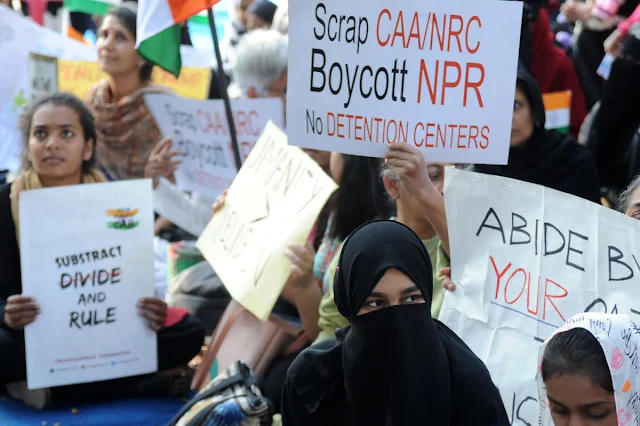
Hate crime: 'Act against BJP, RSS leaders, repeal of CAA-NPR-NRC programme'

Counterview Desk 

In a letter to President Ram Nath Kovind, about 1200+ citizens ranging from farmers to housemakers to academics, retired bureaucrats and senior citizens to civil society activists, doctors and lawyers to journalists, have endorsed a statement seeking his intervention for the repeal of the Citizens Amendment Act-National Population Register-National Register of Citizens (CAA-NPR-NRC) immediately.
Celebrating two years of the Shaheen Bagh protests which rocked Delhi in 2019, in an open letter, they said, "The CAA-NPR-NRC project of the government of India has been deeply problematic since it was first proposed and rushed through Parliament."
"In fact", the letter said, "Starting in the Shaheen Bagh area of New Delhi in late 2019, protests against it rose spontaneously in over 100 neighbourhood sites across the nation, and indeed the globe. These protests articulated the Constitutional right of every citizen of India to be treated as an equal irrespective of caste, gender, religion, region, ethnicity, etc."
Stating that the protests were "withdrawn or forcibly shut down following the Coronavirus pandemic", it noted, "The peoples’ demand for the withdrawal has remained as steadfast as ever", pointing out, "Citizens across caste, religion, creed and gender" have again come together at "more than 25 sites across the country to reiterate our plea for the repeal of CAA-NPR-NRC" with memorandums already submitted to many district and state level officials across the country "to this effect as well."

Text:

We, citizens from villages, towns and cities across the country write to you with regard to the Citizenship Amendment Act 2019 and the NPR-NRC project linked to it.
We write to you to register our strong opposition to the Citizenship Amendment Act 2019 and demand its repeal. This Act threatens the very foundation of our Constitution by redefining citizenship on the basis of religion. It violates Article 14 of our Constitution that accords that no person residing in India will be discriminated against on the basis of religion, caste, gender etc. 
Nationwide implementation of a project like NRC that would demand its citizens to submit elaborate documentation that a large majority of the working poor population of the country do not possess, would only be an instrument of harassment and exclusion for stripping citizens from citizenship rights. It is clear to us that the combination of CAA-NPR-NRC is being used to target religious minorities in our country and to further communalise and polarise our society on religious lines.
All through the months after the passing of the CAA in Dec '19 until the national lockdown imposed due to Covid-19 on 24th March 2020, citizens organised peaceful demonstrations and sit-in protests across the country to register their democratic dissent against this law. However, our demands still remain unaddressed. 
Instead, many who exercised their right to democratic dissent have been framed in fabricated cases and even anti-terror laws. Most still continue to languish behind bars facing a harsh pre-trial incarceration. In a dubious and false narrative, peaceful protestors who raised their voices against this law, particularly from the Muslim community, have been labeled and targetted by the police as 'rioters', 'conspirators' and 'terrorists'.
It is the responsibility of a democratic government to listen to its citizens and engage with voices of dissent. What we have instead encountered with regard to the movement demanding the repeal of CAA is state repression and violence from the ruling government. We once again come together to put forward the following demands to you:
  1. The repeal of CAA-NPR-NRC and Unlawful Activities Prevention Act (UAPA).
  2. Enquiry by a sitting Supreme Court judge into the Delhi violence ‘20.
  3. The immediate and unconditional release of all anti-CAA-NPR-NRC protestors and withdrawal of all false cases against them
  4. Justice and rehabilitation for all victims of the Delhi riots ‘20
  5. Action against the BJP politicians and RSS workers responsible for hate crimes.
---
Click here for prominent signatories

Comments

TRENDING

The golden crop: How turmeric is transforming women's lives in tribal India

By Vikas Meshram*   When the lush green fields of turmeric sway in the tribal belt of southern Rajasthan, Madhya Pradesh, and Gujarat, it is not merely a spice crop — it is the golden glow of self-reliance. In villages where even basic spices once had to be bought from the market, the very soil today is yielding a prosperity that has transformed the lives of thousands of families. At the heart of this transformation is the initiative of Vaagdhara, which has linked turmeric with livelihoods, nutrition, and village self-governance — gram swaraj.

Swami Vivekananda's views on caste and sexuality were 'painfully' regressive

By Bhaskar Sur* Swami Vivekananda now belongs more to the modern Hindu mythology than reality. It makes a daunting job to discover the real human being who knew unemployment, humiliation of losing a teaching job for 'incompetence', longed in vain for the bliss of a happy conjugal life only to suffer the consequent frustration.

Was Netaji forced to alter face, die in obscurity in USSR in 1975? Was he so meek?

  By Rajiv Shah   This should sound almost hilarious. Not only did Subhas Chandra Bose not die in a plane crash in Taipei, nor was he the mysterious Gumnami Baba who reportedly passed away on 16 September 1985 in Ayodhya, but we are now told that he actually died in 1975—date unknown—“in oblivion” somewhere in the former Soviet Union. Which city? Moscow? No one seems to know.

Love letters in a lifelong war: Babusha Kohli’s resistance in verse

By Ravi Ranjan*  “War does not determine who is right—only who is left.” Bertrand Russell’s words echo hauntingly in our times, and few contemporary Hindi poets embody this truth as profoundly as Babusha Kohli. Emerging from Jabalpur, Madhya Pradesh, Kohli has carved a unique space in literature by weaving together tenderness, protest, and philosophy across poetry, prose, and cinema. Her work is not merely artistic expression—it is resistance, refuge, and a call for peace.

Buddhist shrines were 'massively destroyed' by Brahmanical rulers: Historian DN Jha

Nalanda mahavihara By Rajiv Shah  Prominent historian DN Jha, an expert in India's ancient and medieval past, in his new book , "Against the Grain: Notes on Identity, Intolerance and History", in a sharp critique of "Hindutva ideologues", who look at the ancient period of Indian history as "a golden age marked by social harmony, devoid of any religious violence", has said, "Demolition and desecration of rival religious establishments, and the appropriation of their idols, was not uncommon in India before the advent of Islam".

Authoritarian destruction of the public sphere in Ecuador: Trumpism in action?

By Pilar Troya Fernández  The situation in Ecuador under Daniel Noboa's government is one of authoritarianism advancing on several fronts simultaneously to consolidate neoliberalism and total submission to the US international agenda. These are not isolated measures, but rather a coordinated strategy that combines job insecurity, the dismantling of the welfare state, unrestricted access to mining, the continuation of oil exploitation without environmental considerations, the centralization of power through the financial suffocation of local governments, and the systematic criminalization of all forms of opposition and popular organization.

Echoes of Vietnam and Chile: The devastating cost of the I-A Axis in Iran

​ By Ram Puniyani  ​The recent joint military actions by Israel and the United States against Iran have been devastating. Like all wars, this conflict is brutal to its core, leaving a trail of human suffering in its wake. The stated pretext for this aggression—the brutality of the Ayatollah Khamenei regime and its nuclear ambitions—clashes sharply with the reality of the diplomatic landscape. Iran had expressed a willingness to remain at the negotiating table, signaling a readiness to concede points emerging from dialogue. 

False claim? What Venezuela is witnessing is not surrender but a tactical retreat

By Manolo De Los Santos  The early morning hours of January 3, 2026, marked an inflection point in Venezuela and Latin America’s centuries-long struggle for self-determination and independence. Operation Absolute Resolve, ordered by the Trump administration, constituted the most brutal and direct military assault on a sovereign state in the region in recent memory. In a shocking operation that left hundreds dead, President Nicolás Maduro and First Lady Cilia Flores were illegally kidnapped from Venezuelan soil and transported to the United States, where they now face fabricated charges in a New York federal detention facility. In the two months since this act of war, a torrent of speculation has emerged from so-called experts and pundits across the political spectrum. This has followed three main lines: One . The operation’s success indicated treason at the highest levels of the Bolivarian Revolution. Two . Acting President Delcy Rodríguez and the remaining leadership have abandone...

The price of silence: Why Modi won’t follow Shastri, appeal for sacrifice

By Arundhati Dhuru, Sandeep Pandey*  ​In 1965, as India grappled with war and a crippling food crisis, Prime Minister Lal Bahadur Shastri faced a United States that used wheat shipments under the PL-480 agreement as a lever to dictate Indian foreign policy. Shastri’s response remains legendary: he appealed to the nation to skip one meal a day. Millions of middle-class households complied, choosing temporary hunger over the sacrifice of national dignity. Today, India faces a modern equivalent in the energy sector, yet the leadership’s response stands in stark contrast to that era of self-reliance.