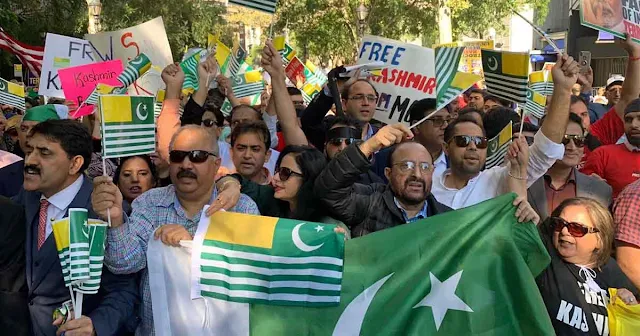
Pro-Pak Kashmiri diaspora group terribly annoyed with US' 'leave-it-alone stance'

By A Representative 

A Pakistan-backed Kashmiri diaspora group based in the US is terribly perturbed. Calling itself World Kashmir Awareness Forum, its general secretary Dr Ghulam Nabi Fai, a controversial figure who was sentenced to two years’ prison for working as an agent of the Pakistan government in the US without disclosing his affiliation, has sharply criticised the US administration for maintaining a "largely leave-it-alone posture" towards the Kashmiri problem.
Speaking at a Islamic union conference in Istanbul, Dr Fai said, the US posture as that of other western powers have failed to stop hostilities on Kashmir with the conflict remaining "unresolved", leading to a "colossal waste of an arms race" between India and Pakistan, with the alleged potential of putting at stake the fate of "1.5 billion people of South Asia which is one fifth of total human race." The conference where he spoke was organised, among others, by the Pakistan Centre for Aerospace and Security Studies (CASS).
Suggesting how the US has changed its stance, Dr Fai said, in 1947-48, it championed the stand that the future status of Kashmir must be ascertained in accordance with the wishes and aspirations of the people of the territory while sponsoring of the resolution #47 which was adopted by the UN Security Council on April 21, 1948.
He claimed, there was now a "misplaced focus of the world powers including the US on the wrong-headed talk about the 'sanctity' of the line of control in Kashmir", adding, "It is forgotten that this line continues to exist only because the international agreements which had been concluded between India and Pakistan, with the full support of the US."
Calling the line of control "temporary" pending the demilitarization of Jammu and Kashmir, and advocating the holding of a plebiscite under "impartial" observers to determine its future, he insisted, "Any kind of agreement procured to that end, whether by the US or under its influence, will not only not endure; it will invite resentment and revolt against whichever leadership in Kashmir will sponsor or subscribe to it."
Dr Fai wondered, “What should be the procedure for putting the Kashmir dispute on the road to a settlement? For the US to do so by itself would be to arouse undue suspicion as though it has its own axe to grind. The better way would be that US asks the Secretary General of the United Nations, with the concurrence of the Security Council, to engage itself."

Comments

TRENDING

Pace bowlers who transcended pace bowling prowess to heights unscaled

By Harsh Thakor*   This is my selection and ranking of the most complete and versatile fast bowlers of all time. They are not rated on the basis of statistics or sheer speed, but on all-round pace-bowling skill. I have given preference to technical mastery over raw talent, and versatility over raw pace.

When a lake becomes real estate: The mismanagement of Hyderabad’s waterbodies

By Dr Mansee Bal Bhargava*  Misunderstood, misinterpreted and misguided governance and management of urban lakes in India —illustrated here through Hyderabad —demands urgent attention from Urban Local Bodies (ULBs), the political establishment, the judiciary, the builder–developer lobby, and most importantly, the citizens of Hyderabad. Fundamental misconceptions about urban lakes have shaped policies and practices that systematically misuse, abuse and ultimately erase them—often in the name of urban development.

When grief becomes grace: Kerala's quiet revolution in organ donation

By Vidya Bhushan Rawat*  Kerala is an important model for understanding India's diversity precisely because the religious and cultural plurality it has witnessed over centuries brought together traditions and good practices from across the world. Kerala had India's first communist government, was the first state where a duly elected government was dismissed, and remains the first state to achieve near-total literacy. It is also a land where Christianity and Islam took root before they spread to Europe and other parts of the world. Kerala has deep historic rationalist and secular traditions.

Bangladesh goes to polls as press freedom concerns surface

By Nava Thakuria*  As Bangladesh heads for its 13th Parliamentary election and a referendum on the July National Charter simultaneously on Thursday (12 February 2026), interim government chief Professor Muhammad Yunus has urged all participating candidates to rise above personal and party interests and prioritize the greater interests of the Muslim-majority nation, regardless of the poll outcomes. 

'Serious violation of international law': US pressure on Mexico to stop oil shipments to Cuba

By Vijay Prashad   In January 2026, US President Donald Trump declared Cuba to be an “unusual and extraordinary threat” to US security—a designation that allows the United States government to use sweeping economic restrictions traditionally reserved for national security adversaries. The US blockade against Cuba began in the 1960s, right after the Cuban Revolution of 1959 but has tightened over the years. Without any mandate from the United Nations Security Council—which permits sanctions under strict conditions—the United States has operated an illegal, unilateral blockade that tries to force countries from around the world to stop doing basic commerce with Cuba. The new restrictions focus on oil. The United States government has threatened tariffs and sanctions on any country that sells or transports oil to Cuba.

Beyond the conflict: Experts outline roadmap for humane street dog solutions

By A Representative   In a direct response to the rising polarization surrounding India’s street dog population, a high-level coalition of parliamentarians, legal experts, and civil society leaders gathered in the capital to propose a unified national framework for humane animal management. The emergency deliberations were sparked by a recent Suo Moto judgment that has significantly deepened the divide between animal welfare advocates and those calling for the removal of community dogs, a tension that has recently escalated into reported violence against both animals and their caretakers in states like Telangana.

Buddhist shrines were 'massively destroyed' by Brahmanical rulers: Historian DN Jha

Nalanda mahavihara By Rajiv Shah  Prominent historian DN Jha, an expert in India's ancient and medieval past, in his new book , "Against the Grain: Notes on Identity, Intolerance and History", in a sharp critique of "Hindutva ideologues", who look at the ancient period of Indian history as "a golden age marked by social harmony, devoid of any religious violence", has said, "Demolition and desecration of rival religious establishments, and the appropriation of their idols, was not uncommon in India before the advent of Islam".

Walk for peace: Buddhist monks and America’s search for healing

By Vidya Bhushan Rawat*  The #BuddhistMonks in the United States have completed their #WalkForPeace after covering nearly 3,700 kilometers in an arduous journey. They reached Washington, DC yesterday. The journey began at the Huong Đạo Vipassana Bhavana Center in Fort Worth, Texas, on October 26, 2025, and concluded in Washington, DC after a 108-day walk. The monks, mainly from Vietnam and Thailand, undertook this journey for peace and mindfulness. Their number ranged between 19 and 24. Led by Venerable Bhikkhu Pannakara (also known as Sư Tuệ Nhân), a Vietnamese-born monk based in the United States, this “Walk for Peace” reflected deeply on the crisis within American society and the search for inner strength among its people.

Declaration on raw cotton imports contradicts claim: 'Agriculture outside US trade deal'

By A Representative   The All India Kisan Sabha (AIKS) has alleged that recent remarks by Union Commerce and Industry Minister Piyush Goyal on raw cotton imports from the United States contradict the government’s claim that agriculture is not part of the proposed India–US trade arrangement.