
By Rajiv Shah
There is now well-researched proof, if it can be called that, indicating that the Government of India may have fudged data to show lower Covid death rate. A new paper, published in “Science”, has said that while officially the Government of India’s Covid-related death estimates as of January 1, 2022 – 345 per million population – are one-seventh of the US death rate, the actual analysis of crude death rate in India suggests, this may be a gross underestimation. In fact, massive “misclassification of deaths” by showing Covid deaths as non-Covid, suggest the paper, “Covid mortality in India: National survey data and health facility deaths”, authored 11 scholars, led by Prabhat Jha of the University of Toronto, Canada, and consisting of an Indian Institute of Management-Ahmedabad (IIM-A) faculty Chinmay Tumbe.
The authors of the paper estimate that India’s actual Covid-related deaths were in the range of about 2,300 to 2,500 per million, or approximately 6- to 7-fold the officially reported rate on September 1, 2021. “This would put India’s death rate per million population just below the range reported in Brazil (2800/million) or Colombia (2500/million), where registration of deaths is far more complete”, the authors say, adding, “The actual excess deaths in the facilities may be larger as the Government of India has yet to release these data from June 2021 onward”.
Adopting a complex methodology, based on “mortality reported in a nationally representative telephone survey conducted by CVoter” (which the authors qualify “established, independent, private polling agency”, data sources from public hospitals and smaller facilities, and the Census of India’s Civil Registration System (CSR), the authors say, “The majority of Covid deaths India experienced throughout the pandemic occurred from April 1 to July 1, 2021 (2.7 million).”
Adopting a complex methodology, based on “mortality reported in a nationally representative telephone survey conducted by CVoter” (which the authors qualify “established, independent, private polling agency”, data sources from public hospitals and smaller facilities, and the Census of India’s Civil Registration System (CSR), the authors say, “The majority of Covid deaths India experienced throughout the pandemic occurred from April 1 to July 1, 2021 (2.7 million).”
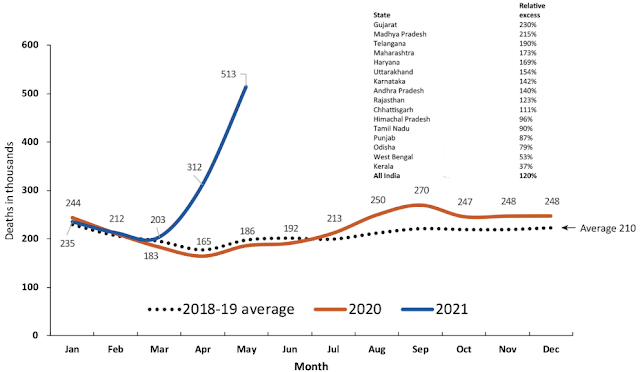 |
| Covid-related deaths across States |
In fact, according to them, “The crude death rate … more than doubled in 2021 compared to 2019… Much of this excess occurred in April-May 2021 (0.45 million or 71%), reaching a 120% increase over earlier year totals. The increase in deaths in the first viral wave was predominantly urban, but deaths in the second wave affected both urban and rural facilities.”
India’s death rate per million was just below the range reported in Brazil (2800/million) or Colombia (2500/million)
The authors continue, compared to 2018-19 totals, the increase in all-cause deaths in April-May 2021 varied across states, with Gujarat reporting a 230% increase – the highest among ten States for which data were available and analysed – and Kerala the lowest, having a 37% increase. They add, “Total excess all-cause deaths were 1.25 million for the ten States that reported about half of national official Covid deaths.”
Underlining that the “actual excess deaths in the facilities may be larger as the Government of India has yet to release these data from June 2021 onward”, the authors say, “Both the 2020 and 2021 viral waves were characterized by widespread (and, for 2021, mostly uncontrolled) multigenerational transmission of the virus within households, with high levels of antibodies detected.”
The authors state, “India’s significantly higher Covid death rate in 2021 compared to the lower than expected death rate in 2020 requires further research. The spread of infection to rural areas in 2021 is one factor, but there might also be differences in the pathogenicity between the original virus (Wuhan) in 2020 and the mix of alpha and delta variants accounting for most of the 2021 viral wave.”
They add, “Similarly, tracking death rates will be essential to understanding the effects of the Omicron wave currently underway in India, or future viral variants.”
Underlining that the “actual excess deaths in the facilities may be larger as the Government of India has yet to release these data from June 2021 onward”, the authors say, “Both the 2020 and 2021 viral waves were characterized by widespread (and, for 2021, mostly uncontrolled) multigenerational transmission of the virus within households, with high levels of antibodies detected.”
The authors state, “India’s significantly higher Covid death rate in 2021 compared to the lower than expected death rate in 2020 requires further research. The spread of infection to rural areas in 2021 is one factor, but there might also be differences in the pathogenicity between the original virus (Wuhan) in 2020 and the mix of alpha and delta variants accounting for most of the 2021 viral wave.”
They add, “Similarly, tracking death rates will be essential to understanding the effects of the Omicron wave currently underway in India, or future viral variants.”
Comments