
It took nine days to understand the possibilities of resolving a nine-year long conflict for right over a house to live between a mother and a daughter. In those nine 9 days, there was a local festival namely, Hal Shashthi, which is popularly celebrated for the wellbeing of the child; and then was the Global Senior Citizens Day which is celebrated to acknowledge and appreciate the life of the senior citizens. One thinks that an intergenerational companionship between a mother and a daughter could have been a win-win situation to celebrate both the days. Especially when the daughter lived with the mother for almost entire life barring few years of graduation and marriage. It is important that the next gen realizes the meaning of respect to the ex-gen especially for providing a decent life including living in the house. The worst is taking parents for granted just because they give birth. Unfortunate and unacceptable.
This article is a tribute to Anuradha Bal, a retired teacher, a mother of four daughters including me, and a simple sorted-out person. The tribute is importantly to her personality as a mini builder. In retrospection of my 30 years into the profession of architecture, interior, construction, and urban design, the knack for a better built environment is now better understood through her life story especially when recently I drove her to the number of houses we inhabited in the sleepy town of Bilaspur Chhattisgarh. The tribute is also to highlight the hardships parents do to ensure dignified life for the family. Anuradha is extraordinary in this sense in her aspirations for herself as well as her daughters. It is evident from her strategic career building as a builder which kept her financially, emotionally, and physically fit for her entire life. After all these years of hardship, she (and all parents) certainly deserves a peaceful and dignified living at a place they built brick by brick.
Anuradha implicitly built an alternate career of a mini builder. It was nostalgic for her when I recently drove her to the buildings built and inhabited with her husband, four daughters and her career in the near 54 years in Bilaspur. Her mini builder-ship and the buildings brought us all better living conditions and dignified life of good education, food, and financial security. Here is a narration of life in the buildings (houses) that she inhabited in 54 years.
Lodhipara House
Anuradha was brought to a rented house on her marriage and soon they moved to self-built house in Lodhipara along the bank of River Arpa. In those days, Lodhipara was a peri-urban area across the Arpa Bridge (of the British times), the only connection to the main city. A forest office, a rice mill and a British time building of Rai Sahab were the well-known landmarks nearby. The three-room house with clay tiles roofing was linear in layout. It was the first house for the family where her first three daughters including me were born. Since she was married just after high school, she cycled four 4 kilometers one way daily to the Degree College for her higher education to graduation. I am told that she even cycled to the Civil Hospital for giving birth to me. Wow! unimaginable for me today. Later she moved me to her mother (my Dida) to manage her house, the elder daughter, and her higher education.
Sarkanda House
In the aspiration to move closer to the city and make a bigger-better house, the family moved to a three-room rented house in Zabra para in Purana Sarkanda between 1979-80 closer to the place where the new house was getting built at New Sarkanda. The new house was ready in 1980 and was inhabited until 1989. It was in a colony of 12 plots, half of which had buildings and thus there was a social life with neighbors. The four-room kitchen with a courtyard, a back entry, formal drawing and dining rooms is where I have my most childhood and school memories. Her youngest daughter was borne here, and through her we sisters learned parenting early in life under the guidance of mother. The neighborhood life was fully lived with around many children of the similar age group. While the terrace was the lifeline for several activities including plantation, the drawing room played a crucial social space for playing with friends in the daytime after returning from the school. The most loving games were of playing house-house and doing theatres for the uncle-aunties in the weekends. Shadow dance on the terrace parapet was also a highlight.The house being close to the Arpa Bridge made it easier for us to go to the school and father to the Tehsil office. However, Anuradha teaching job at the Khalsa Girls School still made her cycle almost five kilometers one way daily which she later settled with a Luna for efficient and ease of transportation since now she could do so with her salary. I recall that we used to walk through the river regularly playfully from the bank at Chatapara to the Sarkanda bank while returning from the school in order to avoid the increasing traffic. It is only in the high school when we learned cycling and parents could afford to buy for us, we cycled to the school. Visiting the crematorium (called Marghat) was a regular activity to pluck flowers and was also the nearest so-called public garden to stroll.
While living in this house, a Bakery adjacent to the Tehsil Office (where Anuradha’s husband spent all his life) was rented to start a new business but it soon brought us heavy losses. This house was then sold to incur the loss and a small plot was bought adjacent to the Bakery where two shops were constructed. It was not possible to run shops for both in jobs, so the shops were soon sold to get new plot. Slowly it was apparent that there were losses in commercial investments and that she cannot handle that. Anuradha strategized her savings stronger than before.
Jatia Talaab House
The aspiration to have a bigger-better house and going to the main city located in the other (main) side of the Arpa bridge was convincing. This was augmented with the arguments to go closer to the school and office amidst the increasing traffic risks, besides getting a better property value. This made us move to a rented house closer to the planned next building behind the Girls Degree College in the Civil lines. Now our school was just the college campus away which we could easily trespass daily. She continued with her Luna to school and her husband in scooter to office. The train-like three-room kitchen like rented house was lived while the construction of the next house begun. It is in this time that I left for my architecture education to university to never return to the city to live for more than 2-3 days until this time when I stayed for nine days to understand the issues arising with Anuradha’s present house. Here her elder daughter was married off who had her child raised here for a year during her graduation.Well, the next house was in the middle of nowhere, near Jatia Talab, was constructed between 1990-2000. This four-room kitchen house was spacious, with front yard, backyard, terrace and a room above. However, the access to the house was difficult, it being almost outside the city with no road. I remember going home in the semester breaks and walking the muddy roads alongside the hutments, the farms and the pond. Can’t imagine how she was doing it every day. By then her third daughter was out of the town for studies and the youngest and her husband were left to live there. I recall them having a pet dog, as an early sign of effluence. However, it wasn’t easy living in this house after living a colony life in the past. The number of house thefts and the bleak hope of the surrounding getting developed pushed her to think again to move further to a better and safe location. She graduated to Scooty from Luna as the school became 10 kilometeres awat. She recalls that she used to leave her Scooty at a shop on the road and then walk to the house with gumboots on; and the next morning go in gumboots and extra pair of cloth to take the Scooty to go to the school. Unimaginable routine! It was nostalgic for her during our visit, especially because the neighborhood is now well developed with buildings, roads, infrastructure, and amenities. It is now among the expensive areas of the town with places like Chandela Colony, Cricket ground, etc. in the vicinity.

Nagdaoney House
The difficulty of living in this house and the urge for a bigger-better house in a posh colony in the main city led to find a new plot for new building. By selling this house, she moved to a house near Jarhabhata at the Guho house between 2000-01, and the construction of a new house begun in Mitra Vihar. While the building was just near completion, she found a buyer willing to give a good price for the plot and the building, since it was located at a prime location. She sold that building immediately and then begun the last (present) house endeavor at Nagdaoney colony in Vyapar Vihar.This last house construction at Nagdaoney colony in Vyapar Vihar is part of a plot subdivision in a colony development with common public space, temple, shops, road, infra, etc. When she built her house, there were not many buildings in the colony but soon the colony got built fully. Today the neighborhood is among the expensive areas of the town. This new house with three rooms, hall, kitchen, terrace, a porch and a large empty space in a colony development was really a life-time upgrade. She basically invested in two plots and chose to build the house in one and kept one empty with the intention to sell if there is need for funds in future. The empty plot now is a mini forest hosting one jackfruit, one mango, one guava, one moringa tree besides, several flowering trees and plants and parking for two cars. Her house is the greenest in the colony. Bingo!


Life lessons
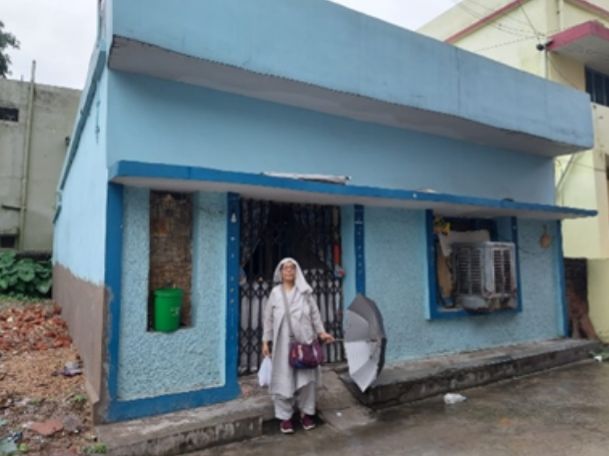
Looking back into the life in retrospection and visiting the above four houses within four hours was also nostalgic for her as well as me. We lived together the 50 years in these hours of touring the houses. There are some common things in Anuradha’s style of building such as, every house was built as single (ground) floor with a terrace and a courtyard shows the alignment with the local architecture and affordability; love for yellow color base and maroon for the bands highlight the local architecture besides that being the cheapest color material; none of houses have any dampness; while the first three houses had the basic potted plants, the present house with a mini forest shows her love for nature; the bare basic things in each house shows the urge for affordability at the same time dignity.Many more lessons can be drawn from Anuradha’s mini builder-ship. While writing this narration on Anuradha, it reminded of the popular Bob the Builder animation.
Jokes apart, it is necessary to learn how mothers (parents) take up hardships to ensure dignity of life for the siblings and self. Since, she is 73 years old now, it is her wish to spend rest of her life in her present house peacefully with her belongings, and she rightfully deserves so. Ironically, she is distressed to live in her own house by none other than her sibling. This is really embarrassing as instead of being grateful to her hardships including alternate career as a mini builder, one is putting her into stress to live in her own house by violent and legal means. For what? Just for getting a share of the property that she built brick by brick! That to when she is alive? For Why? No one can demand for it even after her life, let alone when she is alive, as per the law of the land.
Let every child in the country know that a Woman is entitled for her right to property, and she is not obliged to give it to her siblings. She is free to decide what she likes to do with her property after her. By no means, the siblings can demand a part or full of a woman’s self-acquired property. Any demand from siblings on a part/full share of the property is unlawful and unethical. When she is living in the house or can live in the house, she has the full cognizance to do anything/everything with her belongings as per the law of the land.
Poor lady, she fought a legal battle for six years at the SDM court, ‘just praying for living in peace in her own house’, and she got the judgement in her favor. That SDM judgment addressed to the Tehsil Office Bilaspur and Local (Civil Lines) Police Station Bilaspur are ironically not executed by the said offices. Under these circumstances, she is unable to live in her own house out of trauma and fear created out of violence and legal means because of which she is pushed to go to Kolkata to live with her another sibling for longer durations. Even when I visited now to support her, I preferred to stay in hotel to avoid unfriendly encounters in the house. This is not the way things should be with a senior citizen, mother, teacher and importantly a self-sufficient woman, just because the system is acting at the behest of some unknown influence.
Like every/any citizen, Anuradha is entitled to her fundamental Right to Live with dignity to be ensured by the siblings and the system especially after she worked hard to make her life and now after getting the legal battle in her favor. The Article 21 of the Constitution guarantees the life and personal liberty to all persons. It guarantees the right of persons to life with human dignity. Therein are included, all the aspects of life which go to make a person's life meaningful, complete and worth living.
People in the country are casual to shun away such narrations of a woman’s life. However, this is a narration rather apathy of nearly 90% of the women/mothers in the country. This pattern of personal matter with the apathy of women especially senior citizens in the country make it very much a social matter and when the matter goes to judiciary, it is more a system matter. That is why I wrote that a mother in pain is Mother India in pain. I did not write this article when Anuradha was fighting the legal battle to respect her faith in the society and the system. An intergenerational companionship is sought for even if that is modelled around economy, empathy towards the senior citizens remain at the core of it. So ideally, the sibling should live cordially be grateful to be allowed to live despite she is being self-sufficient. Ideally, the system should follow the court order and obey it in due time and if it is seven months (and counting) already, there seems a malice in the intent of implementation.
The article is written now because, the society and the system besides the sibling should be embarrassed of the harassment made to a senior citizen woman for no fault of hers. If she wishes to live in her own house with her belongings and peace for which she sought support of the judiciary, the least the society and the sibling can do is respect and support in her right to do so by just doing an ordinary thing, make the system FOLLOW THE LAW OF THE LAND. It is again a request to the Tehsil Office Bilaspur and Local (Civil Lines) Police Station Bilaspur to just implement the judgement of the SDM issued in January 2022.
---
*Entrepreneur | Researcher | Educator | Speaker| Mentor. More info on her learning and sharing are at: www.mansee.in
Comments