
IIM-A survey 'debunks' GoI claim, says: Sales, profits of Indian firms remain subdued

By Rajiv Shah 

The Indian Institute of Management-Ahmedabad's (IIM-A's) latest round of Business Inflation Expectations Survey (BIES) has found that sales and profit margins of Indian businesses have remained subdued despite tall claims by the Government of India (GoI) that the Indian economy doing well even as world is going in wrong direction.
The survey says that about 56% of the firms are reporting ‘much less than normal’ or ‘somewhat less than normal’ sales in September 2023 – up from 52% reported in August 2023, even as the percentage of firms reporting ‘normal’ and above normal sales has marginally declined to 45% in September 2023 from 47% reported in August 2023.
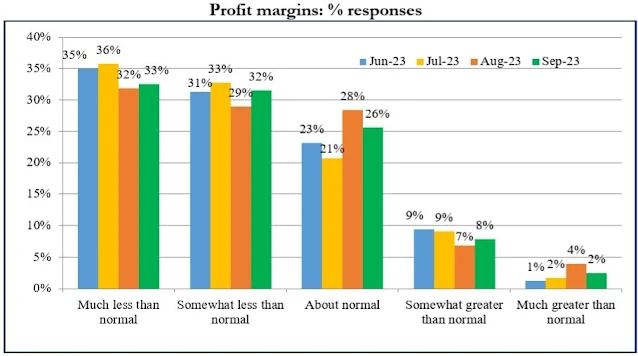
The IIM-A survey further says that around 36% of the firms in September 2023 are reporting profit margins to be ‘about normal’ or greater, as compared to 39% reported in August 2023, even as pointing ou that, "Overall, the profit margins expectations have remained somewhat subdued" for businesses.
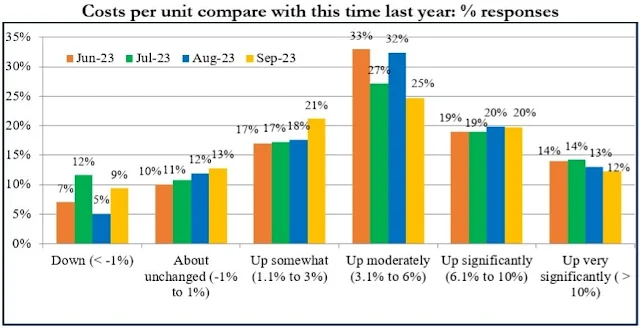
At the same time, the survey says that the cost perceptions data in September 2023 does not indicate any significant increase in cost pressures. The percentage of firms perceiving significant cost increase (over 6%) has remained unchanged around 33% during last four rounds.
The survey seeks to examine the amount of slack in the economy by polling a panel of business leaders, asking them questions about year-ahead cost expectations and the factors influencing price changes, such as profit, sales levels, etc. It is considered unique in that it goes straight to businesses -- the price setters -- rather than to consumers or households, to understand their expectations of the price level changes.
Providing an indirect assessment of overall demand condition of the economy, results of the Survey are claimed to be useful in understanding the inflation expectations of businesses and complement other macro data required for policy making. Carried out by the Misra Centre for Financial Markets and Economy, IIM-A, results of the survey are based on the responses of around 1,100 companies.
According to the survey, "One year ahead business inflation expectation, as estimated from the mean of individual probability distribution of unit cost increase, has marginally increased to 4.39% in September 2023, from 4.32% reported in August 2023. Average inflation expectation of the firms remained anchored around 4.3% for the past five consecutive months."

Comments

Amarjyoti said…
I am not an expert. But have a question after reading this blog. If business is operating in less than normal profit or turnover is below normal than the survey sample may not be statistically correct as monthly GST collection is rising from ₹1.59 lakh crore to more than ₹1.62 lakh crore in Aug to Sept 23.
C Satyanarayana said…
GST is rising because fewcompanies are earning profits at the cost of others. It is like this:700 orfinary passengers travel they pay ony 100.total collection 70000. But if 500 travel in AC they each 300 total 150000.Nirmala using this technique.
Anonymous said…
The IIM-A study is quite contrary to the analysis. May be the sample surveyed must be skewed. May be even a Narrative building exercise. (Academics are full of leftist ideologues). The increasing GST collections is contrary to these claims.
Anonymous said…
GST is a function of Sales turnover and not of Profit.
Anonymous said…
Besides, who tells the real picture anyways? This is a publicity article by phony academics.
Sudip said…
Perception surveys are mostly misleading and naturally biased. Look for factual data like GST collection, income tax return etc
Anonymous said…
GST collection is a function of manufaty and services output. These figures are not being correlated. Also.GST collection has to read along with no of raids conducted showing ITC claims without actual sales.

TRENDING

The golden crop: How turmeric is transforming women's lives in tribal India

By Vikas Meshram*   When the lush green fields of turmeric sway in the tribal belt of southern Rajasthan, Madhya Pradesh, and Gujarat, it is not merely a spice crop — it is the golden glow of self-reliance. In villages where even basic spices once had to be bought from the market, the very soil today is yielding a prosperity that has transformed the lives of thousands of families. At the heart of this transformation is the initiative of Vaagdhara, which has linked turmeric with livelihoods, nutrition, and village self-governance — gram swaraj.

Buddhist shrines were 'massively destroyed' by Brahmanical rulers: Historian DN Jha

Nalanda mahavihara By Rajiv Shah  Prominent historian DN Jha, an expert in India's ancient and medieval past, in his new book , "Against the Grain: Notes on Identity, Intolerance and History", in a sharp critique of "Hindutva ideologues", who look at the ancient period of Indian history as "a golden age marked by social harmony, devoid of any religious violence", has said, "Demolition and desecration of rival religious establishments, and the appropriation of their idols, was not uncommon in India before the advent of Islam".

Swami Vivekananda's views on caste and sexuality were 'painfully' regressive

By Bhaskar Sur* Swami Vivekananda now belongs more to the modern Hindu mythology than reality. It makes a daunting job to discover the real human being who knew unemployment, humiliation of losing a teaching job for 'incompetence', longed in vain for the bliss of a happy conjugal life only to suffer the consequent frustration.

Beyond the election manifesto: Why climate is now a kitchen table issue

By Vikas Meshram*  March has long been a month of gentle transition, the period when winter softly retreats and a mild warmth signals nature’s renewal. Yet, in recent years, this dependable rhythm has been disrupted. This year, since the beginning of March, temperatures across vast swathes of the country have shattered previous records, soaring to between 35 and 40 degrees Celsius in some regions. This is not a mere fluctuation in the weather; it is a serious and alarming indicator of climate change .

As India logs historic emissions drop, expert warns govt against 'policy blunders'

By A Representative   In a significant development that underscores the rapid transformation of India's energy landscape, new data reveals the country recorded its largest drop in power sector emissions in 2025. However, a top power sector analyst has urged the Union Government to view this "silver lining" as a stark warning against continuing to invest in new coal, large hydro, and nuclear projects, which he argues could become "redundant" stranded assets.

The selective memory of a violent city: Uttam Nagar and the invisible victims of Delhi

By Sunil Kumar*  Hundreds of murders take place in Delhi every year, yet only a few incidents become topics of nationwide discussion. The question is: why does this happen? Today, the incident in Uttam Nagar has become the centre of national debate. A 26-year-old man, Tarun Kumar, was killed following a dispute that reportedly began after a balloon hit a small child. In several colonies of Delhi, slogans such as “Jai Shri Ram” and “Vande Mataram” are being raised while demanding the death penalty for Tarun’s killers. As a result, nearly 50,000 residents of Hastsal JJ Colony are now living in what resembles a state of confinement. 

NGO Arunoday’s journey of support and struggle: Standing firm with the distressed

By Bharat Dogra    It was a situation of acute distress. Nearly ten thousand people returning to their villages during the COVID-19 pandemic had gathered at the border of Uttar Pradesh and Madhya Pradesh near Kanha. Exhausted after walking long distances with little or no food, they were desperate for relief. Yet entry could not be granted without completing essential records and complying with pandemic rules.  

How wars are undermining climate promises even as accelerating global warming

By N.S. Venkataraman*     Since 1995, global climate conferences have convened annually, with the 29th Conference of Parties (COP29) held in November 2024. These gatherings attract world leaders and generate extensive media coverage, raising hopes of decisive strategies to address the climate emergency. Yet, despite lofty promises and ambitious targets, the crisis remains unabated.  

Fresh citizenship framework suggested amidst electoral roll concerns

By Kathyayini Chamaraj  The ongoing exercise of Special Intensive Revision (SIR) of electoral rolls has raised serious concerns about the potential disenfranchisement of large numbers of citizens. In many instances, people are being asked to produce retrospective documents to establish their citizenship—documents that many genuine citizens are unable to provide. The challenge before policymakers is to identify prospective amendments to the Citizenship Act that would ensure that no legitimate citizen is excluded either from citizenship or from the electoral roll.