.jpeg)
The Gujarat government has issued a notification hiking minimum wages for sugarcane harvesting workers from Rs 238 per tonne to Rs 476 per tonne. The notification came after a long eight-year struggle of workers led by their Union Majoor Adhikar Manch.
The hiked wages will benefit almost three lakh tribal workers – almost all of them seasonal migrants from districts of Tapi and Dang in Gujarat, Nandurbar and Dhule in Maharashtra, and Badwani in MP. It is expected that the hike will lead to additional wages of Rs. 357 crores per year.
The sugarcane harvesting sector is riddled with exploitation -- low wages, irregular and non-payment of wages, long working hours, lack of occupational safety and health, exploitative recruiting practices that amount to bondage, and poor working and living cconditions The Majur Adhikar Manch, a trade union of informal workers, has been working with the sugarcane harvesting workers in Gujarat since 2015.
When the union started working with the sugarcane harvesting workers in South Gujarat, workers were getting Rs 238 per tonne. Whereas, the findings of the ergonomic study (time-motion study) done by the Centre for Labour Research and Action in collaboration with IIT Bombay revealed that the workers should be getting 539 Rs per tonne as minimum wage.
Using this study coupled with another study – A Bitter Harvest (CLRA, 2017), the union launched a massive awareness campaign among the workers regarding the state of sugarcane harvesters and advocated for dignified living wages and improved conditions of the workers.
The sugarcane harvesting sector is riddled with exploitation -- low wages, irregular and non-payment of wages, long working hours, lack of occupational safety and health, exploitative recruiting practices that amount to bondage, and poor working and living cconditions The Majur Adhikar Manch, a trade union of informal workers, has been working with the sugarcane harvesting workers in Gujarat since 2015.
When the union started working with the sugarcane harvesting workers in South Gujarat, workers were getting Rs 238 per tonne. Whereas, the findings of the ergonomic study (time-motion study) done by the Centre for Labour Research and Action in collaboration with IIT Bombay revealed that the workers should be getting 539 Rs per tonne as minimum wage.
Using this study coupled with another study – A Bitter Harvest (CLRA, 2017), the union launched a massive awareness campaign among the workers regarding the state of sugarcane harvesters and advocated for dignified living wages and improved conditions of the workers.
The campaign resulted in a mass workers’ movement in 2019 where sugarcane harvesters in the source area (Dang, Tapi and Dhule-Nandurbar) refused to go to work at the sugar factories unless the rate per tonne was increased by the sugar factories. As a result, the sugar factories increased the rate to Rs 275 per tonne.
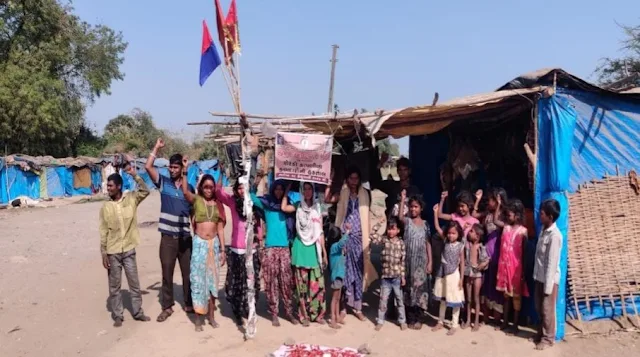 In 2021, the government increased the minimum agricultural wage but the minimum wage for sugarcane harvesters did not see any increase and continued to remain stagnant for more than six years.

As the representative of the sugarcane harvesting workers, Majur Adhikar Manch submitted a memorandum containing a charter of demands to the labour commissioner at Gandhinagar as well as the Gujarat Sugar Cooperative Federation.
The union also filed a Public Interest Litigation (PIL) in the Gujarat high court in the same year to demand a hike in the minimum wages of sugarcane harvesters.
As a result of these advocacy efforts, the Gujarat government issued a draft notification on 5th February 2022 where it hiked the minimum wage for sugarcane harvesting workers to 476 Rs per tonne. However, the fight still continued for the government to issue a final notification of the wage hike in the Gazette.
As a result of these advocacy efforts, the Gujarat government issued a draft notification on 5th February 2022 where it hiked the minimum wage for sugarcane harvesting workers to 476 Rs per tonne. However, the fight still continued for the government to issue a final notification of the wage hike in the Gazette.
The union organised public campaigns in the source areas, gave memorandums to MLAs of all political parties in Gujarat and continuously voiced workers’ concerns in the tripartite meetings. Last harvesting season (2022), all the Mukadams from South Gujarat refused to sign any agreement with sugar factories till Rs 476 per tonne rate was promised by the sugar factories.
Finally, eight years after the last revision, the Gujarat government has raised the minimum daily wages of sugarcane workers by 100 per cent; from Rs 238 per tonne to Rs 476 per tonne which will benefit more than two lakh sugarcane workers in the state. This is a huge success achieved by the 8 years-long struggle led by the workers’ movement.
---
*Secretary, Dang unit of the Majoor Adhikar Manch
Finally, eight years after the last revision, the Gujarat government has raised the minimum daily wages of sugarcane workers by 100 per cent; from Rs 238 per tonne to Rs 476 per tonne which will benefit more than two lakh sugarcane workers in the state. This is a huge success achieved by the 8 years-long struggle led by the workers’ movement.
---
*Secretary, Dang unit of the Majoor Adhikar Manch
Comments