
BBC documentary row: Delhi varsity students detained for holding protest meeting

By A Representative

On March 24, even as commemorating the martyrs Bhagat Singh, Sukhdev and Rajguru on their 92nd martyrdom day, several left-wing students’ organisations -- bsCEM, BASF, Fraternity Movement, SIO, AISA and SFI -- held a protest against the recent action of debarring several students for organising the screening of the banned BBC documentary on Prime Minister Narendra Modi's role in Gujarat riots.
The meeting was organised under the banner of the Bhagat Singh Chhatra Ekta Manch. 
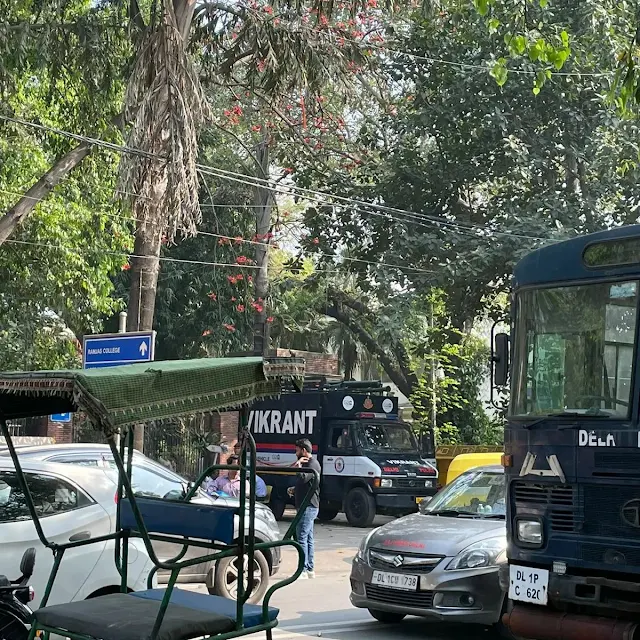
In no time, claimed student sources, approximately 100 guards and 100 Delhi police force, including 50 CRPF men, that marched into Delhi University.
Students were manhandled and detained, the sources said. Women and queer students were attacked to the extend that their clothes were pulled and derogatory statements were made. Women guards stated that “girls like you deserve to be treated as such.”
The students’ demands included:
  • Take back the arbitrary notice of debarring students.
  • Take back the arbitrary notice asking apology for democratic activity.
  • Stop inflicting FIRs on the students.
  • Allot auditorium in the campus for democratic programs to students.
  • Apologies to the students for their mental harassment. And we will struggle until the university authority fulfills our demands.

Comments

TRENDING

From colonial mercantilism to Hindutva: New book on the making of power in Gujarat

By Rajiv Shah  Professor Ghanshyam Shah ’s latest book, “ Caste-Class Hegemony and State Power: A Study of Gujarat Politics ”, published by Routledge , is penned by one of Gujarat ’s most respected chroniclers, drawing on decades of fieldwork in the state. It seeks to dissect how caste and class factors overlap to perpetuate the hegemony of upper strata in an ostensibly democratic polity. The book probes the dominance of two main political parties in Gujarat—the Indian National Congress and the BJP—arguing that both have sustained capitalist growth while reinforcing Brahmanic hierarchies.

From protest to proof: Why civil society must rethink environmental resistance

By Shankar Sharma*  As concerned environmentalists and informed citizens, many of us share deep unease about the way environmental governance in our country is being managed—or mismanaged. Our complaints range across sectors and regions, and most of them are legitimate. Yet a hard question confronts us: are complaints, by themselves, effective? Experience suggests they are not.

Kolkata event marks 100 years since first Communist conference in India

By Harsh Thakor*   A public assembly was held in Kolkata on December 24, 2025, to mark the centenary of the First Communist Conference in India , originally convened in Kanpur from December 26 to 28, 1925. The programme was organised by CPI (ML) New Democracy at Subodh Mallik Square on Lenin Sarani. According to the organisers, around 2,000 people attended the assembly.

Dalit woman student’s death sparks allegations of institutional neglect in Himachal college

By A Representative   A Dalit rights organisation has alleged severe caste- and gender-based institutional violence leading to the death of a 19-year-old Dalit woman student at Government Degree College, Dharamshala, Himachal Pradesh, and has demanded arrests, resignations, and an independent inquiry into the case.

Urgent need to study cause of large number of natural deaths in Gulf countries

By Venkatesh Nayak* According to data tabled in Parliament in April 2018, there are 87.76 lakh (8.77 million) Indians in six Gulf countries, namely Bahrain, Kuwait, Oman, Qatar, Saudi Arabia and the United Arab Emirates (UAE). While replying to an Unstarred Question (#6091) raised in the Lok Sabha, the Union Minister of State for External Affairs said, during the first half of this financial year alone (between April-September 2018), blue-collared Indian workers in these countries had remitted USD 33.47 Billion back home. Not much is known about the human cost of such earnings which swell up the country’s forex reserves quietly. My recent RTI intervention and research of proceedings in Parliament has revealed that between 2012 and mid-2018 more than 24,570 Indian Workers died in these Gulf countries. This works out to an average of more than 10 deaths per day. For every US$ 1 Billion they remitted to India during the same period there were at least 117 deaths of Indian Workers in Gulf ...

The architect of Congolese liberation: The life and legacy of Patrice Lumumba

By Harsh Thakor*  Patrice Émery Lumumba remains a central figure in the history of African decolonization, serving as the first Prime Minister of the independent Republic of the Congo. Born on July 2, 1925, Lumumba emerged as a radical anti-colonial leader who sought to unify a nation fractured by decades of Belgian rule. His tenure, however, lasted less than seven months before his dismissal and subsequent assassination on January 17, 1961.

ArcelorMittal faces global scrutiny for retreat from green steel, job cuts, and environmental violations

By  Jag Jivan    ArcelorMittal is facing mounting criticism after cancelling or delaying nearly all of its major green steel projects across Europe, citing an “unsupportive policy environment” from the European Union . The company has shelved projects in Germany , Belgium , and France , while leaving the future of its Spanish decarbonisation plan uncertain. The decision comes as global unions warn that more than 5,500 jobs are at risk across its operations, including 4,000 in South Africa , 1,400 in Europe, and 160 in Canada .

Venezuela and the crisis of global order: Erosion of rules-based international order

By Vidya Bhushan Rawat*  The American attack on Venezuela violates every principle of international law that the collective West claims to uphold. The response from the European Union—“we are monitoring the situation”—exposes the hollowness of these claims. WhatsApp gossipers may celebrate this as an act of “bravery,” but what kind of bravery is it to intimidate a neighbour that is neither large in size nor strong in military power? 

A comrade in culture and controversy: Yao Wenyuan’s revolutionary legacy

By Harsh Thakor*  This year marks two important anniversaries in Chinese revolutionary history—the 20th death anniversary of Yao Wenyuan, and the 50th anniversary of his seminal essay "On the Social Basis of the Lin Biao Anti-Party Clique". These milestones invite reflection on the man whose pen ignited the first sparks of the Great Proletarian Cultural Revolution and whose sharp ideological interventions left an indelible imprint on the political and cultural landscape of socialist China.