
The advocacy group South Asia Network on Dams, Rivers and People (SANDRP), commenting on a massive landslide which hit the Subajsiri Hydropower project on the border of Assam-Arunachal Pradesh, has said that this is in continuation of India facing “multiple dam disasters”. One of the biggest in recent times washing away of the massive 1200 MW Teesta 3 dams in Sikkim.
It underlined, “It is high time that the authorities wake up and do no allow hydropower developers allow to adopt short cuts, the way Teesta 3 dam developers did and now NHPC seems to be doing in case of Lower Subansiri HEP.”
The river water, about 997 cumecs (cubic meters per second) suddenly started flowing towards the dam, where the spillway gates were still under installation, yet to be tested. The water could overflow from the under construction spillway gates once the reservoir reached 145 meters level (above Mean Sea Level).
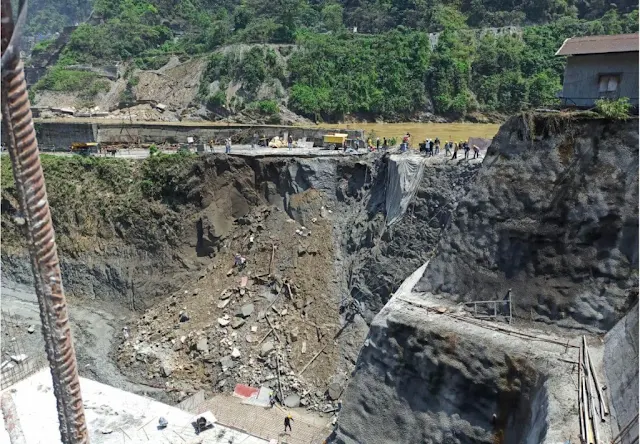
The massive, majestic Subansiri river was completely without any flow till the river water started flowing through the spillway gates about twelve hours later. (Feature photo above shows the snapshot when landslide started and in the foreground, water is seen rushing towards the dam).
Diversion Tunnels (DT) are constructed to take river water from the upstream of the coffer (temporary) dam to downstream of the dam site so that dam site can remain dry for the work to go on. For Lower Subansiri HEP, five such diversion tunnels each of diameter 9.5 meters have been constructed on the left bank at about 100 m above mean sea level.
A senior official of NHPC said: “The other four numbers of diversion tunnels had already been blocked earlier”, partly due to landslide, the official did not say. Even this last functioning DT was also hit by a landslide in April 2023 and also October 2022.
However, the studies were not carried out. The report also lists the landslide incidents at project site since beginning of the project work in 2005. This negligence by NHPC in not taking measures suggested by CEA and not taking necessary follow up action has once again led to the fresh damage to the project and delayed its commissioning.
Interestingly, a senior NHPC official told media: “We are working in the hills and construction activity can trigger such situations.” This acceptance that the hydropower projects can trigger landslides is something hydropower companies never accept.
The CEA report further states: “It is understood that the civil works would proceed only in dry/ lean season. Further, after the Civil Contractor hands over the (Spillway) bays to HM Contractor, it would take a minimum of 3.5 months for erection of Spillway Radial Gates and their testing.”
All these processes need to go as directed, else there is bound to be serious issues concerning safety of the project. We hope NHPC is not bypassing any of these directions and CEA, CWC and NDMA (National Disaster Management Authority) will not allow NHPC to bypass of the safety measures. It is not clear why the NHPC did not use the silt flushing tunnel to continue the flow in the river downstream, assuming the dam has silt flushing tunnel at the bottom.
It underlined, “It is high time that the authorities wake up and do no allow hydropower developers allow to adopt short cuts, the way Teesta 3 dam developers did and now NHPC seems to be doing in case of Lower Subansiri HEP.”
Text:
Once again, after several such incidents in the past, the controversial 2000 MW Lower Subansiri Hydropower project on Assam Arunachal Border was hit by a massive landslide at around 11.30 am on Oct 27 2023. The landslide damaged the project, further delaying the commissioning of the first unit, increasing the cost and time over runs of the expensive, much delayed project. Following the landslide, the only functioning diversion tunnel no 1 of the project, about 200 m upstream from the dam was blocked.The river water, about 997 cumecs (cubic meters per second) suddenly started flowing towards the dam, where the spillway gates were still under installation, yet to be tested. The water could overflow from the under construction spillway gates once the reservoir reached 145 meters level (above Mean Sea Level).
The massive, majestic Subansiri river was completely without any flow till the river water started flowing through the spillway gates about twelve hours later. (Feature photo above shows the snapshot when landslide started and in the foreground, water is seen rushing towards the dam).
Diversion Tunnels (DT) are constructed to take river water from the upstream of the coffer (temporary) dam to downstream of the dam site so that dam site can remain dry for the work to go on. For Lower Subansiri HEP, five such diversion tunnels each of diameter 9.5 meters have been constructed on the left bank at about 100 m above mean sea level.
A senior official of NHPC said: “The other four numbers of diversion tunnels had already been blocked earlier”, partly due to landslide, the official did not say. Even this last functioning DT was also hit by a landslide in April 2023 and also October 2022.
NHPC needs to follow CEA directions
An “Indian Express” report earlier mentions that the “Central Electricity Authority (CEA) in April 2022 had advised the NHPC to engage a specialized agency to examine the strength of the project’s powerhouse retention wall and also assess the impact of diversion tunnels on the site’s slope stability before the onset of monsoon”.However, the studies were not carried out. The report also lists the landslide incidents at project site since beginning of the project work in 2005. This negligence by NHPC in not taking measures suggested by CEA and not taking necessary follow up action has once again led to the fresh damage to the project and delayed its commissioning.
Interestingly, a senior NHPC official told media: “We are working in the hills and construction activity can trigger such situations.” This acceptance that the hydropower projects can trigger landslides is something hydropower companies never accept.

The NHPC is likely to say that the reduction in water flow in the Subansiri river for about twelve hours will in any case happen whenever they close the DT. However, this closure of DT is not happening as per a planned activity. Since the spillway gates are not yet ready, they will either have to open one of the DTs or build a coffer dam to isolate the spillway gates where work is still incomplete, which will take additional cost, time and impacts ultimately.
CEA had clearly said in its tour report of April 2022: “Further, the reservoir filling would commence only after the dam achieves a certain height and provided all Spillway Radial Gates have been erected and tested.” The reservoir filling taken up now on Oct 27 2023 clearly violates this CEA directions since it is happening while all Spillway Radial Gates have not been erected and tested.The CEA report further states: “It is understood that the civil works would proceed only in dry/ lean season. Further, after the Civil Contractor hands over the (Spillway) bays to HM Contractor, it would take a minimum of 3.5 months for erection of Spillway Radial Gates and their testing.”
All these processes need to go as directed, else there is bound to be serious issues concerning safety of the project. We hope NHPC is not bypassing any of these directions and CEA, CWC and NDMA (National Disaster Management Authority) will not allow NHPC to bypass of the safety measures. It is not clear why the NHPC did not use the silt flushing tunnel to continue the flow in the river downstream, assuming the dam has silt flushing tunnel at the bottom.

The Assam government must assess these impacts and ensure that NHPC compensates the losses to the affected people. The North Lakhimpur District came out with an advisory notice for safety in the downstream area, but the official needs to go far beyond to ensure the affected people are compensated.
In conclusion
As India faces multiple dam disasters this year, including washing away of the massive 1200 MW Teesta 3 dams in Sikkim, it is high time that the authorities wake up and do no allow hydropower developers allow to adopt short cuts, the way Teesta 3 dam developers did and now NHPC seems to be doing in case of Lower Subansiri HEP.Subansiri is a much bigger river and it also has numerous glaciers in the catchment. It may be added that like in case of Teesta 3, Lower Subansiri HEP spillway also are not designed for Glacier Lake Outburst Floods. On top of it, any shortcuts adopted in construction of spillway for the project can only be invitation to trouble. Like the short cuts adopted in construction of Medigadda Dam on Godavari leading to sinking of its pillars last week. Clearly our Dam Safety Mechanism needs to do a lot more to inspire confidence.
Comments