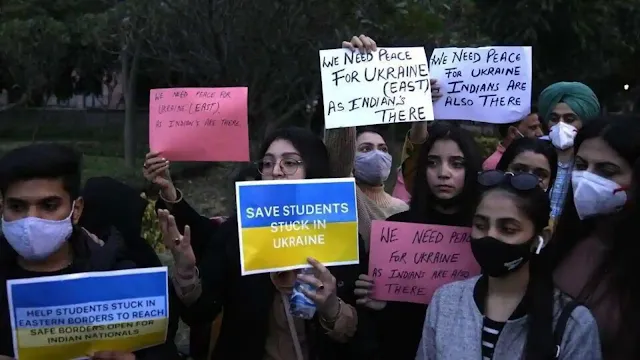
Punjab rallies against the war in Ukraine, condemns 'inter-imperialist' rivalry

By Harsh Thakor* 

A protest was organised by the Lok Sangram Morcha in Punjab at the Nature Park in Moga against the war in Ukraine. The front is a conglomeration of mass organizations. Around 400 persons participated in the protest comprising of farmers, agricultural workers, intellectuals, students and youth.
The participating organisations were Bharatiya Kisan Union (Krantikari), Lok Sangram Morcha,Grameen Mazdoor Sabha, and Association for Democratic Rights (AFDR). The main speech was made by Swaranjeet Singh of AFDR who highlighted the nature of imperialist contention and the mutual aggression.
The protestors marched through the market place shouting slogans and holding banners, culminating the rally at the bus stand. Resolutions were passed demanding Russian withdrawal of troops from Ukraine, supporting demands of farmers, removing corrupt elements from college managements and introducing positive and democratic aspects about progressive Sikh figures in history in school textbooks, who challenged feudalism.
Swaranjeet Singh condemned the Russian invasion of Ukraine but left no stone unturned in exposing the conspiracy of America and Western countries in patronising the fascist regime of Ukraine and expanding NATO.
He summarised how American and other western countries were banging every nail into the wall to subvert nations and sharpen contention for hegemony. He condemned Russia's imperialist designs and felt there was no justification of Russia's claim that it was forced into the act or its goal was to liberate Ukraine from fascist control.
He also condemned the utter insensitivity of Prime Minister Narendra Modi in not coming to the aid of the victimized Indian medical students by vacating them promptly and on the contrary blamed them for migrating to study.
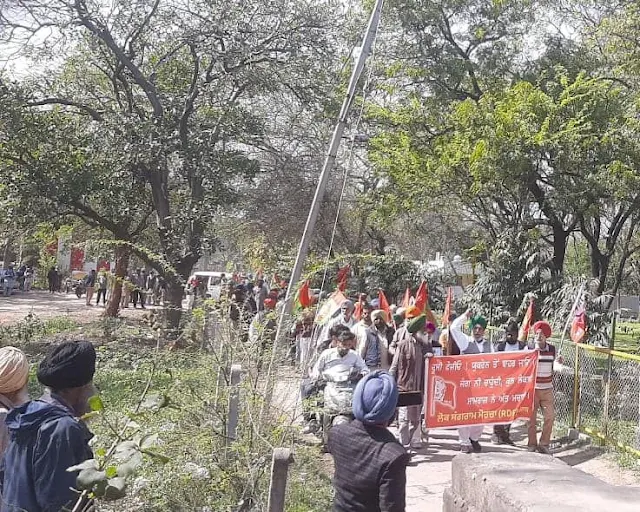
Speakers included Darshan Singh Tur, of the Lok Sangram MorchaTara Singh Moga, Krantikari Pendu Mazdoor Union secretary Lakhveer Singh Lakha, district secretary Parminder Singh Barad, Singh Nathuwala, Jaswinder Kaur, Bhartiya Kisan Union (Krantikari) district member Gurdip Varoke,women's leader Surinder Kaur Dhudike and district secretary Tahal Singh.
The Kirti Kisan Union in village Chakk Sadoka Jalalabad also held a rally protesting the Ukraine war, criticising the wrongs of both sides and condemning Modi. He condemned the inter-imperialist rivalry to grab profits, path towards obtaining hegemony and entrapping the world people in a cross fire.
Even if small, such a protest lit the first sparks in the anti-war resistance of Punjab. A father of a student in Ukraine Ranajeet Singh recounted the misery his daughter was facing, with basic amenities being denied.
---
*Freelance journalist

Comments

TRENDING

Whither space for the marginalised in Kerala's privately-driven townships after landslides?

By Ipshita Basu, Sudheesh R.C.  In the early hours of July 30 2024, a landslide in the Wayanad district of Kerala state, India, killed 400 people. The Punjirimattom, Mundakkai, Vellarimala and Chooralmala villages in the Western Ghats mountain range turned into a dystopian rubble of uprooted trees and debris.

Advocacy group decries 'hyper-centralization' as States’ share of health funds plummets

By A Representative   In a major pre-budget mobilization, the Jan Swasthya Abhiyan (JSA), India’s leading public health advocacy network, has issued a sharp critique of the Union government’s health spending and demanded a doubling of the health budget for the upcoming 2026-27 fiscal year. 

Iswar Chandra Vidyasagar’s views on religion as Tagore’s saw them

By Harasankar Adhikari   Religion has become a visible subject in India’s public discourse, particularly where it intersects with political debate. Recent events, including a mass Gita chanting programme in Kolkata and other incidents involving public expressions of faith, have drawn attention to how religion features in everyday life. These developments have raised questions about the relationship between modern technological progress and traditional religious practice.

Election bells ringing in Nepal: Can ousted premier Oli return to power?

By Nava Thakuria*  Nepal is preparing for a national election necessitated by the collapse of KP Sharma Oli’s government at the height of a Gen Z rebellion (youth uprising) in September 2025. The polls are scheduled for 5 March. The Himalayan nation last conducted a general election in 2022, with the next polls originally due in 2027.  However, following the dissolution of Nepal’s lower house of Parliament last year by President Ram Chandra Poudel, the electoral process began under the patronage of an interim government installed on 12 September under the leadership of retired Supreme Court judge Sushila Karki. The Hindu-majority nation of over 29 million people will witness more than 3,400 electoral candidates, including 390 women, representing 68 political parties as well as independents, vying for 165 seats in the 275-member House of Representatives.

Jayanthi Natarajan "never stood by tribals' rights" in MNC Vedanta's move to mine Niyamigiri Hills in Odisha

By A Representative The Odisha Chapter of the Campaign for Survival and Dignity (CSD), which played a vital role in the struggle for the enactment of historic Forest Rights Act, 2006 has blamed former Union environment minister Jaynaynthi Natarjan for failing to play any vital role to defend the tribals' rights in the forest areas during her tenure under the former UPA government. Countering her recent statement that she rejected environmental clearance to Vendanta, the top UK-based NMC, despite tremendous pressure from her colleagues in Cabinet and huge criticism from industry, and the claim that her decision was “upheld by the Supreme Court”, the CSD said this is simply not true, and actually she "disrespected" FRA.

With infant mortality rate of 5, better than US, guarantee to live is 'alive' in Kerala

By Nabil Abdul Majeed, Nitheesh Narayanan   In 1945, two years prior to India's independence, the current Chief Minister of Kerala, Pinarayi Vijayan, was born into a working-class family in northern Kerala. He was his mother’s fourteenth child; of the thirteen siblings born before him, only two survived. His mother was an agricultural labourer and his father a toddy tapper. They belonged to a downtrodden caste, deemed untouchable under the Indian caste system.

Stands 'exposed': Cavalier attitude towards rushed construction of Char Dham project

By Bharat Dogra*  The nation heaved a big sigh of relief when the 41 workers trapped in the under-construction Silkyara-Barkot tunnel (Uttarkashi district of Uttarakhand) were finally rescued on November 28 after a 17-day rescue effort. All those involved in the rescue effort deserve a big thanks of the entire country. The government deserves appreciation for providing all-round support.

Ganga-Jamuni Tehzeeb: Akbar to Shivaji -- the cross-cultural alliances that built India

​ By Ram Puniyani   ​What is Indian culture? Is it purely Hindu, or a blend of many influences? Today, Hindu right-wing advocates of Hindutva claim that Indian culture is synonymous with Hindu culture, which supposedly resisted "Muslim invaders" for centuries. This debate resurfaced recently in Kolkata at a seminar titled "The Need to Protect Hinduism from Hindutva."

Drowning or conspiracy? Singapore findings deepen questions over Zubeen Garg’s death

By Nava Thakuria*  For millions of fans of Zubeen Garg, who died under unexplained circumstances in Singapore on 19 September last year, disturbing news has emerged from the island nation. Its police authorities have stated that the iconic Assamese singer died while intoxicated and swimming in the sea without a mandatory life jacket.