
On Saturday 20th August 2023, at a Panel Discussion on ‘Does Modi Administration Really Deliver to Protect Environment, Biodiversity and Human Rights?’, I abruptly interrupted Jairam Ramesh, India’s former Minister for Environment & Forests, as he was emphasizing on the need ‘to balance development with environment protection’ in response to my earlier question. I have high regards for the former Hon. Minister and great respect for him as one of the few clean politicians, who has stood up for the truth for the people as Minister for Environment and Forests and subsequently as Minister for Rural Development.
Yet, I went against the decorum to abruptly challenge his smug presumption that development can only happen at the cost of environmental damage and not by benefiting the environment that sustains not just humans but diverse flora and fauna on our beautiful but grievously troubled blue-green planet that many of us, the indigenous peoples, call as Mother Earth.
In my writings since 1998 when I was 27 year old and freshly graduated from the prestigious Indian Institute of Management-Calcutta, I have consistently put forth the need for bold and radical rethink on the development discourse and have developed the LACE-Gaia Model for transformational orbit-shifting innovation approach that from a higher level of thinking creates a virtuous cycle of synergistic and symbiotic relationships between development and environment. It was first published as ‘Cooperative Framework for Economic Development’ in ‘The Strategist’, Business Standard in August 1998 and subsequently here, here and here)
The tone for this interaction with Jairam Ramesh was set by the previous speaker Dr Vandana Shiva, noted environment activist and protector, who from her vast and painstaking experiences over several decades, called upon the gathering to drop the words ‘development’ and ‘environment’ altogether. Instead she proposes that we must call this as Ecological Destruction and Social Injustice, for what it truly is.
She said that the infrastructure projects were the weapons that was causing genocide and ecocide of the people in the hilly regions and as gross violation of constitutional provisions, referring to the massive destruction in Himachal Pradesh and Uttarakhand. She cited a clear correlation in the location of roads and infrastructure projects and ecological destruction.
In his defense, Jairam who is presently Rajya Sabha MP from Karnataka and holds a highly influential position as head of communication, publicity and media wing of the Congress Party that has ruled the country for several decades and carries forth the legacy of its freedom struggle, mentioned about his recent trip to coastal Karnataka where people, as he shared, are oblivious to the climate and ecological crises and their demand is for more road highways, infrastructure and industries.
Incidentally, he is also a member of the International Advisory Board (IAB) for strategic policy advice to the United Nations Environment Programme (UNEP) on the programmatic direction of International Environmental Technology Centre (IETC). As the Environment Minister, he was chief negotiator for India at the 2009 United Nations Climate Change Conference held in Copenhagen, Denmark.
The next speaker was Aneel Hegde from Janta Dal (United), a long time indigenous activist. Aneel who recently was elected to the Rajya Sabha from Bihar has been a powerful grassroots level mobiliser. He has been instrumental in several campaigns as close associate of former trade union leader and Union Minister George Fernandes and with Nitish Kumar, presently Bihar Chief Minister and tipped to be the Convenor for the newly formed INDIA alliance of 26 parties after the merger of United Progressive Alliance and Left Front.
Aneel shared his experiences of how Bt Cotton treacherously captured 98% of the cotton seed market on fraudulent claims causing enormous damage to the farmers, poisoning the soil and the cottonseed oil cakes with gossipol.
Before I tell you what my earlier question was, I must share the backstory of my lifelong campaign to question and clarify that when development is inclusive and well-rounded, why should it irreparably damage the environment that destroys lives and livelihoods of the very people, it claims to serve and endanger the future of youth, children and coming generations, which it claims to safeguard and better. The question that has been churning in my mind is very simple and straightforward. Development for whom? Cui bono - For whose good is it?
Before I tell you what my earlier question was, I must share the backstory of my lifelong campaign to question and clarify that when development is inclusive and well-rounded, why should it irreparably damage the environment that destroys lives and livelihoods of the very people, it claims to serve and endanger the future of youth, children and coming generations, which it claims to safeguard and better. The question that has been churning in my mind is very simple and straightforward. Development for whom? Cui bono - For whose good is it?
I am India. I belong to the world. I am the India that is not a piece of geography but an India that represents the kindred spirit of Earth as a whole. So well ascribed in its ideal of Vasudhaiv Kutumbakam. It simply means World as a family.
This kindred spirit of India transcends the physical realm or the Apara and blissfully embraces the Para as the unbounded wholeness of the cosmo-genesis. I am born into this glorious splendour of an expansive vision of the macrocosm where nothing comes in your way to attain the highest levels of joy and bliss that humans can conceive of, for every individual as the microcosm. Yet, it is only by delusion of ego, that you believe that you are the doer. Much before the World Economic Forum said this in its kinky way - I own nothing and I am happy and free of the burden of owning stuff. The difference is that the WEF is guilty of hypocrisy as numerous commentators have pointed out. I however walk the talk and bicycle my rides for my daily needs up to 10kms all the year and use public transportation to move further.
This worldview of Microcosm is Macrocosm - Yatha Pinde Tatha Brahmande - is craftily enmeshed into my way of living and in my world view as samashti-vyashti. It stays with me when I bicycle early in the morning for a 20 kms roundtrip from my home to the Gaushala to fetch raw cow milk prasad and while waiting for my turn I joyously watch the calves playing and hopping around, the mothers caressing them, people feeding the the cows and the majestic bulls in the green and serene ambience. Closeby, on my way is the fruits and vegetables farmers and wholesale market. There is also a flower market next to it - colorful, fragrant and resplendent in all the hues and shades, where I picked flowers for a festive occasion the other day.
This unity of samashti - the Universal and vyashti - the Individual is one of the important characteristics of Vedantic philosophy. In this, the practical and spiritual are not separate but are interrelated and holistic. This sutra provides a prime example of how practical knowledge is related to a spiritual principle.
The downpour washed away vehicles and subsumed buildings into flood waters, smashing key road and rail links. The tragedy wrecked not just remote locations on mountain fringes but popular tourist destinations, including Himachal Pradesh’s capital Shimla, where 11 bodies were buried under the debris of a temple. The disaster was made worse by the fact that this was the second time that the hill states were pounded by sheets of torrential rainfall. In July, floods, landslides and mudslides washed away portions of a critical national highway, inundated neighborhoods and caused landslides that cut off mountain cities and villages. Even in the national Capital, the heaviest deluge for a July day in 21 years marooned large swathes of the city. The real culprit however is not excess rainfall but the severe constriction on the river with numerous bridges causing silting and the encroachments - which at ITO alone has eaten away 5kms stretch of the Yamuna river floodplains.
After famously calling dams, power plants and the large integrated steel plants as ‘temples of modern India’ in 1954, Jawahar Lal Nehru, India’s first Prime Minister while inaugurating the Bhakra Nangal had changed his mind by 1958, observing that we in India might be suffering from “the disease of gigantism” and rooted for smaller irrigation projects. In a letter to chief ministers in 1957, Nehru had pointed out the need to balance development projects with the need to protect the environment.
Leo Saldanah, who was moderating the session, mentioned how we should learn from Nehru’s mistakes of pushing gigantic projects and glorifying them as ‘modern temples’. Ironically, the same mistakes are being repeated many times over with its penchant for gigantic projects - sardar sarovar dam, bullet trains, highway expansion, industrial corridors, chardham yatra, central vista and solar land banks.
This defies the pronounced global trend to do away with large projects that disrupt not just the lives and livelihoods of the people who live in these areas, but also cause ecological destruction. Over a thousand dams have been removed till date in the USA alone. Even modest sized dams have been found to create problems of water quality and ecosystems. The near extinction of fish such as the Atlantic salmon and sturgeons has been directly linked to the presence of dams on their migration routes. Several studies have recognised the building of dams as having the most substantial impact on the destruction of riverine ecosystems. The building of the Aswan Dam in Egypt has been blamed for the erosion of the Nile River delta, deterioration of agriculture in the area, and the increased incidents of parasitic diseases such as schistosomiasis.
Big dams such as the Sardar Sarovar have been built on an obsolete belief that the benefits of hydropower outweigh its other costs. But the unaccounted costs of ecological damages is coming home to roost for the much bandied Gujarat Model. Veteran journalist Achyut Yagnik pointed out several such unforeseen consequences that have ravaged the coastal state of Gujarat and reduced it to a basket case of ecological destruction.
Limestone is extremely important for preserving sweet water in coastal areas. “It acts like a sponge”, he noted. “If indiscriminate limestone mining continues, it would lead to salinity ingress in the green patches of coastal Saurashtra.” Mining being carried out on the borders of Gir forest, which houses Asia’s only surviving lion, similarly and the eviction of maldharis or cattle breeders, who lived in Gir forests for centuries, against their wishes under the pretext of preserving the green cover, had a deleterious effect on the forest. It is breaking the man-animal-green cover cycle, continuing for centuries.
 Its key objective is to transform every rural and urban neighborhood to achieve the Sustainable Development Goals in an accelerated manner. GAIA Innovation Lab started as a collaboration between ABES Engineering College based in the city of Ghaziabad in Western Uttar Pradesh Province and Global Academy of Indigenous Activism (GAIA) – a social and cultural organization focused on leveraging traditional knowledge systems for accelerated achievement of Sustainable Development Goals, Smart neighborhoods and Universal Livelihood Security based on every individual’s uniqueness, social and individual needs and aspirations.
---
*B.Tech IIT Kharagpur, MBA IIM Calcutta, hief Mentor & Innovation Coach - GAIA Innovation Labs, Convener - Global Academy for Indigenous Activism (GAIA)
This kindred spirit of India transcends the physical realm or the Apara and blissfully embraces the Para as the unbounded wholeness of the cosmo-genesis. I am born into this glorious splendour of an expansive vision of the macrocosm where nothing comes in your way to attain the highest levels of joy and bliss that humans can conceive of, for every individual as the microcosm. Yet, it is only by delusion of ego, that you believe that you are the doer. Much before the World Economic Forum said this in its kinky way - I own nothing and I am happy and free of the burden of owning stuff. The difference is that the WEF is guilty of hypocrisy as numerous commentators have pointed out. I however walk the talk and bicycle my rides for my daily needs up to 10kms all the year and use public transportation to move further.
This worldview of Microcosm is Macrocosm - Yatha Pinde Tatha Brahmande - is craftily enmeshed into my way of living and in my world view as samashti-vyashti. It stays with me when I bicycle early in the morning for a 20 kms roundtrip from my home to the Gaushala to fetch raw cow milk prasad and while waiting for my turn I joyously watch the calves playing and hopping around, the mothers caressing them, people feeding the the cows and the majestic bulls in the green and serene ambience. Closeby, on my way is the fruits and vegetables farmers and wholesale market. There is also a flower market next to it - colorful, fragrant and resplendent in all the hues and shades, where I picked flowers for a festive occasion the other day.
This unity of samashti - the Universal and vyashti - the Individual is one of the important characteristics of Vedantic philosophy. In this, the practical and spiritual are not separate but are interrelated and holistic. This sutra provides a prime example of how practical knowledge is related to a spiritual principle.
Resurrection of Nehru’s ‘disease of gigantism’
Dr Vandana Shiva drove the point home that the ecological destruction and social injustice caused by roads and infrastructure projects in the ecologically sensitive areas despite the dire warnings, must be held responsible for the genocide, loss of livelihoods and economic losses. Earlier in August this month, devastating landslides and rampaging rivers killed more than 100 people in the hill states of Himachal Pradesh and Uttarakhand with many more missing. The economic losses from the ecological damage caused by roads and infrastructure projects that destabilize the hilly landscapes have been estimated at over 10,000 crores in just one week.The downpour washed away vehicles and subsumed buildings into flood waters, smashing key road and rail links. The tragedy wrecked not just remote locations on mountain fringes but popular tourist destinations, including Himachal Pradesh’s capital Shimla, where 11 bodies were buried under the debris of a temple. The disaster was made worse by the fact that this was the second time that the hill states were pounded by sheets of torrential rainfall. In July, floods, landslides and mudslides washed away portions of a critical national highway, inundated neighborhoods and caused landslides that cut off mountain cities and villages. Even in the national Capital, the heaviest deluge for a July day in 21 years marooned large swathes of the city. The real culprit however is not excess rainfall but the severe constriction on the river with numerous bridges causing silting and the encroachments - which at ITO alone has eaten away 5kms stretch of the Yamuna river floodplains.
After famously calling dams, power plants and the large integrated steel plants as ‘temples of modern India’ in 1954, Jawahar Lal Nehru, India’s first Prime Minister while inaugurating the Bhakra Nangal had changed his mind by 1958, observing that we in India might be suffering from “the disease of gigantism” and rooted for smaller irrigation projects. In a letter to chief ministers in 1957, Nehru had pointed out the need to balance development projects with the need to protect the environment.
Leo Saldanah, who was moderating the session, mentioned how we should learn from Nehru’s mistakes of pushing gigantic projects and glorifying them as ‘modern temples’. Ironically, the same mistakes are being repeated many times over with its penchant for gigantic projects - sardar sarovar dam, bullet trains, highway expansion, industrial corridors, chardham yatra, central vista and solar land banks.
This defies the pronounced global trend to do away with large projects that disrupt not just the lives and livelihoods of the people who live in these areas, but also cause ecological destruction. Over a thousand dams have been removed till date in the USA alone. Even modest sized dams have been found to create problems of water quality and ecosystems. The near extinction of fish such as the Atlantic salmon and sturgeons has been directly linked to the presence of dams on their migration routes. Several studies have recognised the building of dams as having the most substantial impact on the destruction of riverine ecosystems. The building of the Aswan Dam in Egypt has been blamed for the erosion of the Nile River delta, deterioration of agriculture in the area, and the increased incidents of parasitic diseases such as schistosomiasis.
Big dams such as the Sardar Sarovar have been built on an obsolete belief that the benefits of hydropower outweigh its other costs. But the unaccounted costs of ecological damages is coming home to roost for the much bandied Gujarat Model. Veteran journalist Achyut Yagnik pointed out several such unforeseen consequences that have ravaged the coastal state of Gujarat and reduced it to a basket case of ecological destruction.
Limestone is extremely important for preserving sweet water in coastal areas. “It acts like a sponge”, he noted. “If indiscriminate limestone mining continues, it would lead to salinity ingress in the green patches of coastal Saurashtra.” Mining being carried out on the borders of Gir forest, which houses Asia’s only surviving lion, similarly and the eviction of maldharis or cattle breeders, who lived in Gir forests for centuries, against their wishes under the pretext of preserving the green cover, had a deleterious effect on the forest. It is breaking the man-animal-green cover cycle, continuing for centuries.
Local is the Future
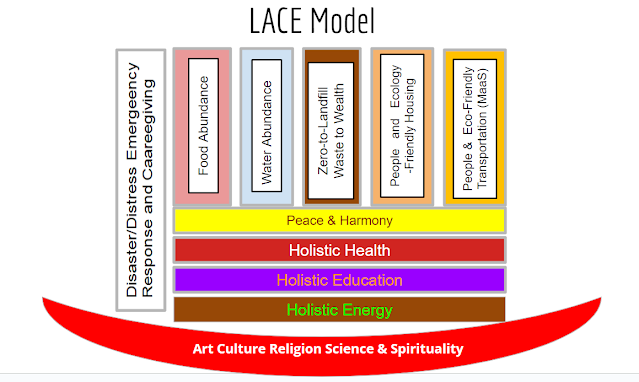
Localized, Abundant and Circular Economy (LACE) Model is an amalgamation of two diverse, synergistic and symbiotic approaches – a. New Urbanist Regional Planning with Smart Neighborhood Approach and b. Traditional Regional Planning with Vedic Gram Approach (Indigenous approach in India based on classical and folk traditions in the letter and spirit of United Nations Declaration for Rights of Indigenous Peoples 2007).
---
*B.Tech IIT Kharagpur, MBA IIM Calcutta, hief Mentor & Innovation Coach - GAIA Innovation Labs, Convener - Global Academy for Indigenous Activism (GAIA)
Comments
Post a Comment
NOTE: Hateful, abusive comments won't be published. -- Editor