
US report compares Nazi rule before, during Holocaust with today's happenings in India

By Rajiv Shah

In an unusual move, a US-based non-profit, Justice for All, has released a report to “explain” how the BJP-RSS are seeking to establish the ideology of Hindu supremacy called Hindutva in an effort to draw inspiration from Nazi ideologies, resulting in what calls “Nazification of India.”
The 48 page report draws a dozen odd parallels, pointing out that the comparison of what the Nazis did before and during the Holocaust and what is happening in India today “clearly demonstrates that India is on a dangerous trajectory to becoming a Nazi-inspired, fascist, majoritarian state, where its minorities and particularly its more than 200 million Muslims, face an impending danger of genocide.”
Noting that the non-profit Genocide Watch has already warned that the situation in India “reached the stages of polarization, preparation, and persecution respectively, the 6th, 7th, and 8th stages of the Ten Stages of Genocide”, the report insists, “The world must heed these warning signs and act as a matter of urgency to prevent history from repeating itself.”
It wants global leaders to “condemn the gross human rights violations occurring in India and pressure the government to hold true to India’s secular constitution”, even as asking international human rights organizations and genocide researchers “to dedicate resources to work with Indian civil society to understand the architecture of repression and help dismantle it.”
The report asks the US government to use the Global Magnitsky Act “to sanction the officers who torture and fail to protect, as well as those monks who are openly calling for genocide and soliciting suicide bombers.” The law authorizes the US government to sanction those foreign government officials worldwide that are human rights offenders, freeze their assets, and ban them from entering the US.
A detention camp under construction in Assam
Recalling that Prime Minister Narendra Modi was banned from entering the US for a decade because of his role in the 2002 Gujarat communal violence violence, and identifying a few leaders (e.g. Yati Narsinghanand Saraswati) who reportedly called for exterminating members of minority communities, it does not, however, specify on which among the top officials should the US government apply the Global Magnistky Act.
Comparing Nazis with Indian BJP-RSS, the report states that while the while Nazis had to sought to establish Aryan supremacy, RSS-BJP seeks to establish Hindu supremacy; and if Nazis resorted to anti-Semitism and vilification of Jewish population as political agenda, RSS-BJP is using Islamophobia and vilification of Muslim population as its political agenda.
The report says that while Nazis came up with Reich Citizenship Law which redefined German citizenship to exclude Jewish people, India’s National Register of Citizens (NRC) seeks to strip many of their citizenship, “as is already happening in Assam since they do not possess historic documents”. It also notes now the Citizenship Amendment Act (CAA) aims at granting “non-Muslims a path to regain citizenship”, even as ensuring that Muslims “remain stateless”.
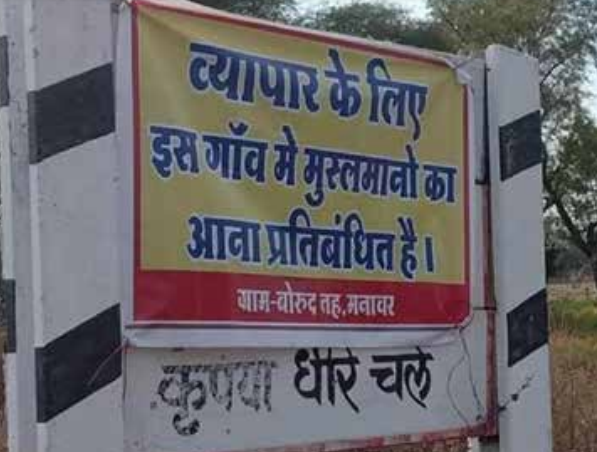
Call to boycott Muslims
Then, says the report, the Nazis came up with the Law for the Protection of German Blood and Honour, which banned marriage and extramarital relations between Jews and those of ‘German blood’, while a Prohibition of Unlawful Conversion of Religion Ordinance 2020, also known as Love Jihad law, has been promulgated in India in order to “protect” Hindu women and their honour from Muslim men by preventing inter-faith marriages.
Further, the report says, while the Nazis legally banned kosher slaughter, RSS-BJP, acting on the similar lines, has launched “a campaign against halal products, even as banning beef consumption and allowing lynching on the transportation of cattle.”
Also pointing towards how the Nazis’ Propaganda Ministry controlled the press to propagate Nazi ideology, the report notes, in India a professional information technology cell and a compliant media (called godi or lapdog media) are spreading fake news to demonize minorities in order to mold public opinion in favour of Hindutva ideology. The textbooks demonize Muslims, and admiration for Nazism is rampant in the BJP-RSS ideology.
And finally, the report notes, if the Nazis ensured economic boycott of Jewish-owned businesses and Jewish professionals, RSS-BJP seek economic boycott of Muslim owned businesses and Muslim professionals.

Comments

Unknown said…
Thank you for covering this report. It is an important one for the education of all, for what is happening in India against Christians, Muslims and other minorities. Anyone critical of Modi, is termed an anti-National, and thugs of the Bajrang Dal and the RSS-BJP groups terrorize Muslims and Christians. But the report does not compare the Holocaust, which is the result of preparations of the Nazis against the Jews of Germany. Rather it compares those preparations of Nazi Germany which led to the Holocaust. Those preparations are clear in India today against the Muslims, and the leader of the largest Hindu religious body in the country has stated it openly. Lawlessness is rising, Judiciary is compromised, and rapists and killers go free, as long as they are RSS-BJP supporters.
Zahir Adil said…
Thank you and appreciate the write focused on the report.
I will point out a few areas where I believe the message may have been better presented.
1) Title: We do not compare the result of Nazi preparations, viz. the Holocaust with what is happening today. We compare instead the preparations that happened in Nazi Germany, to preparations that are happening in India today. The Holocaust was the result of the vilification of Jews, persecution from different angles, and the pogroms that were happening, led to. Those same preparations are happening in India today.
2) Not sure why you termed it as unusual move on our part. This is not something sudden, but it has happened over the years while Modi has been in power. Several people have actually written about these similarities and have spoken to that topic. What we did is to put it down in a formal way so education of these preparations for a genocide of Muslims is easier.
3) We do know what the final solution that the RSS-BJP aligned monks and Hindutva religious leaders envision. As the leader of the largest organization of Hindu monks and priests has said (Yati Narsinghanand), the goal is to kill 2 million so that the rest would be forced to leave India. That is the Burmese model against the Rohingya that he referred to.
If you can change the title so it does not refer to a comparison to the Holocaust itself, that will be appreciated.
We have changed the title to what Nazis did "before and during" Holocaust, quoting from your Conclusion, which clearly states, and let me quote, "This report’s comparison of what the Nazis did before and during the Holocaust and what is happening in India today..."
Jag Jivan said…
I was wondering whether such one-to-one comparison is correct. Any research work needs to focus on both comparisons and also (and this is very important) what cannot be compared between two different periods, in this case the Nazi rule and the Modi rule.
Otherwise, it will become a propaganda piece without proper, reasonable analysis.
Anonymous said…
But as per Muslims holocaust never happened and giving a Yehudis as an example is shaitani behavior.

TRENDING

Modi’s Israel visit strengthened Pakistan’s hand in US–Iran truce: Ex-Indian diplomat

By Jag Jivan   M. K. Bhadrakumar , a career diplomat with three decades of service in postings across the former Soviet Union, Pakistan, Iran, Afghanistan, South Korea, Sri Lanka, Germany, and Turkey, has warned that the current truce in the US–Iran war is “fragile and ridden with contradictions.” Writing in his blog India Punchline , Bhadrakumar argues that while Pakistan has emerged as a surprising broker of dialogue, the durability of the ceasefire remains uncertain.

Manufacturing, services: India's low-skill, middle-skill labour remains underemployed

By Francis Kuriakose* The Indian economy was in a state of deceleration well before Covid-19 made its impact in early 2020. This can be inferred from the declining trends of four important macroeconomic variables that indicate the health of the economy in the last quarter of 2019.

Incarceration of Prof Saibaba 'revives' the question: What is crime, who is criminal?

By Kunal Pant* In 2016, a Supreme Court Judge asked the state of Maharashtra, “Do you want to extract a pound of flesh?” The statement was directed against the state for contesting the bail plea of Delhi University Professor GN Saibaba. Saibaba was arrested in 2014, a justification for which was to prevent him from committing what the police called “anti-national activities.”

Why Indo-Pak relations have been on 'knife’s edge' , hostilities may remain for long

By Utkarsh Bajpai*  The past few decades have seen strides being made in all aspects of life – from sticks and stones to weaponry. The extreme case of this phenomenon has been nuclear weapons. The menace caused by nuclear weapons in the past is unforgettable. Images of Hiroshima and Nagasaki from 1945 come to mind, after the United States dropped two atomic bombs on the cities.

Food security? Gujarat govt puts more than 5 lakh ration cards in the 'silent' category

By Pankti Jog* A new statistical report uploaded by the Gujarat government on the national food security portal shows that ensuring food security for the marginalized community is still not a priority of the state. The statistical report, uploaded on December 24, highlights many weaknesses in implementing the National Food Security Act (NFSA) in state.

The soundtrack of resistance: How 'Sada Sada Ya Nabi' is fueling the Iran war

​ By Syed Ali Mujtaba*  ​The Persian track “ Sada Sada Ya Nabi ye ” by Hossein Sotoodeh has taken the world by storm. This viral media has cut across linguistic barriers to achieve cult status, reaching over 10 million views. The electrifying music and passionate rendition by the Iranian singer have resonated across the globe, particularly as the high-intensity military conflict involving Iran entered its second month in March 2026.

Lata Mangeshkar, a Dalit from Devdasi family, 'refused to sing a song' about Ambedkar

By Pramod Ranjan*  An artist is known and respected for her art. But she is equally, or even more so known and respected for her social concerns. An artist's social concerns or in other words, her worldview, give a direction and purpose to her art. History remembers only such artists whose social concerns are deep, reasoned and of durable importance. Lata Mangeshkar (28 September 1929 – 6 February 2022) was a celebrated playback singer of the Hindi film industry. She was the uncrowned queen of Indian music for over seven decades. Her popularity was unmatched. Her songs were heard and admired not only in India but also in Pakistan, Bangladesh and many other South Asian countries. In this article, we will focus on her social concerns. Lata lived for 92 long years. Music ran in her blood. Her father also belonged to the world of music. Her two sisters, Asha Bhonsle and Usha Mangeshkar, are well-known singers. Lata might have been born in Indore but the blood of a famous Devdasi family...

'Batteries now cheap enough for solar to meet India's 90% demand': Expert quotes Ember study

By A Representative   Shankar Sharma, Power & Climate Policy Analyst, has urged India’s top policymakers to reconsider the financial and ecological implications of the country’s energy transition strategy in light of recent global developments. In a letter dated April 10, 2026, addressed to the Union Ministers of Finance, Power, New & Renewable Energy, Environment, Forest & Climate Change, and the Vice Chair of NITI Aayog, with a copy to the Prime Minister, Sharma highlighted concerns over India’s ambitious plans for coal gasification and the Prototype Fast Breeder Reactor (PFBR).

Labour unrest in Manesar trigger tensions: Recently enacted labour codes blamed

By A Representative   A civil rights coalition has expressed concern over recent developments in the industrial hub of Manesar in Haryana, where a series of labour actions and police responses have drawn attention. A statement, released by the Campaign Against State Repression (CASR), said it stood in solidarity with workers in IMT Manesar and other parts of the country, while also alleging instances of police excess during ongoing unrest.