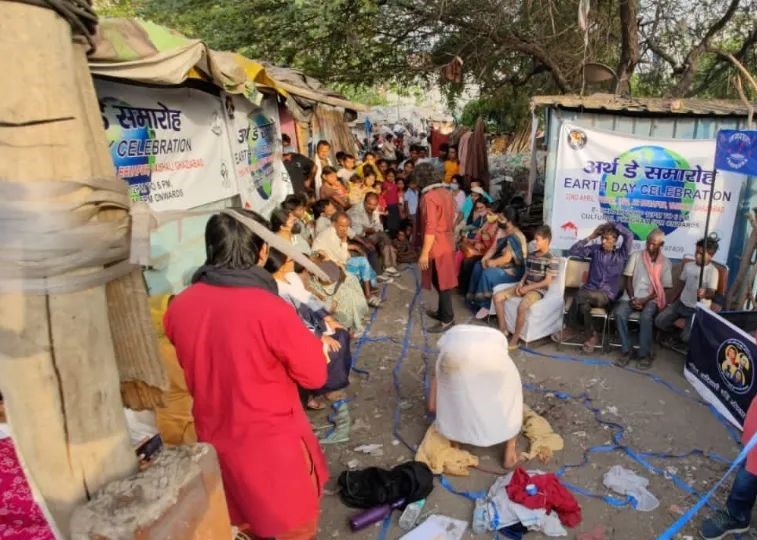
Whither waste pickers in managing waste?, ask Dalit groups at Earth Day event

By A Representative 

A recent event, organised by the Dalit Adivasi Shakti Adhikar Manch (DASAM) with the help of Janpahal, Workers Welfare Foundation and Basti Suraksha Manch to mark the Earth Day 2022, has pointed towards terribly inadequate plans to have landfill sites for waste management and involvement of waste pickers in waste management.
Consisting of discussions and celebrations, and pointing towards “loss of land due to lack of scientific management of waste and the role of waste pickers”, it was asserted during the discussion that currently are just 262 acres of land for four landfills in Delhi for waste management.
If Burari, Shastri Park, Sukhdev Vihar are included for processing, then this figure reaches close to 300 acres. If the slope houses are included in the mohallas, then this figure goes beyond the minimum 400 acres, which comes to just around 1.62 sq km, an expert participant said.
According to an estimate, this expert said, by 2050, land equivalent to 88 sq km will be required for waste disposal – which is equivalent to the New Delhi Municipal Council (NDMC) area, suggesting poor planning for this as of today.
The expert said, “If the workers in the unorganized sector involved in waste management are made partners, one third of the land currently being used can be better managed. Also, if the municipality implements the recommendation of Municipal Solid Wastes (Management & Handling) (MSW) Rules 2016, then there is a possibility of utilising more than 90% waste through Material Recovery Facility (MRF).”
“We all should try together for this that waste should be managed in a scientific way”, it was added. The event – organised against backdrop of the Earth Day 2022 focus on accelerating solutions to combat the world’s greatest threat, climate change – saw the participation especially of waste pickers, who, it was said, contribute the most to earth without even being recognised for their work i.e. the waste picking.
The event took place at Ghaziabad with a play by Sangwari Group centred around the life and struggles of Ambedkar, songs, discussion and a free health and e-shram card camp.

Comments

TRENDING

NYT: RSS 'infiltrates' institutions, 'drives' religious divide under Modi's leadership

By Jag Jivan   A comprehensive New York Times investigation published on December 26, 2025, chronicles the rise of the Rashtriya Swayamsevak Sangh (RSS) — characterized as a far-right Hindu nationalist organization — from a shadowy group founded in 1925 to the world's largest right-wing force, marking its centenary in 2025 with unprecedented influence and mainstream acceptance. Prime Minister Narendra Modi , who joined the RSS as a young boy and later became a full-time campaigner before being deputized to its political wing in the 1980s, delivered his strongest public tribute to the group in his August 2025 Independence Day address. Speaking from the Red Fort , he called the RSS a "giant river" with dozens of streams touching every aspect of Indian life, praising its "service, dedication, organization, and unmatched discipline." The report describes how the RSS has deeply infiltrated India's institutions — government, courts, police, media, and academia — ...

Why experts say replacing MGNREGA could undo two decades of rural empowerment

By A Representative   A group of scientists, academics, civil society organisations and field practitioners from India and abroad has issued an open letter urging the Union government to reconsider the repeal of the Mahatma Gandhi National Rural Employment Guarantee Act (MGNREGA) and to withdraw the newly enacted Viksit Bharat–Guarantee for Rozgar and Ajeevika Mission (Gramin) Act, 2025. The letter, dated December 27, 2025, comes days after the VB–G RAM G Bill was introduced in the Lok Sabha on December 16 and subsequently approved by both Houses of Parliament, formally replacing the two-decade-old employment guarantee law.

ArcelorMittal faces global scrutiny for retreat from green steel, job cuts, and environmental violations

By  Jag Jivan    ArcelorMittal is facing mounting criticism after cancelling or delaying nearly all of its major green steel projects across Europe, citing an “unsupportive policy environment” from the European Union . The company has shelved projects in Germany , Belgium , and France , while leaving the future of its Spanish decarbonisation plan uncertain. The decision comes as global unions warn that more than 5,500 jobs are at risk across its operations, including 4,000 in South Africa , 1,400 in Europe, and 160 in Canada .

Domestic vote-bank politics 'behind official solidarity' with Bangladeshi Hindus

By Sandeep Pandey, Faisal Khan  The Indian government has registered a protest with Bangladesh over the mob lynching of two Hindus—Deepu Chandra Das in Mymensingh and Amrit Mandal in Rajbari. In its communication, the government cited a report by the Association of Hindus, Buddhists and Christian Unity Council, which claims that more than 2,900 incidents of killings, arson, and land encroachments targeting minorities have taken place since the interim government assumed power in Bangladesh. 

From colonial mercantilism to Hindutva: New book on the making of power in Gujarat

By Rajiv Shah  Professor Ghanshyam Shah ’s latest book, “ Caste-Class Hegemony and State Power: A Study of Gujarat Politics ”, published by Routledge , is penned by one of Gujarat ’s most respected chroniclers, drawing on decades of fieldwork in the state. It seeks to dissect how caste and class factors overlap to perpetuate the hegemony of upper strata in an ostensibly democratic polity. The book probes the dominance of two main political parties in Gujarat—the Indian National Congress and the BJP—arguing that both have sustained capitalist growth while reinforcing Brahmanic hierarchies.

Investment in rule of law a corporate imperative, not charity: Business, civil society leaders

By A Representative   In a compelling town hall discussion hosted at L.J School of Law , prominent voices from industry and civil society underscored that corporate investment in strengthening the rule of law is not an act of charity but a critical business strategy for building a safer, stronger, and developed India by 2047. The dialogue, part of the Unmute podcast series, examined the intrinsic link between ethical business conduct , robust legal frameworks, and sustainable national development, against the sobering backdrop of India ranking 79th out of 142 countries on the global Rule of Law Index .

2025 was not just a bad year—it was a moral failure, it normalised crisis

By Atanu Roy*  The clock has struck midnight. 2025 has passed, and 2026 has arrived. Firecrackers were already bursting in celebration. If this is merely a ritual, like Deepavali, there is little to comment on. Otherwise, I find 2025 to have been a dismal year, weighed down by relentless odds—perhaps the worst year I have personally witnessed.

Gig workers’ strike halts platforms, union submits demands to Labour Ministry

By A Representative   India’s gig economy witnessed an partial disruption on December 31, 2025, as a large number of delivery workers, app-based service providers, and freelancers across the country participated in a nationwide strike called by the Gig & Platform Service Workers Union (GIPSWU). The strike, which followed days of coordinated protests, shut down major platforms including Zomato , Swiggy , Blinkit , Zepto , Flipkart , and BigBasket in several areas.

Can global labour demand absorb India’s growing workforce?

By N.S. Venkataraman*  Over the past eleven years, India has claimed significant economic growth , emerging as the world’s fourth-largest economy. With the Government of India continuing to pursue economic and industrial development initiatives, this growth momentum is expected to continue in the medium term.