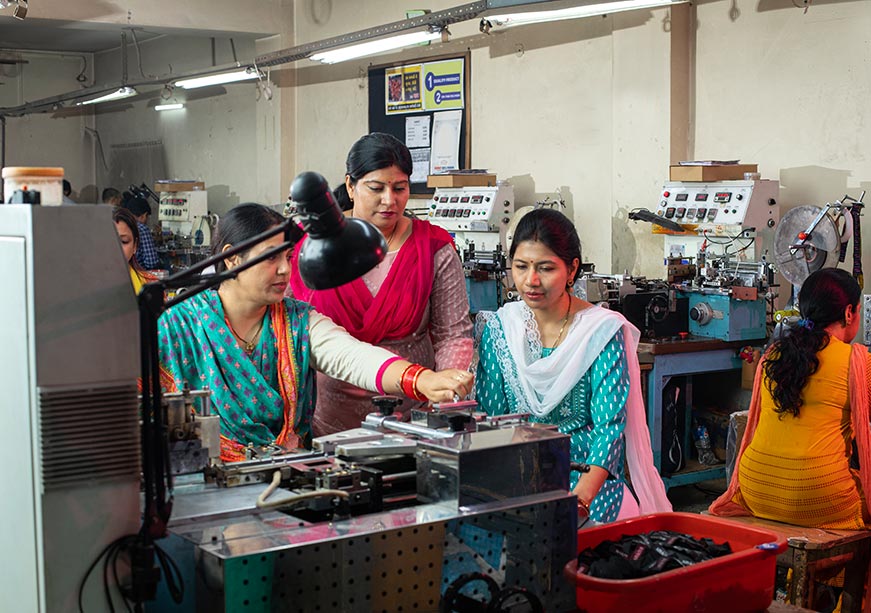
Informal economy offers complex blend of empowerment and disempowerment for women

By Harasankar Adhikari 
The informal economy has emerged as a significant feature of the global economic landscape. Often referred to as the "other path," it provides new income-generating opportunities for the poor while posing little threat to the wealthy. This sector is less capital-intensive, relies less on foreign exchange and technology, and offers avenues of employment for the less educated. However, it is also criticized as exploitative, repressive, and occasionally bordering on illegality, serving as a source of cheap goods and labor for mainstream economies.
Despite its criticisms, the informal economy has contributed to human security, gender equality, and economic growth. In India, it is the fastest-growing economic sector, employing approximately 110 million people as of 2022-23, or about 20% of the workforce. Women, in particular, have benefited from this sector, which has enabled them to break free from traditional patriarchal roles and gain financial independence.
Women now participate actively in sectors like sales, small trade, and services, earning incomes that enhance their families' welfare. These earnings often go toward essentials such as food, housing, education, and leisure. Access to income reduces dependency on male family members and provides women with greater control over their lives and decisions. Women's contributions to household finances have disrupted traditional patriarchal norms, giving them a more significant role in decision-making. Through their earnings, women can redefine their social identities, embracing modern lifestyles centered on work, fashion, and leisure.
While some women find financial success, others remain trapped in low-wage, exploitative jobs, reinforcing class divisions. Women are often employed for roles that capitalize on their physical appearance and soft skills, perpetuating traditional gender norms. Economic independence has led to conflicts in personal relationships, marital disputes, and family crises. Inadequate maternal involvement has also caused behavioral and academic issues among children. Economic disparities among women have grown, with affluent women enjoying privileges that starkly contrast with the struggles of poorer women.
The informal economy offers a complex blend of empowerment and disempowerment for women. While it has enabled many to assert their rights and redefine gender roles, it has also exacerbated class divisions and introduced new social challenges. To maximize the potential of this sector, it is crucial to address issues of exploitation, ensure fair wages, and provide support systems for women balancing work and family responsibilities. A balanced approach will help women in the informal economy achieve sustainable progress while fostering gender equality.

Comments

TRENDING

Countrywide protest by gig workers puts spotlight on algorithmic exploitation

By A Representative   A nationwide protest led largely by women gig and platform workers was held across several states on February 3, with the Gig & Platform Service Workers Union (GIPSWU) claiming the mobilisation as a success and a strong assertion of workers’ rights against what it described as widespread exploitation by digital platform companies. Demonstrations took place in Delhi, Rajasthan, Karnataka, Maharashtra and other states, covering major cities including New Delhi, Jaipur, Bengaluru and Mumbai, along with multiple districts across the country.

Swami Vivekananda's views on caste and sexuality were 'painfully' regressive

By Bhaskar Sur* Swami Vivekananda now belongs more to the modern Hindu mythology than reality. It makes a daunting job to discover the real human being who knew unemployment, humiliation of losing a teaching job for 'incompetence', longed in vain for the bliss of a happy conjugal life only to suffer the consequent frustration.

Budget 2026 focuses on pharma and medical tourism, overlooks public health needs: JSAI

By A Representative   Jan Swasthya Abhiyan India (JSAI) has criticised the Union Budget 2026, stating that it overlooks core public health needs while prioritising the pharmaceutical industry, private healthcare, medical tourism, public-private partnerships, and exports related to AYUSH systems. In a press note issued from New Delhi, the public health network said that primary healthcare services and public health infrastructure continue to remain underfunded despite repeated policy assurances.

'Gandhi Talks': Cinema that dares to be quiet, where music, image and silence speak

By Vikas Meshram   In today’s digital age, where reels and short videos dominate attention spans, watching a silent film for over two hours feels almost like an act of resistance. Directed by Kishor Pandurang Belekar, “Gandhi Talks” is a bold cinematic experiment that turns silence into language and wordlessness into a powerful storytelling device. The film is not mere entertainment; it is an experience that pushes the viewer inward, compelling reflection on life, values, and society.

Penpa Tsering’s leadership and record under scrutiny amidst Tibetan exile elections

By Tseten Lhundup*  Within the Tibetan exile community, Penpa Tsering is often described as having risen through grassroots engagement. Born in 1967, he comes from an ordinary Tibetan family, pursued higher education at Delhi University in India, and went on to serve as Speaker of the Tibetan Parliament-in-Exile from 2008 to 2016. In 2021, he was elected Sikyong of the Central Tibetan Administration (CTA), becoming the second democratically elected political leader of the administration after Lobsang Sangay. 

When compassion turns lethal: Euthanasia and the fear of becoming a burden

By Deepika   A 55-year-old acquaintance passed away recently after a long battle with cancer. Why so many people are dying relatively young is a question being raised in several forums, and that debate is best reserved for another day. This individual was kept on a ventilator for nearly five months, after which the doctors and the family finally decided to let go. The cost of keeping a person on life support for such extended periods is enormous. Yet families continue to spend vast sums even when the chances of survival are minimal. Life, we are told, is precious, and nature itself strives to protect and sustain it.

Report exposes human rights gaps in India's $36 billion garment export industry

By Jag Jivan   A new report sheds light on the urgent human rights challenges within India’s vast textile and garment industry, as global regulations increasingly demand corporate accountability in supply chains. Titled “Beneath the Seams,” the study reveals that despite the sector employing over 45 million people, systemic issues of poverty wages, unfair purchasing practices, and the exclusion of workers from decision-making persist, leaving millions vulnerable.

When resistance became administrative: How I learned to stop romanticising the labour movement

By Rohit Chauhan*   On my first day at a labour rights NGO, I was given a monthly sales target: sixty memberships. Not sixty workers to organise, not sixty conversations about exploitation, not sixty political discussions. Sixty conversions. I remember staring at the whiteboard, wondering whether I had mistakenly walked into a multi-level marketing office instead of a trade union. The language was corporate, the urgency managerial, and the tone unmistakably transactional. It was my formal introduction to a strange truth I would slowly learn: in contemporary India, even rebellion runs on performance metrics.

Silencing the university: How fear is replacing debate in academic India

By Sunil Kyumar*  “Republic Day is a powerful symbol of our freedom, Constitution, and democratic values. This festival gives us renewed energy and inspiration to move forward together with the resolve of nation-building”, said Prime Minister Narendra Modi on January 26, 2026. On this occasion, the Prime Minister also shared a Sanskrit subhashita— “Paratantryābhibhūtasya deśasyābhyudayaḥ kutaḥ. Ataḥ svātantryamāptavyaṁ aikyaṁ svātantryasādhanam.”