
Communal division? Bengali Muslim waste pickers kept away from Swacch Bharat meet

By Sanjeev Danda* 

"Had I not been poor, I would not be collecting waste. If I could find work at home, I would not be in Delhi struggling to earn money", said Manju, a waste picker from Bhuapur, Ghaziabad in the Press Conference organised by Dalit Adivasi Shakti Adhikar Manch (DASAM) on the exclusion of waste pickers from the Waste Management System held at the Press Club of India, New Delhi.
Working for the issues of informal waste pickers in Delhi NCR, activists from DASAM, which has been working for the implementation of government policies on ground level for the benefit of the poor community, noted at the media meet that the exploitation of waste pickers are not limited to their occupation, but is also rooted in issues of caste, gender and religion.
Typically, Bengali Muslim waste pickers of Bhalswa were kept away from the Bhalswa landfill during the Government of India-sponsored Swachh Bharat Abhiyan celebrations on 2nd October.
The activists, backed by waste pickers, proposed that if the informal waste pickers are given space in the waste management system, the waste management process would become more efficient and environment-friendly.
Approximately, 50% waste is organic which can be converted to manure using natural methods and 30% waste is recyclable waste which can be brought to use without any treatment, they said. Around 80% of the waste can be managed by waste pickers without the need of incineration or waste to energy plants. This would relieve the economic burden from the government and lead to an ecologically sound waste management.
Dr Aparna Agarwal, Assistant Professor, OP Jindal Global University, who did her doctorate from Oxford university on the waste economy of Delhi, pointed out that waste pickers constitute approximately 1% of India’s workforce, and the 3- 4 lakh waste pickers in Delhi are informally working for the recycling of 15-20% of Delhi’s waste.
In a scenario where most of the waste in Delhi is not recycled but sent for incineration, waste pickers are the only ones handling waste in an environment-friendly manner, she asserted. However, they are not only excluded from the waste management system, but the Delhi government is increasing the informal workforce in the name of formalization through outsourcing the work to private companies.
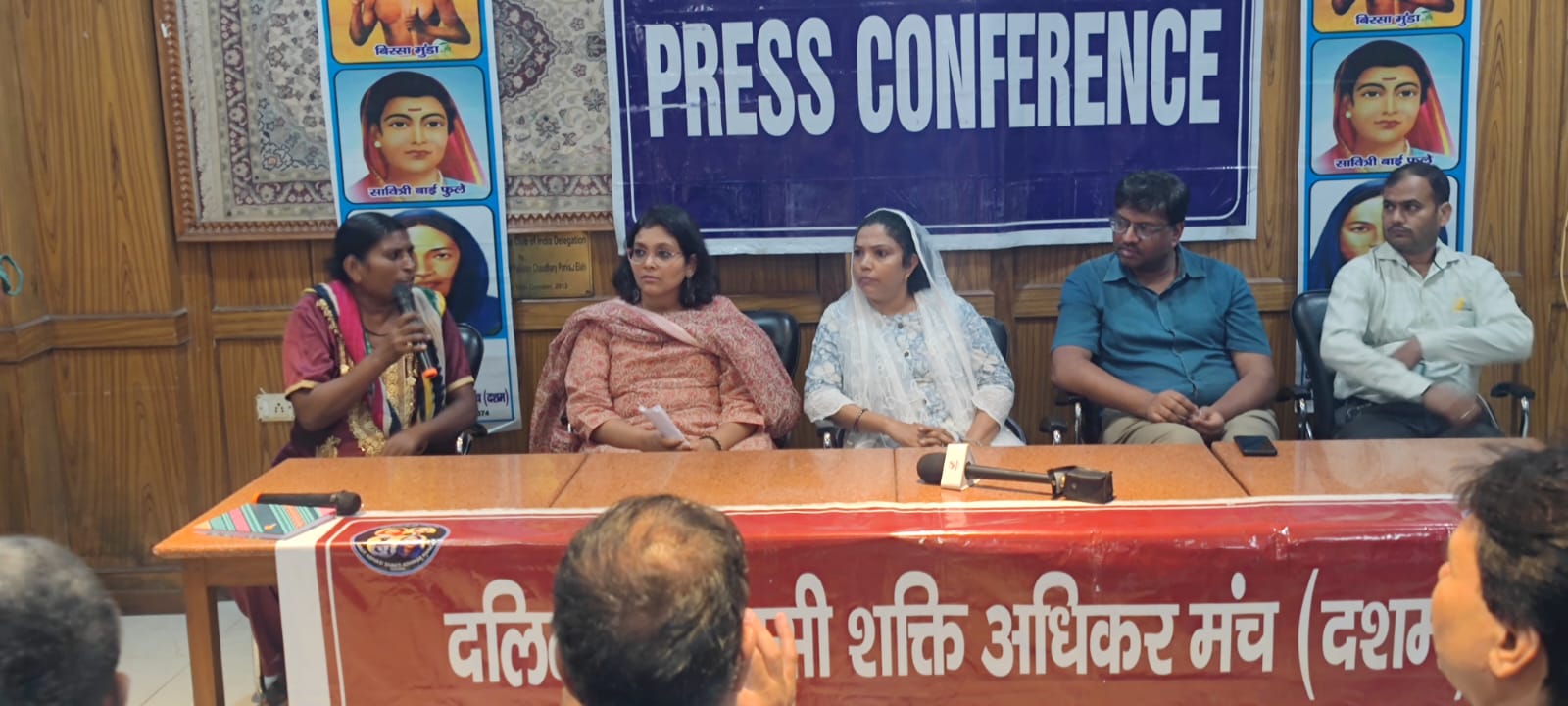
Ayesha, a waste picker and community leader from Rithala, Rohini, appealed that the money spent by the government on private contracts should be invested for the welfare of waste pickers by providing them with ID cards, medical facilities, social security, etc.
Talking about privatization, Shashi B Pandit, Joint Secretary, DASAM, pointed out that the control over waste is now given to people who have no experience of dealing with waste, and people who have years of experience are excluded from the management system.
Shravan Kumar, an informal waste picker in the NDMC area, talked about the dual profit companies earn by taking money through contracts and also from the informal waste pickers who collect waste from sites. The waste pickers who are helping the companies through their informal work have to pay them money and face additional harassment from the authorities.
Ayodhya Prasad, an informal waste picker working in Ghaziabad, added that they are also not allowed to throw waste on the dumping sites by the authorities after segregation.
Recognizing the exploitation by the private companies, an employee of one such company working for waste management in Ghazipur, Delhi admitted before the media that the only goal of privatization is earning money and said that waste must not be used for generating money, but it should be used for public utility.
---
*Dalit rights activist

Comments

TRENDING

Academics urge Azim Premji University to drop FIR against Student Reading Circle

  By A Representative   A group of academics and civil society members has issued an open letter to the leadership of Azim Premji University expressing concern over the filing of a police complaint that led to an FIR against a student-run reading circle following a recent incident of violence on campus. The signatories state that they hold the university in high regard for its commitment to constitutional values, critical inquiry and ethical public engagement, and argue that it is precisely because of this reputation that the present development is troubling.

'Policy long overdue': Coalition of 29 experts tells JP Nadda to act on SC warning label order

By A Representative   In a significant development for public health, the Supreme Court of India has directed the Food Safety and Standards Authority of India (FSSAI) to seriously consider implementing mandatory front-of-pack warning labels on pre-packaged food products. The order, passed by a bench of Justices J.B. Pardiwala and K.V. Viswanathan on February 10, 2026, comes as the Court expressed dissatisfaction with the regulatory body's progress on the issue.

When tourism meets tribal law: The Vanajangi dispute in Andhra Pradesh

By Palla Trinadha Rao   A writ petition presently before the High Court of Andhra Pradesh has brought into focus an increasingly important question in the governance of tribal regions: can eco-tourism projects in Scheduled Areas be implemented without the consent of the Gram Sabha? The case concerns the establishment of a Community Based Eco-Tourism centre at Vanajangi village in Paderu Mandal of Alluri Sitarama Raju District, a region located within the Scheduled Areas of Andhra Pradesh. 

UAPA action against Telangana activist: Criminalising legitimate democratic activity?

By A Representative   The National Investigation Agency's Hyderabad branch has issued notices to more than ten individuals in Telangana in connection with FIR No. RC-04/2025. Those served include activists, former student leaders, civil rights advocates, poets, writers, retired schoolteachers, and local leaders associated with the Communist Party of India (CPI) and the Indian National Congress. 

Vaccination vs screening: Policy questions raised on cervical cancer strategy

By A Representative   A public policy expert has written to Union Health Minister J. P. Nadda raising a series of concerns regarding the national Human Papillomavirus (HPV) vaccination campaign launched on February 28 for 14-year-old girls.

The new anti-national certificate: If Arundhati Roy is the benchmark, count me in

By Dr. Mansee Bal Bhargava*   Dear MANIT Alumni Network Committee, “Are you anti-national?” I encountered this fascinating—some may say intimidating—question from an elderly woman I barely know, an alumna of Maulana Azad College of Technology (MACT, now Maulana Azad National Institute of Technology - MANIT), Bhopal, and apparently one of the founders of the MACT (now MANIT) Alumni Network. The authority with which she posed the question was striking. “How much anti-national are you? What have you done for the Alumni Network Committee to identify you as anti-national?” When I asked what “anti-national” meant to her and who was busy certifying me as such, the response came in counter-questions.

The ultimate all-time ODI XI: A personal selection of icons across eras

By Harsh Thakor* This is my all-time best XI chosen for ODI (One Day International) cricket:  1. Adam Gilchrist (W) – The absolute master blaster who could create the impact of exploding gunpowder with his electrifying strokeplay. No batsman was more intimidating in his era. Often his knocks decided the fate of games as though the result were premeditated. He escalated batting strike rates to surreal realms.

Buddhist shrines were 'massively destroyed' by Brahmanical rulers: Historian DN Jha

Nalanda mahavihara By Rajiv Shah  Prominent historian DN Jha, an expert in India's ancient and medieval past, in his new book , "Against the Grain: Notes on Identity, Intolerance and History", in a sharp critique of "Hindutva ideologues", who look at the ancient period of Indian history as "a golden age marked by social harmony, devoid of any religious violence", has said, "Demolition and desecration of rival religious establishments, and the appropriation of their idols, was not uncommon in India before the advent of Islam".

Minority concerns mount: RTI reveals govt funded Delhi religious meet in December

By Syed Ali Mujtaba*  Indian Muslims have expressed deep concern over what they describe as rising hate speech and hostility against their community under the BJP-led government in India. A recent flashpoint was the event organised by Sanatan Sanstha titled “Sanatan Rashtra Shankhnad Mahotsav” in New Delhi on 13–14 December 2025.