
Procrustes in Greek mythology was the owner of an estate In Corydalus in Attica, between Athens and Eleusis where mysterious rites were performed. He had a strange way of looking after his guests. He had an iron bed on which he invited them to rest after treating them to a generous dinner. But there was a catch.
Procrustes had a peculiar obsession. He wanted the traveller to fit the bed to perfection. If the guest happened to be shorter than the bed, he stretched the victims to fit the bed. Alternatively, if the victim was taller, he sawed off the unfortunate person’s legs. Either way, the victim was tied, tortured and made to fit the bed.
Does it ring a bell? Do we get a déjà-vu feeling? Logically we know we haven’t experienced this moment before. But our gut is likely to tell us something which can be quite an unsettling and strange feeling. Unfortunately, the vast majority of us has been numbed by the “shock and awe” caused by the high intensity panic and panic-driven responses of the recent pandemic.
Measures unprecedented in public health history violating all logic and principles of pandemic control were implemented with a heavy hand in almost all the countries of the world often taking help of the police for enforcement. All the principles of public health ethics and human rights were breached.
The world is still to recover from this “shock” and a number of “aftershocks” as a result of an alarm, sans evidence, of an “impending pandemic” of highly lethal and contagious "Disease X". Meanwhile, instead of working on steps to heal a fractured society, silent and hectic preparations are on for creation of a giant bed of Procrustes. This colossal bed will accommodate the whole of humanity and even include the animal kingdom.
The promotion of this giant bed has started with catchy slogans like, “One World, One Health.” Such slogans are reminiscent and ominous in equal measure, of the catchphrase in Animal Farm – “All animals are equal, but some animals are more equal than others!”
“One World” concept glosses over the inherent social inequities and diversities in various parts of the world and even within a country, for example in a vast country like India. Similarly, “One Health” is an oxymoron. The WHO in its definition of health defines “...health as a state...” A person well today may get sick tomorrow and the needs during different phases will be different. The same is true for different countries which may be in different phases of socioeconomic development with varying health statuses and needs.
“One Health Packages” will not fit the needs of different countries. Besides health, the factors that contribute to health and illness differ widely between countries. Housing, sanitation, income, population density, demographics and age structures, and other known and unknown factors all of which have an impact on health call for urgent action, particularly among less privileged people of the world before pushing for vaccines and drugs against a yet unknown “Disease X.”
But we are digressing from the story, i.e. the remaking of the Bed of Procrustes. Bureaucrats, shall we call them carpenters, with the WHO are working silently behind the scenes designing a one-size-fits-all modern and colossal “Bed of Procrustes” which will accommodate the citizens of 194 countries which enjoy the hospitality of the WHO.
This bed will be called the WHO Pandemic Treaty. Due to hype of the impending pandemic of “Disease X” by an obliging mainstream media, and blockbuster movies on pandemics, serving as the opium of the masses, people will look up to the WHO for succour. The WHO will eagerly oblige having ensured the “silence of the lambs” by the “shock and awe” of panic and propaganda.
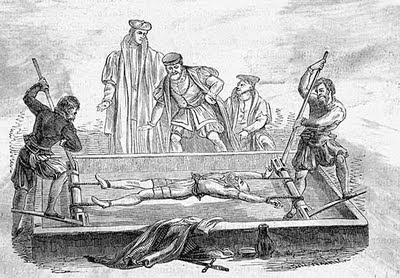
Owner of an estate in Greek mythology, Procrustes had an iron bed on which he tied, tortured and made the traveller to fit the bed to perfection
There are two sets of carpenters working silently around the clock since 2021. One group is working to design the giant rigid bed, the Pandemic Treaty, and the other group is sharpening the tools, by way of the 300 amendments to the International Health Regulations (IHR), that will ensure that everyone who sleeps on the bed, human or animal, fits perfectly in it, if need be by chopping or stretching.
Had humanity not been drugged throughout the pandemic years few would have been persuaded to sleep in a strange bed. However, most citizens of the world are too tired and drowsy to care and would sleep at the first bed available. To make matters worse, their elected representatives, who should know better, are too intoxicated with power and perhaps the promise of having more in cahoots with the WHO to care two hoots where the innocent lambs are led to.
Had humanity not been drugged throughout the pandemic years few would have been persuaded to sleep in a strange bed. However, most citizens of the world are too tired and drowsy to care and would sleep at the first bed available. To make matters worse, their elected representatives, who should know better, are too intoxicated with power and perhaps the promise of having more in cahoots with the WHO to care two hoots where the innocent lambs are led to.
Once in the bed the hapless citizen will lose all autonomy. The occupant has to fit the bed perfectly. If human or beast fails to fit perfectly in this bed of One World, One Health, and One Bed, the tools in the form of the amendments to the IHR will ensure the occupant is stretched or cut to size to fit this huge bed. Once in this bed, the host will have all liberty to inject experimental vaccines or drugs to the occupants.
The host will have no liability to compensate for any harms arising out of these mysterious rites. The bed will ensure continuous profits for its sponsors, the makers of diagnostic kits, drugs and vaccines. They will fund for maintenance of this magic bed which will ensure steady profits for all and sundry at the cost of the hapless innocent occupants.
As a result of high pressure marketing, the bed is almost sold to 194 countries, and if the order is not cancelled within a couple of months, the citizens of the world will have no choice but to sleep on the bed constructed with labour of various conflicts of interests.
I need to consult a shrink. I think I am suffering from obsessive compulsive disorder. I am having sleep disorders. My fitful sleep is often interrupted by nightmares in which I find myself in a huge bed surrounded by humans and animals of all forms.
At times I am being stretched to fill the bed, at other times I feel as someone is trying to chop off my legs and I wake up shivering and sweating and relieved on realizing it is only a dream.
---
*Epidemiologist who is presently Professor in a Medical College at Pune. He had served as an epidemiologist in the armed forces for over two decades. He recently ranked in Stanford University list of world’s top 2% scientists. He has written the book, “Covid-19 Pandemic: A Third Eye”
The host will have no liability to compensate for any harms arising out of these mysterious rites. The bed will ensure continuous profits for its sponsors, the makers of diagnostic kits, drugs and vaccines. They will fund for maintenance of this magic bed which will ensure steady profits for all and sundry at the cost of the hapless innocent occupants.
As a result of high pressure marketing, the bed is almost sold to 194 countries, and if the order is not cancelled within a couple of months, the citizens of the world will have no choice but to sleep on the bed constructed with labour of various conflicts of interests.
I need to consult a shrink. I think I am suffering from obsessive compulsive disorder. I am having sleep disorders. My fitful sleep is often interrupted by nightmares in which I find myself in a huge bed surrounded by humans and animals of all forms.
At times I am being stretched to fill the bed, at other times I feel as someone is trying to chop off my legs and I wake up shivering and sweating and relieved on realizing it is only a dream.
---
*Epidemiologist who is presently Professor in a Medical College at Pune. He had served as an epidemiologist in the armed forces for over two decades. He recently ranked in Stanford University list of world’s top 2% scientists. He has written the book, “Covid-19 Pandemic: A Third Eye”
Comments