
In India's North Maharashtra, as tradition has it, Palghar District’s Mokhada taluka bears testimony to Bohada -- the 250-year-old festival that peaks in the last three days, transporting its residents into a magical realm of a mythological past.
Charged with age-old charm, the nights in this Palghar town, known for its dependence on nature and traditional local healers, come alive with flaming mashaals accompanying the vibrantly-hued masked entities dancing with wild abandon to the beats of the Sambal and the mesmerising tune of Shehnai played by Warli musicians.
Local performers adorning colourful masks of deities, over generations together are guided by revellers through one end of the road till the other. Some carrying mashaals move through the dark of the night and amidst a swiftly surging sea of the devout, bringing to life the legendary festivities once again, the day after Holi on Dhulandi, at Mokhada.
The traditional welcome to the gavdevi, Jagdamba Devi is associated with ceremonial dances of mythological characters from Ramayana, Mahabharat, etc., and include Lord Ganesha, Goddess Saraswati or Sharada, Ravana, Bheem, Tratika, etc.
The tribal mask festival called Bohada is celebrated in Mokhada roughly during the Shimga festival, as Holi is known in Konkan region, and extends from five to 15 days depending on the zone. Interestingly, each tribal partaking in the festival has been doing so for over generations and harbours fond memories of his father, even grandfather dancing all night long while adorning an age-old mask and costume that goes back into a sacred prayer area in his house, after each festival, to emerge again the next year.
This year, Mokhada resident and autorickshaw-driver thirty-year-old Prasad Patil was particularly nostalgic. Till seven years back, it was his father Yuvraj Patil who would get dressed in the costume and partake in the utsav. “My father passed away and, as is the tradition, I took his place in the festival the following year. Bohada will always be very special to me.”
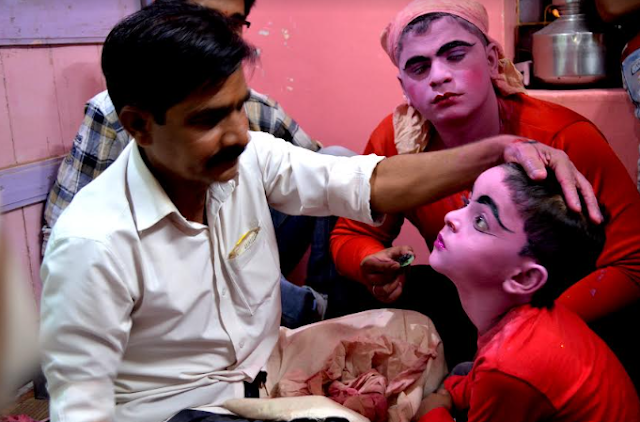 So, during the Bohada festivities in Mokhada, Prasad drives an auto-rickshaw by the day, becomes Bheem by night. “I am also training Niranjan so, this year, I had him dressed up too to perform with me. After all, he will carry forward the family tradition after me.”
Curious onlookers jostled to grab a peep through windows of changing rooms in huts where young boys were being applied make-up, even dressed up as female characters by older women to recreate mythological forms like Saraswati, Hidimba and others who’d go on to perform all night long.
The highlight of the evening, a retired primary school headmaster Ramchandra Jadhav transforms thin adolescent boys into strong, vibrant characters through bright face paint, wigs and dyes to fit into roles cut out for them, and perform, year after year. “I have been doing this for 50 years and after retiring as a primary school headmaster last year, now all my time is devoted to this service only,” he maintains.
Interestingly, each family whose member transforms into a mythological character and performs to perfection is responsible for all the related activities as well. So, for example, for every procession, the family has to arrange for the torch or temba, as it is locally known, for devotees to carry with the procession. Some even light firecrackers, other use LED lights, etc., to draw public attention to ‘their’ performance.
It’s the last three days of the festival that are the main days when thousands from nearby villages flock to Mokhada to be a part of the procession and revelry. It is a ceremony laced with sagas of significance, religious compulsion and community sentiments. The villagers believe if they won’t observe Mokhada, bad things will happen to them.

Curious onlookers jostled to grab a peep through windows of changing rooms in huts where young boys were being applied make-up, even dressed up as female characters by older women to recreate mythological forms like Saraswati, Hidimba and others who’d go on to perform all night long.
The highlight of the evening, a retired primary school headmaster Ramchandra Jadhav transforms thin adolescent boys into strong, vibrant characters through bright face paint, wigs and dyes to fit into roles cut out for them, and perform, year after year. “I have been doing this for 50 years and after retiring as a primary school headmaster last year, now all my time is devoted to this service only,” he maintains.
Interestingly, each family whose member transforms into a mythological character and performs to perfection is responsible for all the related activities as well. So, for example, for every procession, the family has to arrange for the torch or temba, as it is locally known, for devotees to carry with the procession. Some even light firecrackers, other use LED lights, etc., to draw public attention to ‘their’ performance.
It’s the last three days of the festival that are the main days when thousands from nearby villages flock to Mokhada to be a part of the procession and revelry. It is a ceremony laced with sagas of significance, religious compulsion and community sentiments. The villagers believe if they won’t observe Mokhada, bad things will happen to them.
Local Rushikesh Lade looks forward to this ‘favourite’ time every year. During the festival, he spends his evenings sitting with his mother Pramila outside his general store along the main road where the procession takes place. “I have been watching this since childhood, it’s one of my earliest memories and I still love to relive it in person. It’s a time when the entire village comes together to prepare for the festival,” he says. “It’s a wonderful feeling of camaraderie for us all.”
Nearby, three-year-old Durvesh clings on to his mother Bharti and hides behind her each time a ‘demon’ walks past. Bharti arrived to Mokhada after marriage a few years back and will be witnessing Bohada for the very first time. “Neither did I nor my son witness the festival earlier. Durvesh loves to see all the masked deities and demons…their dance and fights. Sometimes he gets scared as well but then soon, his curiosity overcomes his fears and he is ready for more,” she says.
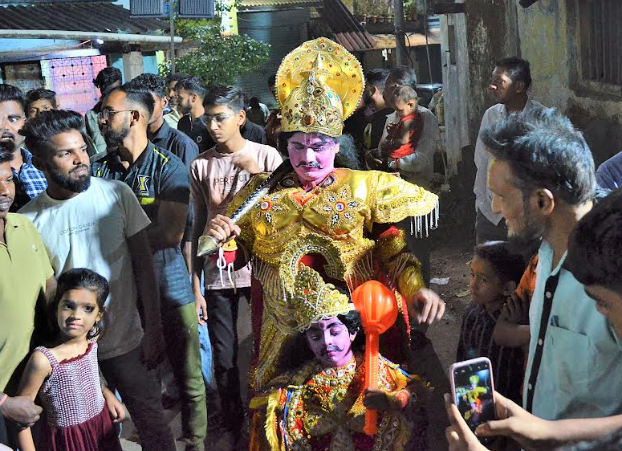 Nineteen-year-old Anurag Nikam holds five-year-old Niranjan Patil playing the role of Chhota Bheem with his father Prasad Patil, who plays Bheem, during the Bohada festival at Mokhada. Anurag enacted the role of Lord Ganesha this year taking over from father Prakash Nikam, also the Palghar Zilla Parishad President, as is the local tradition. Prakash, himself a Bohada enthusiast, recalls having performed the role of Ravana and dancing with a multi-headed heavy mask during the Bohada festival in 2016.
Bohada being a performance-based festival, a lot of efforts are put towards make-up and costumes. During these three days, traditional songs and tribal music emanate from customary instruments played by Warli musicians. Masks worn are first revered in religious ceremonies and then put to use.
Prayers to Lord Ganesha, Saraswati, Maruti and Mahadev are followed by story narrations of Tratika, Hiranyakashapu, Bheem Bakasur, Agni Dev, Ravana, Narsimha, Vishnu Dev, Brahma Dev, Indra Dev and the saga of Ramayana. Men dressed as women provide the sprinkle of amusement to locals.
Mock-fights between mythological characters complete with plastic swords and papier-mâché spears performed in open areas cordoned off by the family members guarantee entertainment all night long. Warli performers play locally-made instruments, some stringed, others doling out shrill piped-music for the benefit of the revellers.
Bohada isn’t just about music or festivities. It’s about recreating the legends that hold sway on their lives, all their lives. So, some of Mokhada’s tribals will stop consuming alcohol for the three-day period; some desist from eating meat and a few mask-wearers get into trances that symbolise the entry of the deity into his body.
And, till the deity stays in his body, swaying to the beats of the night, everyone will move in sync and offer their prayers in the moment that, they believe, will deliver them from grief and trepidation.
Bohada is a lot more than merely a festival for the tribals of the zone who celebrate their mythology in person and, over generations together, for those precious nights.
---
*Editor, “The Draft”. A version of this story was first published in The Draft
Nearby, three-year-old Durvesh clings on to his mother Bharti and hides behind her each time a ‘demon’ walks past. Bharti arrived to Mokhada after marriage a few years back and will be witnessing Bohada for the very first time. “Neither did I nor my son witness the festival earlier. Durvesh loves to see all the masked deities and demons…their dance and fights. Sometimes he gets scared as well but then soon, his curiosity overcomes his fears and he is ready for more,” she says.

Bohada being a performance-based festival, a lot of efforts are put towards make-up and costumes. During these three days, traditional songs and tribal music emanate from customary instruments played by Warli musicians. Masks worn are first revered in religious ceremonies and then put to use.
Prayers to Lord Ganesha, Saraswati, Maruti and Mahadev are followed by story narrations of Tratika, Hiranyakashapu, Bheem Bakasur, Agni Dev, Ravana, Narsimha, Vishnu Dev, Brahma Dev, Indra Dev and the saga of Ramayana. Men dressed as women provide the sprinkle of amusement to locals.
Mock-fights between mythological characters complete with plastic swords and papier-mâché spears performed in open areas cordoned off by the family members guarantee entertainment all night long. Warli performers play locally-made instruments, some stringed, others doling out shrill piped-music for the benefit of the revellers.
Bohada isn’t just about music or festivities. It’s about recreating the legends that hold sway on their lives, all their lives. So, some of Mokhada’s tribals will stop consuming alcohol for the three-day period; some desist from eating meat and a few mask-wearers get into trances that symbolise the entry of the deity into his body.
And, till the deity stays in his body, swaying to the beats of the night, everyone will move in sync and offer their prayers in the moment that, they believe, will deliver them from grief and trepidation.
Bohada is a lot more than merely a festival for the tribals of the zone who celebrate their mythology in person and, over generations together, for those precious nights.
---
*Editor, “The Draft”. A version of this story was first published in The Draft
Comments
Post a Comment
NOTE: Hateful, abusive comments won't be published. -- Editor