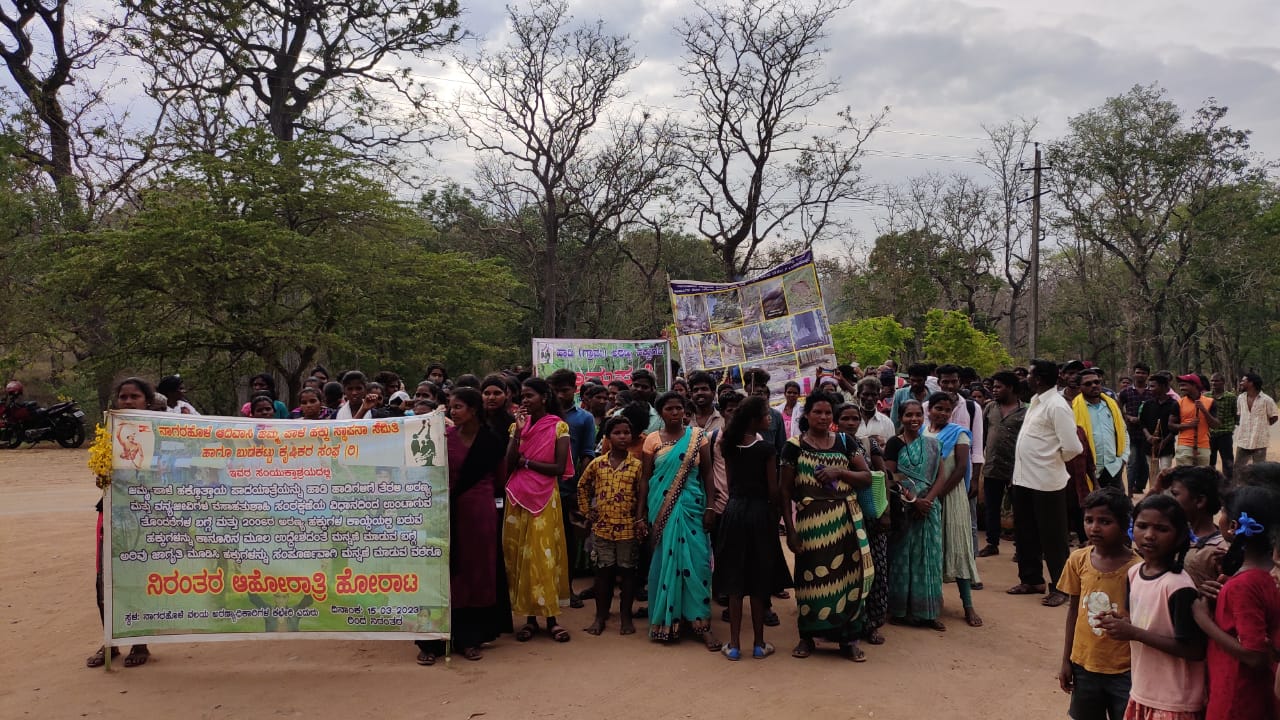
Community Network Against Protected Areas (CNAPA), a newly formed group of community networks consisting of people’s movements and groups resisting colonial conservation, recently organised a week-long padayatra of the indigenous communities of Nagarhole, Karnataka, to protest against the manner in which community lands and forests have been forcibly grabbed to create a tiger reserve.
The padyatra, in which Adivasi community leaders from nearly 12 protected areas and states participated, took place from 15th to 20th March 2023 and arrived in front of the Forest Department office of Nagarhole tiger reserve on 20th March 2023.
Following the week long event, CNAPA came up with a concept note criticising what it called “global capitalistic conservation model” based on “neo-colonial conservation practices of the national authorities”.
The mushrooming of PAs in India - from one, i.e. Jim Corbett National Park in 1936, to a vast network of 998 PAs is the stark result of this fortress idea of conservation. Furthermore, the proposed upscaling of PAs areas under Post-2020 Global Biodiversity Framework (30% by 2030 target) is another sinister move by the international conservation industry/lobby and the neoliberal Indian state to oust the indigenous people and local communities from their ancestral homelands in the name of conservation. This green colonisation, disguised as ‘biodiversity conservation’, which has been destroying the lives, livelihoods and ethno-ecological lifeworlds of thousands of communities through eviction, is now opting for heavy militarisation of the so-called PAs by unilaterally declaring these as ‘eco-sensitive zones’. The concept of PAs has today become a means to annex forest commons, agricultural lands, water sources, etc belonging to Adivasi/Tribal and other forest-dwelling communities. Thus this neo-colonial attitude of the government has had a devastating impact on the forest dwelling indigenous and other marginalised communities.
 Once forced out of their ancestral forests, the situation of such displaced communities across India is appalling with community elders dying within two-three years of separation from their original habitats. Most youth and men get addicted to alcohol and women are forced to work as daily wage labourers in construction sites, coffee/tea plantations or nearby towns for survival. For example, members of the Jenu Kuruba community from Bhogepura village, who were forcefully relocated, staged a protest last year as their access to their sacred spaces within the forests was being curtailed. In similar other instances. ‘relocated’ families living on the periphery of PAs like in Achanakmar (Chhattisgarh) or in settlements nearly 50-70 km away from their original lands like in Similiapal (Odisha) or Nagarhole (Karnataka) are restricted from collecting anything from inside PAs, including fuelwood. Communities who live adjacent to PAs and need access to those forests for livelihood are also stopped from going in. These violations have pushed forest communities into an abyss of injustice and exploitation.
The violations of people’s forest rights and right to community forest governance by the forest departmentconservation lobby-NGO cartel have a fourth constituent – the mining corporations. There is a significant overlap of tiger-bearing forests with mining concessions and the forest department has seldom filed objections to massive diversion of dense forest regions for different mining operations. But the forest bureaucracy, demonstrating unparalleled hypocrisy, has derailed or stalled constitutionally mandated recognition of CFR, CFRR and Habitat Rights of Adivasi/Tribal and other forest-dwelling communities in the name of protecting or conserving forest regions. It is important to underline that the relocation programmes run by NTCA are increasingly being financed from CAMPA money - money that mining companies deposit with the government in lieu of forest diversion, read destruction, required for their mining operations. Thus, the linkage between mining, deforestation, and eviction is part and parcel of the ‘fortress conservation model’ (parks without people) being pursued in India.
 This is also counterproductive for achieving the goal of biodiversity conservation as the capitalist conservation paradigm values wildlife merely as an economic resource of the state or leisurely objects of the rich, and not as a part of local peoples' folk cultures. As tourism projects start growing inside PAs, there has been simultaneous growth of dangerous eco-engineering practices like forest regrowth through the planting of alien tree species and the introduction of exotic alien animals like cheetahs. There has been no in-depth study or research into the impacts of these alien trees and animals on the local flora and fauna and culture. In fact, while this conservationtourism nexus caters to the luxurious needs of tourists, photographers, politicians, bureaucrats and celebrities; forest people are branded encroachers in their own land and forced out to faraway resettlement colonies. And any resistance to these projects by Adivasis and other forest-dwelling communities results in their criminalisation and erosion of their human and civil liberties through policing, militarisation and weaponisation of the whole forest, commons and conservation landscapes.
Major demands of CNAPA, for the communities across India who have been fighting against illegal imposition of protected areas on their lands:
Text:
India’s conservation policy has created long-standing conflicts of who is first - people or animals? The conservation policy and practice that forest departments, wildlife bureaucracy, urban conservationists and the majority of wildlife conservation NGOs pursue across India is rooted in the exclusionary idea of ‘fortress conservation’ - a colonial model of protecting wildlife through the creation of inviolate areas of ‘wilderness.’ Hence, this policy continues to wage capitalist, brahminical and patriarchal dominance over Adivasis/ Scheduled Tribes, pastoralists, fisherfolks and other forest-dwelling communities. This hegemonic model continues to visualise and propagate a dangerous myth that the relationship between wildlife and humans is separate and isolated, therefore forcing policy moves such as the creation of more and more protected areas (PAs), including wildlife sanctuaries, national parks and tiger reserves.The mushrooming of PAs in India - from one, i.e. Jim Corbett National Park in 1936, to a vast network of 998 PAs is the stark result of this fortress idea of conservation. Furthermore, the proposed upscaling of PAs areas under Post-2020 Global Biodiversity Framework (30% by 2030 target) is another sinister move by the international conservation industry/lobby and the neoliberal Indian state to oust the indigenous people and local communities from their ancestral homelands in the name of conservation. This green colonisation, disguised as ‘biodiversity conservation’, which has been destroying the lives, livelihoods and ethno-ecological lifeworlds of thousands of communities through eviction, is now opting for heavy militarisation of the so-called PAs by unilaterally declaring these as ‘eco-sensitive zones’. The concept of PAs has today become a means to annex forest commons, agricultural lands, water sources, etc belonging to Adivasi/Tribal and other forest-dwelling communities. Thus this neo-colonial attitude of the government has had a devastating impact on the forest dwelling indigenous and other marginalised communities.
Debunking Protected Areas
The declaration of these PAs has led to thousands of Adivasi/Tribal and other communities getting evicted and displaced ‘forcefully’ for a ‘relocation package’ which includes cash compensation and facilities like house, access to health and education infrastructure offered by the forest departments or National Tiger Conservation Authority (NTCA) under the government of India. Several communities have been protesting and resisting this for years and many community experiences have brought to light that the evictions are in no way ‘voluntary relocations’ but rather are ‘coerced and forced relocations.’ This imposition of PAs on communities is a violation of constitutional rights vested in Gram Sabhas and forest rights committees (FRCs). In many instances, the forest department, along with the wildlife and forest conservation lobby (NGOs and bureaucracy) have played a sinister role in harassing families and community leaders mobilizing against their community’s displacement. Many Adivasi/Tribal leaders have been slapped with false cases, many have been murdered and some tortured and forced to accept these relocation packages by the forest department and NTCA authorities. There is much evidence of how Adivasi/Tribal people are made scapegoats in wildlife poaching cases while organised syndicates of poachers have managed to escape scot-free with the help of politicians and the forest department.
Militarisation of Conservation with Impunity
The racist enterprise of conservation has always assumed the Adivasis and local communities as obstacles to wildlife conservation and their nature-based livelihoods and cultural practices have been demonised and treated as something that needs to be annihilated for the ‘nature’ to flourish. This romanticised understanding of nature or biodiversity is now resulting in local people being shot, implicated in false cases, beaten up and killed by park rangers, the Rhino Protection Force, the Special Tiger Protection Force in Kaziranga(Assam), Nagarhole (Karnataka), Similipal (Odisha) and Sundarbans over the years. Kaziranga National Park, which conservationists have often touted as a good-practices model for wildlife conservation in India, has blatantly militarised its park management strategies with its “shoot-at-sight” policy. This eco-fascism is in many ways similar to Salwa Judum (state-sponsored militia consisting of local Adivasi youths who received incentives and are given arms training by para-military) which India’s top court ruled illegal. This growing trend of militarized conservation approach has converted many wildlife reserves in India into war zones wherein local communities and Adivasi peoples are often caught in the crossfire between park managers and poachers/loggers.Community Forest Rights
Claims made by communities living inside PAs for community forest rights (CFR), community forest resource rights (CFRR) and Habitat Rights under the Forest Rights Act, 2006, have been deliberately ignored by authorities across India. This is glaring in cases where the villages had already been marked for relocation by the forest departments, national park managers and NTCA- the central body that funds and regulates Project Tiger in India. This is a serious violation of not just FRA but also of the PESA Act of 1996 applicable in Schedule Areas. According to NTCA official data, 56,257 families have been evicted in 751 villages across 50 tiger reserves in India since the inception of the tiger project in 1972 by the government of India (Source: Report of All India Forum for Forest Movements, Nov 2021). Out of these nearly 44,000 families (i.e., 2,20,000 people) have been evicted and displaced without receiving ‘relocation packages.’ And organisations like WWF, WCS, Conservation International, Wildlife Protection Society of India, Wildlife Trust of India, and Wildlife First, among many others, are complicit in pushing governments to continue imposing a conservation model in forest regions that not only exclude Adivasi/Tribal and other forest dwelling communities but undermines the constitutional rights guaranteed to these communities under FRA and PESA.The violations of people’s forest rights and right to community forest governance by the forest departmentconservation lobby-NGO cartel have a fourth constituent – the mining corporations. There is a significant overlap of tiger-bearing forests with mining concessions and the forest department has seldom filed objections to massive diversion of dense forest regions for different mining operations. But the forest bureaucracy, demonstrating unparalleled hypocrisy, has derailed or stalled constitutionally mandated recognition of CFR, CFRR and Habitat Rights of Adivasi/Tribal and other forest-dwelling communities in the name of protecting or conserving forest regions. It is important to underline that the relocation programmes run by NTCA are increasingly being financed from CAMPA money - money that mining companies deposit with the government in lieu of forest diversion, read destruction, required for their mining operations. Thus, the linkage between mining, deforestation, and eviction is part and parcel of the ‘fortress conservation model’ (parks without people) being pursued in India.
Conservation-Tourism Nexus
The opening up of national parks or Critical Tiger Habitat (CTH) for tourism calls into question the motives of coercing communities living inside forests to relocate out to other areas. This forced relocation is carried out, citing the designation of the area as CTH, when at the same time, tourism projects like eco-resorts, nature camps and safari trails are promoted, and housing complexes and forest rest houses are constructed inside CTHs for outsiders. It is clear that the conservation cartel is deliberately cutting the generations-old connection of Adivasis and other forest-dwelling communities from nature and wildlife through draconian laws like the Wildlife Protection Act and market-based programs like ecotourism is solely responsible for the erosion of local people's conservation ethos, knowledge systems and their customary resource management practices.
Community Ownership of Forests and Commons
Adivasis communities and other forest-dwelling peoples have challenged and resisted the militarised fortress conservation projects that have appropriated their habitats. In many forest regions inclusive and community-led and owned conservation initiatives have shown that colonial conservation models are violent and discriminatory and they do have alternatives. In several forest regions, people’s movements have challenged the cartel of forest departments, wildlife NGOs, conservationists and corporations by exposing their collaborative exploitation of various natural resources and black-marketing of wildlife parts. Nagarhole in Karnataka is one such forest region where community ownership of forests and commons by the Jenu Kurubas, Beta Kurubas, Yaravas and other forest-dwelling communities and their collective movement against the cartel has been happening despite innumerable instances of eviction, abuse, beating, slapping of false cases, etc on its community leaders. Every year the Nagarhole communities not only resist attempts at evicting them, but also those evicted earlier make attempts to go back to their ancestral villages for reclaiming their right to live inside Nagarhole in peaceful coexistence with wildlife, forests and commons, debunking the idea of protected areas.Major demands of CNAPA, for the communities across India who have been fighting against illegal imposition of protected areas on their lands:
- We wholeheartedly support and stand with the adivasi communities of Nagarhole and their protest against eviction, militarization, harassment.
- Karnataka government should take immediate cognizance of the people's demands and stop evicting people and harassing them in the name of conservation.
- The Chief Minister, forest minister and tribal welfare minister of Karnataka and all other states like Odisha, Tamilnadu, Kerala and Assam should immediately go before the people and listen to their concerns before the upcoming election.
- Oppressive conservation NGOs like WWF, WCS, IUCN, WTI, IFAW should stop their anti-people activities across India.
- FRA must be followed in true spirit and the entire conservation regime should rest in the hands of communities.
- The militarization of the forest department should stop immediately. Demand for a judicial commission to enquire into all the atrocities and extra-judicial persecutions that happened in protected areas across India.
- Adivasi and forest-dwelling communities deserve the right to self-determination and complete sovereignty over their land and forests. Eviction and the so-called voluntary resettlement from protected areas must stop and its big lie that it is being done voluntarily.
- Extractive tourism industry like safari should stop immediately. Adivasi people's land and forest are not objects of recreation and luxury.
- Land grabbing happened in the past for private coffee estates, tea gardens, resorts etc must be inquired into and adivasi people living in and around protected areas must be given back their ancestral land
Comments
Post a Comment
NOTE: Hateful, abusive comments won't be published. -- Editor