
BBC documentary row: Delhi varsity students detained for holding protest meeting

By A Representative

On March 24, even as commemorating the martyrs Bhagat Singh, Sukhdev and Rajguru on their 92nd martyrdom day, several left-wing students’ organisations -- bsCEM, BASF, Fraternity Movement, SIO, AISA and SFI -- held a protest against the recent action of debarring several students for organising the screening of the banned BBC documentary on Prime Minister Narendra Modi's role in Gujarat riots.
The meeting was organised under the banner of the Bhagat Singh Chhatra Ekta Manch. 
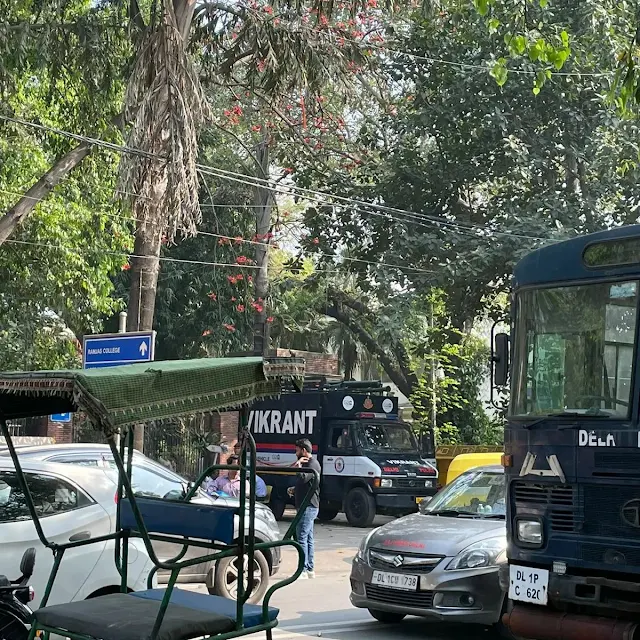
In no time, claimed student sources, approximately 100 guards and 100 Delhi police force, including 50 CRPF men, that marched into Delhi University.
Students were manhandled and detained, the sources said. Women and queer students were attacked to the extend that their clothes were pulled and derogatory statements were made. Women guards stated that “girls like you deserve to be treated as such.”
The students’ demands included:
  • Take back the arbitrary notice of debarring students.
  • Take back the arbitrary notice asking apology for democratic activity.
  • Stop inflicting FIRs on the students.
  • Allot auditorium in the campus for democratic programs to students.
  • Apologies to the students for their mental harassment. And we will struggle until the university authority fulfills our demands.

Comments

TRENDING

The soundtrack of resistance: How 'Sada Sada Ya Nabi' is fueling the Iran war

​ By Syed Ali Mujtaba*  ​The Persian track “ Sada Sada Ya Nabi ye ” by Hossein Sotoodeh has taken the world by storm. This viral media has cut across linguistic barriers to achieve cult status, reaching over 10 million views. The electrifying music and passionate rendition by the Iranian singer have resonated across the globe, particularly as the high-intensity military conflict involving Iran entered its second month in March 2026.

Kolkata dialogue flags policy and finance deficit in wetland sustainability

By A Representative   Wetlands were the focus of India–Germany climate talks in Kolkata, where experts from government, business, and civil society stressed both their ecological importance and the urgent need for stronger conservation frameworks. 

Beyond Lata: How Asha Bhosle redefined the female voice with her underrated versatility

By Vidya Bhushan Rawat*  The news of iconic Asha Bhosle’s ‘untimely’ demise has shocked music lovers across the country. Asha Tai was 92 years young. Normally, people celebrate a passing at this age, but Asha Bhosle—much like another legend, Dev Anand—never made us feel she was growing old. She was perhaps the most versatile artist in Bombay cinema. Hailing from a family devoted to music, Asha’s journey to success and fame was not easy. Her elder sister, Lata Mangeshkar, had already become the voice of women in cinema, and most contemporaries like Shamshad Begum, Suraiya, and Noor Jehan had slowly faded into oblivion. Frankly, there was no second or third to Lata Mangeshkar; she became the first—and perhaps the only—choice for music directors and all those who mattered in filmmaking. Asha started her musical journey at age 10 with a Marathi film, but her first break in Hindustani cinema came with the film "Chunariya" (1948). Though she was not the first choice of ...

Maoist activity in India: Weakening structures, 'shifts' in leadership, strategy and ideology

By Harsh Thakor*  Recent statements by government representatives have suggested that Maoism in India has been effectively eliminated, citing the weakening of central leadership and intensified security operations. These claims follow sustained counterinsurgency efforts across key regions, including central and eastern India. However, available information from security agencies and independent observers indicates that while the organizational structure of the CPI (Maoist) has been significantly disrupted, elements of the movement remain active. Reports acknowledge the continued presence of cadres in certain forested regions such as Bastar and parts of Dandakaranya, alongside smaller, decentralized units adapting their operational strategies.

'Fraudulent': Ex-civil servants urge President to halt Odisha tribal land dispossession

By A Representative   A collective of 81 retired civil servants from the Constitutional Conduct Group has written to the President of India expressing alarm over what they describe as the wrongful dispossession of tribal lands in Odisha’s Rayagada district. The letter, dated April 19, 2026, highlights violent clashes in Kantamal village where police personnel reportedly injured over 70 tribal residents attempting to protect their community rights. 

From Manesar to Noida: Workers take to streets for bread, media looks away

By Sunil Kumar*   Across several states in India, a workers’ movement is gathering momentum. This is not a movement born of luxury or ambition, nor a demand for power-sharing within the state. At its core lies a stark and basic plea: the right to survive with dignity—adequate food, and wages sufficient to afford it.

Dhandhuka violence: Gujarat minority group seeks judicial action, cites targeted arson

By A Representative   The Minority Coordination Committee (MCC) Gujarat has written to the Director General of Police seeking judicial action in connection with recent violence in Dhandhuka town of Ahmedabad district, alleging targeted attacks on properties belonging to members of the Muslim community following a fatal altercation between two bike riders on April 18.

Midnight weeping: The sociology of tragic vision in Badri Narayan’s poetry

By Ravi Ranjan*  Badri Narayan, a distinguished Hindi poet and social scientist, occupies a unique position in contemporary Indian intellectual life by bridging the worlds of creative literature and critical social inquiry. His poetic journey began significantly with the 1993 collection 'Saca Sune Hue Kaï Dina Hue' (Truth Heard Many Days Ago). As a social historian and cultural anthropologist, Narayan pioneered a methodological shift away from elite archives toward the oral traditions and folk myths of marginalized communities. He eventually legitimized "folk-ethnography" as a rigorous academic discipline during his tenure as Director of the G.B. Pant Social Science Institute.  

Why link women’s reservation to delimitation? The unspoken political calculus

By Vikas Meshram*  April 16, 2026, is likely to be recorded as a special day in the history of Indian democracy. In a three-day special session of Parliament, the central government is set to introduce a comprehensive package of three historic bills: the Constitution (131st Amendment) Bill, 2026; the Delimitation Bill, 2026; and the Union Territories Laws (Amendment) Bill, 2026. The stated purpose of all three is the same: to implement the Nari Shakti Vandan Adhiniyam (106th Constitutional Amendment) passed in 2023. However, the political intent concealed behind these measures — and their impact on the federal balance — is far more profound. It is absolutely essential to understand this.