
By Sanjay Singh
The International Literacy Day, September 8, saw the culmination of a 23-day-long India Gets Reading Campaign during the educational crisis brought on by the pandemic. With its outbreak in India, schools screeched to a halt; there was no time to think how to tweak the school curriculum or how to make it accessible under the circumstances.
Going with the maxim “never waste a crisis and build back stronger” Room to Read used the challenging times to bring back the focus on literacy and reading through the Reading Campaign 2020. It aims to sustain reading habits among primary school students during unpredictable times through various means.
The reading campaign ended with an international webinar, the highlight of which was a key note address by Dr Maryanne Wolf, an expert on literacy in a digital culture. The The University of California, Los Angeles distinguished visiting professor of education said, “My ideal world does not include total digital online learning for early grade. We are all uncertain what is best for our children. I know many people will be forced to go online for the whole time during Covid, I understand that, but that should not be the In Thing. We don’t want In Thing in education. We want education based on research. That gives us the best chance for the best learning.”

Dr Wolf emphasized on the urgent need of a new pedagogy for early grade language learning in the new normal digital age as the pandemic has wreaked havoc on the education system. Talking about the consequences of digital online education in early grades, she said, “If reading largely changes to adapt to digital characteristics: we will reduce deep reading, with less time to grasp complexity, to understand another’s feelings, to perceive beauty, and to appreciate our cultural heritage. That I why we need to have biliterate approach to early childhood education that means combination of digital and print medium.”
Launched for the first time in 2019, the Reading Campaign was a massive success with its Read-a-Thon witnessing over 10 lakh children spending one hour reading time together with their teachers and families – a feat we are determined to outdo in 2020.
During the pandemic, educationists saw pedagogy compromised due to the absence of face-to-face classroom. Additionally, indirect tutoring also posed a new set of challenges due to the unavailability of digitalized material. The online classes and dissemination of digital learning material for private schools looked like a seamless transition but government school struggled, especially those in far-flung areas where Internet and mobile connectivity posed a daunting challenge for government and NGOs.
Room to Read works in the field of early grade education closely with government schools in nine Indian states viz. Delhi, Andhra Pradesh, Telangana, Madhya Pradesh, Maharashtra, Uttarakhand, Rajasthan, Chhattisgarh.

Sourav Banerjee, country director of Room to Read, talked about various means to reach out children during campaign, “In the short to medium term, there will be a need for home-based learning, and we need to think of ways to develop the home as a learning space. The role of parents will have to be clearly defined. Room to Read is working closely with teachers and academic coordinators to reach out to children and parents with live lessons and worksheets.”
He added, “Learning content is being delivered through local cable TV network, Community Radio, IVR, and apps. The plan is working well and the response of the children as well as parents is very encouraging in our project areas.”
During the pandemic, where physical access to libraries was not possible, Room to Read published its books online making it available to children through various digital platforms. The Flip books were a big hit with the children and disseminated through I-Leap portal of Madhya Pradesh Government.
“The idea is to encourage children to read. It boots creativity as they learn new words and visual images are formed in their brains as they read. Physical books including those with poems, riddles and stories are sent to the children on their parents’ smart phones on Sundays and they can read it at their own pace throughout the week as part of our joyful learning programme. Some books have also been converted into local languages for children of the tribal districts,” said Lokesh Kumar Jatav, commissioner, Rajya Shiksha Kendra, Madhya Pradesh.
Interactive Voice Response (IVR) was another platform in operation in three states, Chhattisgarh, Madhya Pradesh, and Uttar Pradesh. IVR service, available through a toll-free number (1800 572 1710), enables young children to listen to new stories every day free of cost. It can be accessed with the cheapest feature phone in the market and does not require smart phone and Internet connectivity.
Launching the IVR service, Uttar Pradesh Minister for Basic Education Dr Satish Chandra Dwivedi stated, “The initiative of IVR calls is a great opportunity for children as well as the community. I am sure children will enjoy it surely, I myself will listen to it.”
The minister also lauded Room to Read India for the effort saying, “Room to Read has always set up something innovative be it the resources given to children in the Libraries or E- content.” The combined calls in all three states has crossed 60,000 mark.
Room to Read is a leader in the field of early grade education and has published 1,600 titles and distributed 26 million children’s books in 42 languages. Room to Read joined hands with Google to publish these books and related resources on an online platform called the “Literacy Cloud”.
Sourav Banerjee explains, “The Literacy Cloud in an online repository of Room to Read’s children’s books from all over the world. These colourful books are arranged as per genres and reading levels and there’s a book to suit the taste and reading competency of every child. Apart from the books, the Cloud also has videos and other resources for children, teachers and even authors and illustrators.”
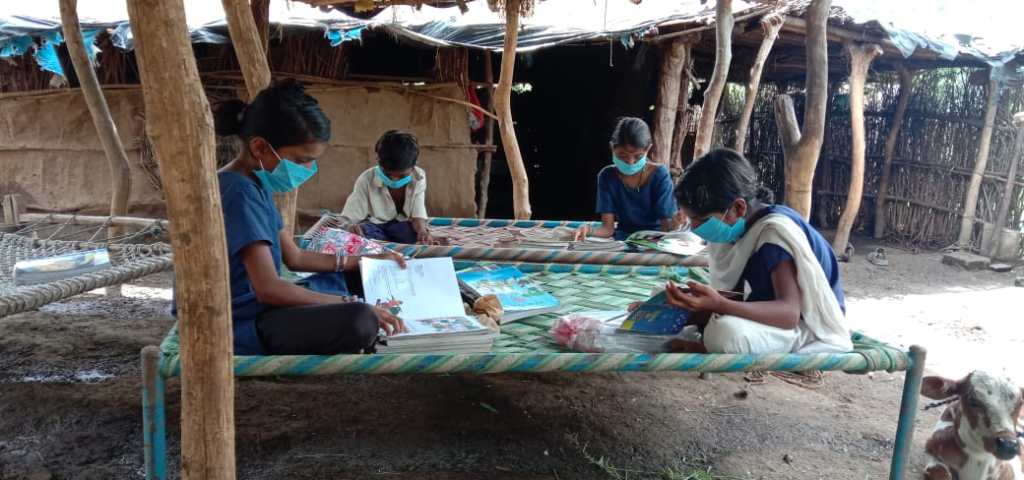
To cater to the children in far flung areas in Uttarakhand where mobile and Internet connectivity is an issue, a van with books constituting a mobile library travelled across the districts of Bageshwar and Rudraprayag during the reading campaign. The van attracted children and adults alike. In Bageshwar district, the books were eagerly consumed by all. Of note was a 75-year-old man who read six books at a go saying he had never seen such interesting and colourful books in his life.

His six year-old granddaughter too eagerly listened to the stories narrated by her mother in the same school premises where the van had set up the mobile library. “The mobile library was conceptualized as one of the means to reach out to remote areas, and encourage children to read by exposing them to good quality reading material,” says Sourav Banerjee, Country Director of Room to Read.
Covid-19 has changed our lives in innumerable ways. The early primary grades, where children are in their foundational years, will probably be the last to come back to school. The children bearing the highest brunt of the pandemic are the ones who need access to high quality education the most. During this crisis, academicians and government will have to work harder than ever to reach the unreachable.
Comments