
Gujarat Dalit activist sends 25 kg plastic "responsible" for cow slaughter to chief minister, insists, punish the guilty

Plastic from cow womb for Gujarat CM on display
at Surendranagar district collector's office
By A Representative
Gujarat's grassroots Dalit rights activist Natubhai Parmar -- who created a flutter by dumping a tractor full of dead cows in front of Surendranagar district office in 2016 following cow vigilantes beating up Dalits belonging to the Rohit community in Una on July 11, 2016 on suspicion of cow slaughter -- has stunned the state administration yet again. Now he has sent across 25 kg of plastic recovered from the womb of a cow to Gujarat chief minister Vijay Rupani to tell him: Plastics are the main cause of cow slaughter.
The cow vigilantes tied up four Dalit boys on an SUV with a chain, and paraded them for about a kilometre up to a local police station, caning them up all the way. The boys were beaten up on suspicion cow slaughter, even as their plea that they were skinning a dead cow, their hereditary occupation, was ignored. After a video went viral showing the incident, protests broken out across Gujarat, with Rohits pledging they would not skin cows any more.
Parmar, an activist with Navsarjan Trust, Gujarat's biggest Dalit rights organization, took this opportunity to tell the administration that Rohits were being forced to do this caste-based occupation, of skinning cows, and would not do it any more because of repeated harassment by the administration and vigilantes, which blamed them for slaughtering cows.
The cow protection exhibition 
A year ago, on May 10, 2017, Parmar led a Dalit rally in Surendranagar, highlighting that cows dead because the ate plastic. A tractor carrying tens of kilos of plastic taken out of dead cows' womb accompanied the rally, insisting, those responsible for failing to take care of cows, setting them free as stray cattle, forcing them to eat leftovers on roadsides mixed with plastic, should be held responsible for cow slaughter.
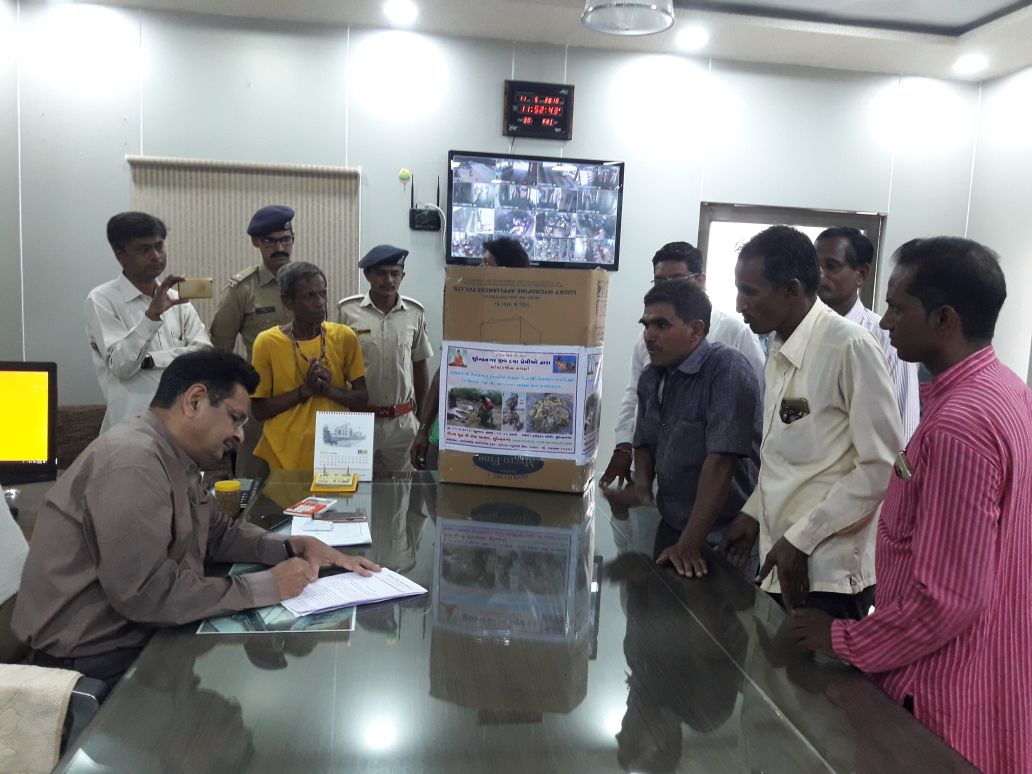
Marking the first anniversary of the rally, on Friday, Parmar organized another rally, taking a 25 kg box, plastic taken out from a dead cow after skinning the animal, to be hands over to the chief minister. The box and a memorandum addressed to the chief minister were given to the district collector, who was told, even though the government claims to revere it as a holy animal, it does not take its proper care.
He told Counterview, "I was told I wouldn't be able to hand over the plastic to the chief minister, who is visiting here for a function. So we decided to hand over this to the district collector, meant as a gift to the chief minister."
Memorandum and plastic being handed over
to district collector
The 12-point memorandum, a copy of which he gave to Counterview, said, the main reason why cows die is because of the state policy which led to disappearance of grazing land across Gujarat. While cow sheds or panjrapols were being closed down, the existing ones do not take care of unproductive cows, hence the animal is forced to go astray, eating whatever it gets on streets, including food mixed with plastics.
The memorandum to the chief minister said, "The government should x-ray dead cows to find out the reason of their death. If plastic is found, the responsibility of setting the cows go astray should be fixed, and those found guilty should be tried under the the state's law which seeks to punish those slaughtering cow."
The memorandum demands taking back grazing land handed over to industrialists, setting up special fodder ration shops for cows, setting up of special veterinary hospital in each Gujarat district by operating upon live cows and taking out out plastic from their womb, a complete ban on plastics, and so on.
Parmar's move follows a unique permanent exhibition on cow protection he has organized on the road leading to Wadhvan town off Ahmedabad-Gandhidham highway. The exhibit is an installation of sorts highlighted by a cow prototype with its stomach exposed, intestines choked with plastic. At the exhibit, swathes of blood and fluid are soaked in plastic, removed by kilos from dead bovines during cow skinning, all of it hung on bamboo rods.
Comments

TRENDING

Academics urge Azim Premji University to drop FIR against Student Reading Circle

  By A Representative   A group of academics and civil society members has issued an open letter to the leadership of Azim Premji University expressing concern over the filing of a police complaint that led to an FIR against a student-run reading circle following a recent incident of violence on campus. The signatories state that they hold the university in high regard for its commitment to constitutional values, critical inquiry and ethical public engagement, and argue that it is precisely because of this reputation that the present development is troubling.

Was Netaji forced to alter face, die in obscurity in USSR in 1975? Was he so meek?

  By Rajiv Shah   This should sound almost hilarious. Not only did Subhas Chandra Bose not die in a plane crash in Taipei, nor was he the mysterious Gumnami Baba who reportedly passed away on 16 September 1985 in Ayodhya, but we are now told that he actually died in 1975—date unknown—“in oblivion” somewhere in the former Soviet Union. Which city? Moscow? No one seems to know.

UAPA action against Telangana activist: Criminalising legitimate democratic activity?

By A Representative   The National Investigation Agency's Hyderabad branch has issued notices to more than ten individuals in Telangana in connection with FIR No. RC-04/2025. Those served include activists, former student leaders, civil rights advocates, poets, writers, retired schoolteachers, and local leaders associated with the Communist Party of India (CPI) and the Indian National Congress. 

The ultimate all-time ODI XI: A personal selection of icons across eras

By Harsh Thakor* This is my all-time best XI chosen for ODI (One Day International) cricket:  1. Adam Gilchrist (W) – The absolute master blaster who could create the impact of exploding gunpowder with his electrifying strokeplay. No batsman was more intimidating in his era. Often his knocks decided the fate of games as though the result were premeditated. He escalated batting strike rates to surreal realms.

Aligning too closely with U.S., allies, India’s silence on IRIS Dena raises troubling questions

By Vidya Bhushan Rawat*  The reported sinking of the Iranian ship IRIS Dena in the Indian Ocean near Sri Lanka raises troubling questions about international norms and the credibility of the so-called rule-based order. If indeed the vessel was attacked by the American Navy while returning from a joint exercise in Visakhapatnam, it would represent a serious breach of trust and a violation of the principles that govern such cooperative engagements. Warships participating in these exercises are generally not armed for combat; they are meant to symbolize solidarity and friendship. The incident, therefore, is not only shocking but also deeply ironic.

Swami Vivekananda's views on caste and sexuality were 'painfully' regressive

By Bhaskar Sur* Swami Vivekananda now belongs more to the modern Hindu mythology than reality. It makes a daunting job to discover the real human being who knew unemployment, humiliation of losing a teaching job for 'incompetence', longed in vain for the bliss of a happy conjugal life only to suffer the consequent frustration.

The kitchen as prison: A feminist elegy for domestic slavery

By Garima Srivastava* Kumar Ambuj stands as one of the most incisive voices in contemporary Hindi poetry. His work, stripped of ornamentation, speaks directly to the lived realities of India’s marginalized—women, the rural poor, and those crushed under invisible forms of violence. His celebrated poem “Women Who Cook” (Khānā Banātī Striyāṃ) is not merely about food preparation; it is a searing indictment of patriarchal domestic structures that reduce women’s existence to endless, unpaid labour.

Asbestos contamination in children’s products highlights global oversight gaps

By A Representative   A commentary published by the International Ban Asbestos Secretariat (IBAS) has drawn attention to the challenges governments face in responding effectively to global public-health risks. In an article written by Laurie Kazan-Allen and published on March 5, 2026, the author examines how the discovery of asbestos contamination in children’s play products has raised questions about regulatory oversight and international product safety. The article opens by reflecting on lessons from the COVID-19 pandemic, noting that governments in several countries were slow to respond to early warning signs of the crisis. Referring to the experience of the United Kingdom, the author writes that delays in implementing protective measures contributed to “232,112 recorded deaths and over a million people suffering from long Covid.” The commentary uses this example to illustrate what it describes as the dangers of underestimating emerging threats. Attention then turns...

India’s foreign policy at crossroads: Cost of silence in the face of aggression

By Venkatesh Narayanan, Sandeep Pandey  The widely anticipated yet unprovoked attack on Iran on March 1 by the United States and Israel has drawn sharp criticism from several quarters around the world. Reports indicate that the strikes have resulted in significant civilian casualties, including 165 elementary school girls, 20 female volleyball players, and many other civilians.