
What lay behind collapse of the Maoist dream in China and how it impacted world

By Harsh Thakor* 
No third world leader in the last century can be said to have shaped the history of a nation to the extent of Mao Zedong did in China. One who tried to elevate Marxism-Leninism to a higher stage, taking massline of Leninism to unexplored regions, even today his writings are a guiding force in many third world countries where globalisation is at the helm.
Politically Mao's main contribution is considered to be formulation of a new military theory of protracted people's war. He also floated the theory of new democratic revolution and continuous revolution under the dictatorship of the proletariat, something he experimented on the ground by ushering in the Cultural Revolution in the late 1960s and the first half of 1970s.
In his writings, in 1942, Mao came up with a new strategy for people of semi-colonial countries, calling upon the peasants in the countryside to encircle the cities. He said that the peasantry was the main force and the countryside was the main area in revolutions in the third world countries. With the skill of a surgeon he integrated the functioning of the Communist Party of China (CPC) with the Red Army.
Mao’s leadership was instrumental in CPC leading the 1935 Long March from Kiangsi to Yenan, the greatest military achievement till then in history. In the 1940s in Yenan he encouraged criticism from below, which became the basis of his "let hundred flowers bloom" campaign of 1950s, when he invited even rightist intellectuals to assert their voice.
One of Mao's contributions was undertaking thought transformation in order to reform landlords, even rightist intellectuals. However, he would strongly refute feudal ideas or customs, which he thought were very strong in the rural areas, including among the soldiers. Unlike Stalin, Mao did not execute enemies or opposition in purges, but galvanised masses to challenge those whom he identified as "capitalist roaders", especially during the Cultural Revolution.
China under Mao from 1949 to 1976 is well documented in the writings of Edgar Snow, William Hinton, Joan Robinson, Felix Greene, Maria Antonietta Macciocchi, Rewi Alley and Charles Bettelheim who visited China to discover what lay behind the claims of its magical strides. These writings are critical of the manner in which the Western media interpreted China under Mao.
During the Cultural Revolution, Mao not just experimented with building a socialist society by integrating manual and mental labour, but went so far as to send technician to work in factories, intellectuals to toil in fields, and students to "learn" from peasants. Commodities were made affordable, unemployment was eradicated, and price rise was controlled. People's Liberation Army personnel were made to aid workers and peasants in their labour. If workers "controlled" factories, peasants' revolutionary committees exercised rights over rural areas.
Under Mao, between 1949 and 1976, China challenged the hegemony of the two superpowers, America and Russia, though it is blamed for the 1962 war with India and its role during the Vietnamese war against America. It refused to condemn the assassination of Salvador Allende in Chile, and placed more emphasis on confronting what it called Soviet social imperialism than US imperialism.
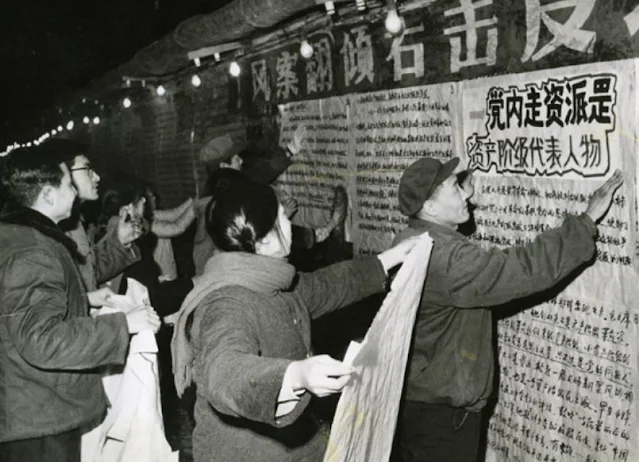
Left sectarian tendencies were predominant during the Cultural Revolution and excessive power was awarded to the military. Excesses were committed on intellectuals, writers and artists. Those who were termed revisionists were meted out with very harsh treatment. Mass organisations were exclusively dependent the CPC, which under Mao exhibited Stalinist tendencies. This could be because the old thinking process of Confucian tradition was strongly embedded in the Chinese culture.
After Mao's death China reverted his policies, and while the country's economy made phenomenal achievement, it also created billionaires. Today many CPC members are millionaires, and corruption has reached a scale on par with countries like India. Workers are subjugated to misery in sweat shops and denied adequate wages. Special economic zones were introduced, healthcare and education were privatised, and at an international level the CPC abandoned all support to national liberation struggles.
Today China has turned into a major imperialist country which is a contender for world hegemony over markets and pursues expansionist military policies. It has exhibited considerable nation chauvinism. A free market economy is in place. CPC cadres are made to study the priority leaders like Liu Shao Chi, Lin Biao and later Deng Xiaoping placed on the development of productive forces. They all advocated ‘It does not matter whether the cat is white or black as long as it catches the mice.’ Deng Xiapong raised the slogan, ‘It is glorious to get rich.’
The CPC has left no stone unturned to suppress any Maoist resurgence in China. It has supressed or censored many a writing of the Cultural Revolution period. It has persecuted the supporters of Mao. Workers' strikes are brutally suppressed. Consumerism has reached a crescendo.
China displayed territorial expansionist policy in Phillipines recently. The only plus point is it confronted the US hegemony and supported Hugo Chavez in Venezuela, and condemned Israeli aggression. Its planning and organisation in handling the Covid crisis too deserves praise.
---
*Freelance journalist based in Mumbai

Comments

TRENDING

Plastic burning in homes threatens food, water and air across Global South: Study

By Jag Jivan  In a groundbreaking  study  spanning 26 countries across the Global South , researchers have uncovered the widespread and concerning practice of households burning plastic waste as a fuel for cooking, heating, and other domestic needs. The research, published in Nature Communications , reveals that this hazardous method of managing both waste and energy poverty is driven by systemic failures in municipal services and the unaffordability of clean alternatives, posing severe risks to human health and the environment.

From protest to proof: Why civil society must rethink environmental resistance

By Shankar Sharma*  As concerned environmentalists and informed citizens, many of us share deep unease about the way environmental governance in our country is being managed—or mismanaged. Our complaints range across sectors and regions, and most of them are legitimate. Yet a hard question confronts us: are complaints, by themselves, effective? Experience suggests they are not.

Economic superpower’s social failure? Inequality, malnutrition and crisis of India's democracy

By Vikas Meshram  India may be celebrated as one of the world’s fastest-growing economies, but a closer look at who benefits from that growth tells a starkly different story. The recently released World Inequality Report 2026 lays bare a country sharply divided by wealth, privilege and power. According to the report, nearly 65 percent of India’s total wealth is owned by the richest 10 percent of its population, while the bottom half of the country controls barely 6.4 percent. The top one percent—around 14 million people—holds more than 40 percent, the highest concentration since 1961. Meanwhile, the female labour force participation rate is a dismal 15.7 percent.

Kolkata event marks 100 years since first Communist conference in India

By Harsh Thakor*   A public assembly was held in Kolkata on December 24, 2025, to mark the centenary of the First Communist Conference in India , originally convened in Kanpur from December 26 to 28, 1925. The programme was organised by CPI (ML) New Democracy at Subodh Mallik Square on Lenin Sarani. According to the organisers, around 2,000 people attended the assembly.

From colonial mercantilism to Hindutva: New book on the making of power in Gujarat

By Rajiv Shah  Professor Ghanshyam Shah ’s latest book, “ Caste-Class Hegemony and State Power: A Study of Gujarat Politics ”, published by Routledge , is penned by one of Gujarat ’s most respected chroniclers, drawing on decades of fieldwork in the state. It seeks to dissect how caste and class factors overlap to perpetuate the hegemony of upper strata in an ostensibly democratic polity. The book probes the dominance of two main political parties in Gujarat—the Indian National Congress and the BJP—arguing that both have sustained capitalist growth while reinforcing Brahmanic hierarchies.

Urgent need to study cause of large number of natural deaths in Gulf countries

By Venkatesh Nayak* According to data tabled in Parliament in April 2018, there are 87.76 lakh (8.77 million) Indians in six Gulf countries, namely Bahrain, Kuwait, Oman, Qatar, Saudi Arabia and the United Arab Emirates (UAE). While replying to an Unstarred Question (#6091) raised in the Lok Sabha, the Union Minister of State for External Affairs said, during the first half of this financial year alone (between April-September 2018), blue-collared Indian workers in these countries had remitted USD 33.47 Billion back home. Not much is known about the human cost of such earnings which swell up the country’s forex reserves quietly. My recent RTI intervention and research of proceedings in Parliament has revealed that between 2012 and mid-2018 more than 24,570 Indian Workers died in these Gulf countries. This works out to an average of more than 10 deaths per day. For every US$ 1 Billion they remitted to India during the same period there were at least 117 deaths of Indian Workers in Gulf ...

The greatest threat to our food system: The aggressive push for GM crops

By Bharat Dogra  Thanks to the courageous resistance of several leading scientists who continue to speak the truth despite increasing pressures from the powerful GM crop and GM food lobby , the many-sided and in some contexts irreversible environmental and health impacts of GM foods and crops, as well as the highly disruptive effects of this technology on farmers, are widely known today. 

History, culture and literature of Fatehpur, UP, from where Maulana Hasrat Mohani hailed

By Vidya Bhushan Rawat*  Maulana Hasrat Mohani was a member of the Constituent Assembly and an extremely important leader of our freedom movement. Born in Unnao district of Uttar Pradesh, Hasrat Mohani's relationship with nearby district of Fatehpur is interesting and not explored much by biographers and historians. Dr Mohammad Ismail Azad Fatehpuri has written a book on Maulana Hasrat Mohani and Fatehpur. The book is in Urdu.  He has just come out with another important book, 'Hindi kee Pratham Rachna: Chandayan' authored by Mulla Daud Dalmai.' During my recent visit to Fatehpur town, I had an opportunity to meet Dr Mohammad Ismail Azad Fatehpuri and recorded a conversation with him on issues of history, culture and literature of Fatehpur. Sharing this conversation here with you. Kindly click this link. --- *Human rights defender. Facebook https://www.facebook.com/vbrawat , X @freetohumanity, Skype @vbrawat

Transgender Bill testimony of Govt of India's ‘contempt’ for marginalized community

Counterview Desk India’s civil society network, National Alliance of People’s Movements (NAPM)* has said that the controversial transgender Bill, passed in the Rajya Sabha on November 26, which happened to be the 70th anniversary of the Indian Constitution, is a reflection on the way the Government of India looks at the marginalized community with utter contempt.