Hate crime: 'Act against BJP, RSS leaders, repeal of CAA-NPR-NRC programme'

Counterview Desk 

In a letter to President Ram Nath Kovind, about 1200+ citizens ranging from farmers to housemakers to academics, retired bureaucrats and senior citizens to civil society activists, doctors and lawyers to journalists, have endorsed a statement seeking his intervention for the repeal of the Citizens Amendment Act-National Population Register-National Register of Citizens (CAA-NPR-NRC) immediately.
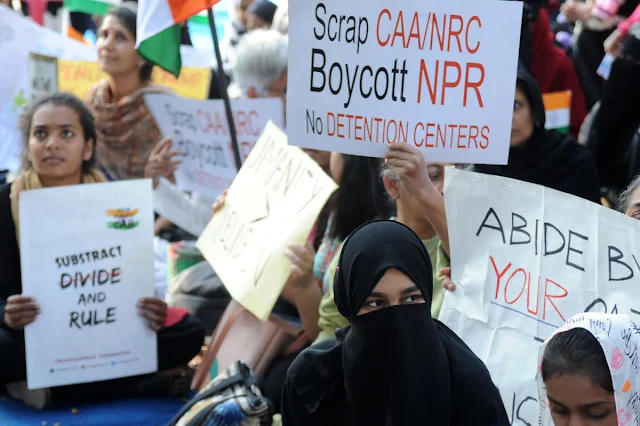
Celebrating two years of the Shaheen Bagh protests which rocked Delhi in 2019, in an open letter, they said, "The CAA-NPR-NRC project of the government of India has been deeply problematic since it was first proposed and rushed through Parliament."
"In fact", the letter said, "Starting in the Shaheen Bagh area of New Delhi in late 2019, protests against it rose spontaneously in over 100 neighbourhood sites across the nation, and indeed the globe. These protests articulated the Constitutional right of every citizen of India to be treated as an equal irrespective of caste, gender, religion, region, ethnicity, etc."
Stating that the protests were "withdrawn or forcibly shut down following the Coronavirus pandemic", it noted, "The peoples’ demand for the withdrawal has remained as steadfast as ever", pointing out, "Citizens across caste, religion, creed and gender" have again come together at "more than 25 sites across the country to reiterate our plea for the repeal of CAA-NPR-NRC" with memorandums already submitted to many district and state level officials across the country "to this effect as well."

Text:

We, citizens from villages, towns and cities across the country write to you with regard to the Citizenship Amendment Act 2019 and the NPR-NRC project linked to it.
We write to you to register our strong opposition to the Citizenship Amendment Act 2019 and demand its repeal. This Act threatens the very foundation of our Constitution by redefining citizenship on the basis of religion. It violates Article 14 of our Constitution that accords that no person residing in India will be discriminated against on the basis of religion, caste, gender etc. 
Nationwide implementation of a project like NRC that would demand its citizens to submit elaborate documentation that a large majority of the working poor population of the country do not possess, would only be an instrument of harassment and exclusion for stripping citizens from citizenship rights. It is clear to us that the combination of CAA-NPR-NRC is being used to target religious minorities in our country and to further communalise and polarise our society on religious lines.
All through the months after the passing of the CAA in Dec '19 until the national lockdown imposed due to Covid-19 on 24th March 2020, citizens organised peaceful demonstrations and sit-in protests across the country to register their democratic dissent against this law. However, our demands still remain unaddressed. 
Instead, many who exercised their right to democratic dissent have been framed in fabricated cases and even anti-terror laws. Most still continue to languish behind bars facing a harsh pre-trial incarceration. In a dubious and false narrative, peaceful protestors who raised their voices against this law, particularly from the Muslim community, have been labeled and targetted by the police as 'rioters', 'conspirators' and 'terrorists'.
It is the responsibility of a democratic government to listen to its citizens and engage with voices of dissent. What we have instead encountered with regard to the movement demanding the repeal of CAA is state repression and violence from the ruling government. We once again come together to put forward the following demands to you:
  1. The repeal of CAA-NPR-NRC and Unlawful Activities Prevention Act (UAPA).
  2. Enquiry by a sitting Supreme Court judge into the Delhi violence ‘20.
  3. The immediate and unconditional release of all anti-CAA-NPR-NRC protestors and withdrawal of all false cases against them
  4. Justice and rehabilitation for all victims of the Delhi riots ‘20
  5. Action against the BJP politicians and RSS workers responsible for hate crimes.
---
Click here for prominent signatories

Comments

TRENDING

Sergei Vasilyevich Gerasimov, the artist who survived Stalin's cultural purges

By Harsh Thakor*  Sergei Vasilyevich Gerasimov (September 14, 1885 – April 20, 1964) was a Soviet artist, professor, academician, and teacher. His work was posthumously awarded the Lenin Prize, the highest artistic honour of the USSR. His paintings traced the development of socialist realism in the visual arts while retaining qualities drawn from impressionism. Gerasimov reconciled a lyrical approach to nature with the demands of Soviet socialist ideology.

Nepal votes amid regional rivalry: Why New Delhi is watching closely

By Nava Thakuria*  As Nepal holds an early national election on Thursday (5 March 2026), the people of northeast India, along with other regional observers, are watching the proceedings closely. The vote was necessitated after the government of Prime Minister Khadga Prasad Sharma Oli collapsed in September 2025 following widespread anti-government protests. The election will determine the composition of the 275-member House of Representatives, originally scheduled for 2027, under the stewardship of an interim government led by former Supreme Court justice Sushila Karki.

From plagiarism to proxy exams: Galgotias and systemic failure in education

By Sandeep Pandey*   Shock is being expressed at Galgotias University being found presenting a Chinese-made robotic dog and a South Korean-made soccer-playing drone as its own creations at the recently held India AI Impact Summit 2026, a global event in New Delhi. Earlier, a UGC-listed journal had published a paper from the university titled “Corona Virus Killed by Sound Vibrations Produced by Thali or Ghanti: A Potential Hypothesis,” which became the subject of widespread ridicule. Following the robotic dog controversy coming to light, the university has withdrawn the paper. These incidents are symptoms of deeper problems afflicting the Indian education system in general. Galgotias merely bit off more than it could chew.

'Policy long overdue': Coalition of 29 experts tells JP Nadda to act on SC warning label order

By A Representative   In a significant development for public health, the Supreme Court of India has directed the Food Safety and Standards Authority of India (FSSAI) to seriously consider implementing mandatory front-of-pack warning labels on pre-packaged food products. The order, passed by a bench of Justices J.B. Pardiwala and K.V. Viswanathan on February 10, 2026, comes as the Court expressed dissatisfaction with the regulatory body's progress on the issue.

From non-alignment to strategic partnership: India's ideological shift toward Israel

By Bhabani Shankar Nayak*  India's historical foreign policy maintained a notable duality: offering sanctuary to persecuted Jewish communities dating back centuries, while simultaneously supporting Palestinian self-determination as an expression of its broader anti-colonial foreign policy commitments. The gradual shift in Indian foreign policy under Hindutva-aligned governance — moving toward a strategic partnership with Israel while reducing substantive engagement with the Palestinian cause — raises legitimate questions about ideological motivation and geopolitical consequence.

Development vs community: New coal politics and old conflicts in Madhya Pradesh

By Deepmala Patel*  The Singrauli region of Madhya Pradesh, often described as “India’s energy capital,” has for decades been a hub of coal mining and thermal power generation. Today, the Dhirouli coal mine project in this district has triggered widespread protests among local communities. In recent years, the project has generated intense controversy, public opposition, and significant legal and social questions. This is not merely a dispute over one mine; it raises a larger question—who pays the price for energy development? Large corporate beneficiaries or the survival of local communities?

Indian ecologist urges United Nations to probe alleged Epstein links within UN ranks

By A Representative   A senior Indian ecologist and long-time United Nations environmental negotiator, Dr. S. Faizi of Thiruvananthapuram, has written to António Guterres, urging the United Nations to launch a high-level investigation into alleged links between certain current and former UN officials and the late American financier Jeffrey Epstein, following disclosures of email communications by the U.S. Department of Justice.

Vaccination vs screening: Policy questions raised on cervical cancer strategy

By A Representative   A public policy expert has written to Union Health Minister J. P. Nadda raising a series of concerns regarding the national Human Papillomavirus (HPV) vaccination campaign launched on February 28 for 14-year-old girls.

Zinaida Portnova: The teenage partisan of the Soviet resistance

By Harsh Thakor*  February 20 marked the birth centenary of Zinaida Portnova, one of the youngest recipients of the Soviet Union’s highest wartime honour. Remembered for her role in the anti-Nazi underground in occupied Belarus during the Second World War, Portnova became a symbol of youth participation in the Soviet resistance.