Nagas being subjected to untold trauma, 'heavy' mental burden: Global rights group

Counterview Desk 

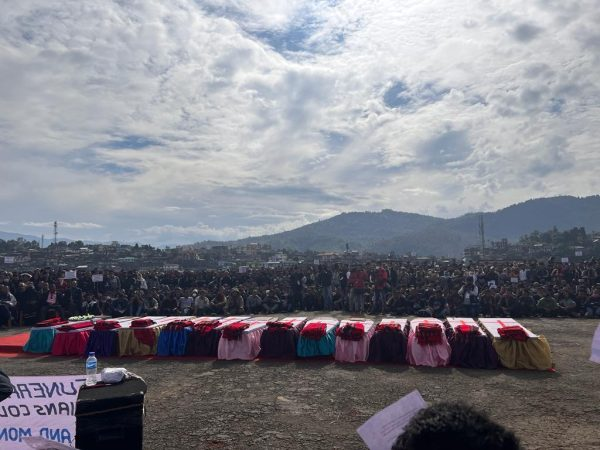
The International League of Peoples' Struggle (ILPS), with presence in 40 countries, even as strongly condemning the "murder" of 15 coal miners and injuring 11 more by the Indian army in Mon district, Nagaland, has said it is "joining" its network, Naga Peoples Movement for Human Rights (NPMHR), adding, it supports the Naga peoples, the people of India’s north east and all lovers of peace and freedom in calling for the immediate repeal of the Armed Forces Special Powers Act (AFSPA), 1958.
Releasing a statement by NPMHR, it said, AFSPA is sought to be implemented by the Government of India in Northeast States allegedly enabling Indian army’s "massacre of indigenous peoples and citizens with impunity." Calling for justice for all the "victims" of the Indian government, it has floated an online petition to repeal AFSPA to seek international solidarity.

NPMHR statement:

Ever since military aggression and occupation of the Naga homeland in 1954, civilians and common Naga people have been the target of the Indian army and the para-military forces. Armed with Draconian and inhuman legal immunity by the Indian Parliament, the Government of India continues unabated to kill civilians and common people at any time and at any place of its conveniences. Our women folks were stripped of all human dignity by the armed forces of the world’s largest Democracy, India.
They are being raped, tortured, made to give birth publicly with no more human dignity left and are being subjected to live lives of untold trauma and heavy mental burdens. The Indian State does not spare any of its armed tools and occupational instruments to extinguish the Naga spirit of human dignity and spirit of equal human brotherhood. The world is prevented from knowing these ceaseless state-sponsored crimes against the Naga people and against humanity.
The reign of the Indian State-sponsored terrorism and war waged on civilian population is yet again showcased when the best-trained Indian elite forces butchered a group of humble people returning to their homes in a truck from their work places. The well-trained Indian army personnel engaged their most sophisticated firearms to kill them as if the simple, humble and bread-earning villagers were diseased and had to be culled.
Are the lives of the Naga people less than the lives of other fellow human beings? This evil act of the Indian government through its military forces once again reveals its true intent of owning our land after exterminating our Naga people.
Our people at all times seek to live in peace with all other people. Our history tells that we have never waged war on any people even in the days of old. We are being denied to live lives of dignity, to exercise our rights and are now being driven to live in fear. The Government of India, time and again, wages war against our Naga people. The actions of the Indian State upon our people are no less than the erstwhile apartheid. No power on earth had ever succeeded in subduing our Naga spirit.
We, the Naga Peoples’ Movement for Human Rights (NPMHR), resolutely condemn the genocide committed upon the humble working-civilian villagers. We squarely hold the Government of India with all its draconian and fascist laws responsible for letting loose their dogs of war to maul to shreds the innocent villagers of Oting who have committed no crime whatsoever except commitment to humbly earn their livelihood with dignity and honor. Even at this moment when we are making this Statement, the Indian military and paramilitary forces are still engaged in their mayhem of killing the civilians in Mon Town.
Our anguish is unspeakable at this moment of grief. Our hearts go to the families of the slain innocent villagers. The NPMHR stands with them all and shall walk with them through thick and thin.

Comments

TRENDING

Sergei Vasilyevich Gerasimov, the artist who survived Stalin's cultural purges

By Harsh Thakor*  Sergei Vasilyevich Gerasimov (September 14, 1885 – April 20, 1964) was a Soviet artist, professor, academician, and teacher. His work was posthumously awarded the Lenin Prize, the highest artistic honour of the USSR. His paintings traced the development of socialist realism in the visual arts while retaining qualities drawn from impressionism. Gerasimov reconciled a lyrical approach to nature with the demands of Soviet socialist ideology.

Nepal votes amid regional rivalry: Why New Delhi is watching closely

By Nava Thakuria*  As Nepal holds an early national election on Thursday (5 March 2026), the people of northeast India, along with other regional observers, are watching the proceedings closely. The vote was necessitated after the government of Prime Minister Khadga Prasad Sharma Oli collapsed in September 2025 following widespread anti-government protests. The election will determine the composition of the 275-member House of Representatives, originally scheduled for 2027, under the stewardship of an interim government led by former Supreme Court justice Sushila Karki.

From plagiarism to proxy exams: Galgotias and systemic failure in education

By Sandeep Pandey*   Shock is being expressed at Galgotias University being found presenting a Chinese-made robotic dog and a South Korean-made soccer-playing drone as its own creations at the recently held India AI Impact Summit 2026, a global event in New Delhi. Earlier, a UGC-listed journal had published a paper from the university titled “Corona Virus Killed by Sound Vibrations Produced by Thali or Ghanti: A Potential Hypothesis,” which became the subject of widespread ridicule. Following the robotic dog controversy coming to light, the university has withdrawn the paper. These incidents are symptoms of deeper problems afflicting the Indian education system in general. Galgotias merely bit off more than it could chew.

'Policy long overdue': Coalition of 29 experts tells JP Nadda to act on SC warning label order

By A Representative   In a significant development for public health, the Supreme Court of India has directed the Food Safety and Standards Authority of India (FSSAI) to seriously consider implementing mandatory front-of-pack warning labels on pre-packaged food products. The order, passed by a bench of Justices J.B. Pardiwala and K.V. Viswanathan on February 10, 2026, comes as the Court expressed dissatisfaction with the regulatory body's progress on the issue.

From non-alignment to strategic partnership: India's ideological shift toward Israel

By Bhabani Shankar Nayak*  India's historical foreign policy maintained a notable duality: offering sanctuary to persecuted Jewish communities dating back centuries, while simultaneously supporting Palestinian self-determination as an expression of its broader anti-colonial foreign policy commitments. The gradual shift in Indian foreign policy under Hindutva-aligned governance — moving toward a strategic partnership with Israel while reducing substantive engagement with the Palestinian cause — raises legitimate questions about ideological motivation and geopolitical consequence.

Development vs community: New coal politics and old conflicts in Madhya Pradesh

By Deepmala Patel*  The Singrauli region of Madhya Pradesh, often described as “India’s energy capital,” has for decades been a hub of coal mining and thermal power generation. Today, the Dhirouli coal mine project in this district has triggered widespread protests among local communities. In recent years, the project has generated intense controversy, public opposition, and significant legal and social questions. This is not merely a dispute over one mine; it raises a larger question—who pays the price for energy development? Large corporate beneficiaries or the survival of local communities?

Indian ecologist urges United Nations to probe alleged Epstein links within UN ranks

By A Representative   A senior Indian ecologist and long-time United Nations environmental negotiator, Dr. S. Faizi of Thiruvananthapuram, has written to António Guterres, urging the United Nations to launch a high-level investigation into alleged links between certain current and former UN officials and the late American financier Jeffrey Epstein, following disclosures of email communications by the U.S. Department of Justice.

Vaccination vs screening: Policy questions raised on cervical cancer strategy

By A Representative   A public policy expert has written to Union Health Minister J. P. Nadda raising a series of concerns regarding the national Human Papillomavirus (HPV) vaccination campaign launched on February 28 for 14-year-old girls.

Zinaida Portnova: The teenage partisan of the Soviet resistance

By Harsh Thakor*  February 20 marked the birth centenary of Zinaida Portnova, one of the youngest recipients of the Soviet Union’s highest wartime honour. Remembered for her role in the anti-Nazi underground in occupied Belarus during the Second World War, Portnova became a symbol of youth participation in the Soviet resistance.