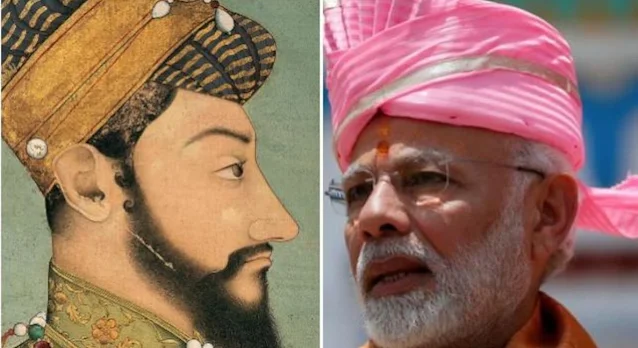
Narendra Modi, a senior swayamsevak (member) of the Rashtriya Swayamsevak Sangh, long back in 2013, declared himself to be a ‘Hindu nationalist’ [Modi interviewed by two Reuters journalists, Ross Colvin and Sruthi Gottipati, on July 12, 2013]. As the PM of the largest democracy in the world, India, he misses no opportunity to stress the favourite Hindutva binary of putting Hindus and Muslims as two communities at war in India.
He resorted back to this favourite polarizing theme of his while speaking at the inauguration of the renovated and expanded Kashi Vishwanath Dham [Kashi Vishwanath Temple] in his Varanasi parliamentary constituency on December 13, 2021. Digging into past of Benares now Varanasi he stated:
“Tyrants attacked this city, tried to destroy it. History is witness to Aurangzeb’s atrocities, his terror. He tried to change civilisation with the sword. He tried to crush culture with fanaticism. But the soil of this country is different from that of the rest of the world. Here if an Aurangzeb comes, a Shivaji also rises.”
For PM, the story of repression and persecution by Aurangzeb, a Mughal king, is not the story of some individual tyrant ruler but a bigoted Muslim who hated Hindus and Hinduism. Aurangzeb personified all Muslims of India and the religion Islam. Unfortunately our PM as a Hindutva protagonist discards some very crucial historical facts even stated in the contemporary ‘Hindu’ narratives about the rule of Aurangzeb [1658-1707].
These records prove that Aurangzeb rule was also the rule of Rajputs or Kshatriyas [members of the second of the four Hindu castes in order of importance after Brahmins] and other members of high castes. Aurangzeb never faced Shivaji in the battlefield.
It was his commander-in-chief, a Rajput ruler of Amer (Rajasthan), Jay Singh II (1688– 1743) who was sent to subjugate Shivaji. He was conferred the title of ‘Sawai' [one and a quarter times superior to his contemporaries] chief by Aurangzeb in 1699 and thus came to be known as Maharaja Sawai Jai Singh. He was also given the title of Mirza Raja [a Persian title for a royal prince] by Aurangzeb.
The other titles bestowed on him by other Mughal rulers were ‘Sarmad-i-Rajaha-i-Hind’ [eternal ruler of India], ‘Raj Rajeshvar’ [lord of kings] and ‘Shri Shantanu ji’ [wholesome king]. These titles are displayed by his descendants even today.
This Rajput chief also gave his daughter in marriage to the son of Aurangzeb who became Mughal emperor after Aurangzeb. To know how Jay Singh II worked as a main hit-man of Aurangzeb, we must read the letter which Shivaji wrote to Jay Singh II condemning his subservience to Aurangzeb. A part of it read:
“I have heard that thou [sic] hast [sic] come to make battle upon me and to subjugate the Deccan. Thou desirest [sic] in this world to make thy face glow with blood drawn from the hearts and eyes of Hindus. But thou knowest [sic] not that thy face is painted in black, because owing to it, this country and religion are in danger…thou hast in fact come to conquer at the instance of Aurangzib [sic] and under the instigation of those who desire to destroy the Hindus.” [text as per the original translation, cited in Golwalkar, MS, "We or Our Nationhood Defined", Bharat Publications, Nagpur, 1939, p. 68.]
Interestingly, we have first-hand account of Raja Rughnath Bahadur, a Kayasth who functioned as Deewan Ala (prime minister) of both the Mughal emperors Shahjahan, and Aurangzeb. According to a diary of one of his direct descendants, Rai Lala Maharaja Lal (son of Rai Bahadur Munshi Jeewan Lal who was one of the main traitors who facilitated capture of Delhi by the British rulers in September 1857 during the 1857 rebellion) despite Aurangzeb being the Emperor:
“Raja Rughnath Bahadur having attained to the most exalted rank of Diwan Ala (prime minister) was not unmindful of the interests of his caste-fellows. As the Kayasths were the only class amongst the Hindoos who could read and write the court language, i.e., Persian, the Raja appointed every one of them to posts of honor and emoluments, according to their individual merits; while many of them were granted titles of honor and valuable jagirs for their services. Not a single Kayasth remained unemployed or in needy circumstances. The Raja procured them everything they wanted, and tried his best to please them in every way he could.” [Lal, Rai Lala Maharaja, "Short Account of the Life and Family of Rai Jeewan Lal Bahadur Late Honrary Magistrate Delhi, With Extracts from His Diary Relating to the Times of Mutiny 1857", IMH Press, Delhi, 1902, pp. 3-4. ]
This account shows that despite the rule of Aurangzeb, a ‘bigoted Muslim’ a Kayasth prime minister of his was able to patronize his caste fellows, all Hindus.
The Hindutva zealots must know that Mughal rule survived due to the Hindu high castes joining the ‘Muslim’ rulers in running the Mughal Empire. How solid this unity was can be gauged by the fact that after Akbar no Mughal emperor was born of a Muslim mother. The Hindu high castes provided brain and muscles to the Mughal rulers continuously. Thus, Mughal rule was the rule of Hindu high castes also. Even Savarkar, before converting into a protagonist of Hindutva, did not subscribe to the religious exclusiveness of ‘Muslim’ rule. He was never shy of sharing the fact that though...
“the ruling prince of Oudh was a Mahomedan [sic]; most of the big land-owners under him were Hindus. Jhagirs [sic] and Talukdari rights had continued from father to son in the families of these zamindars for generations. Hundreds of villages were administered under the single authority of each of these proprietors. They possessed forts and had small armies under them to protect these Jhagirs [sic].” [Savarkar, V. D., "The Indian War of Independence 1857", Rajdhani, Delhi, 1970, p. 50.]
Aurobindo Ghose who played a prominent role in providing Hindu philosophical direction to the Indian nationalism confessed that Mughal rule continued for centuries due to the fact that Mughal rulers gave Hindus, “positions of power and responsibility, used their brain and arm to preserve” their kingdom. [Cited in Chand, Tara, "History of the Freedom Movement in India", vol. 3, Publication Division Government of India, Delhi, 1992, p. 162.]
Renowned historian Tara Chand after studying the primary source material of the medieval period concluded that the from the end of 16th century to the middle of 19th century, “it may reasonably be concluded that in the whole of India, excepting the western Punjab, superior rights in land had come to vest in the hands of Hindus” most of whom happened to be Rajpoots. [Chand, Tara, "History of the Freedom Movement in India", vol. 1, Publication Division Government of India, Delhi, 1961, p. 124.]
Brahmins followed Rajputs in manning the Mughal administration so far as the number was concerned
"Maasir-ul Umra", a biographical dictionary of the officers in the Mughal Empire beginning from 1556 to 1780 [Akbar to Shah Alam], is regarded as the most authentic record of the high rank officials employed by the Mughal kings. This work was compiled by Shahnawaz Khan and his son Abdul Hai between 1741 and 1747.
According to it Mughal rulers in this period employed around 100 high-ranking officials most of them “Rajputs from Rajputana, the midlands, Bundelkhand and Maharashtra”. Brahmins followed Rajputs in manning the Mughal administration so far as the number was concerned. Interestingly, Kashi Nagri Pracharini Sabha [established in 1893] committed to the cause of Hindi as official language published Hindi translation of this book in 1931.
It is nobody’s argument that Aurangzeb did not commit heinous crimes against his subjects. It needs to be remembered that his cruelty was not restricted to non-Muslims; his own father, brothers, Shias, those Muslims who did not follow his brand of Islam and Muslim ruling families in the eastern, central and western parts of his kingdom faced brutal repression.
Aurangzeb executed renowned Sufi saint, Sarmad in the precinct of Jama Masjid of Delhi. It is also true that there were countless cases when Hindus and their religious places were violently targetted during Aurangzeb’s despotic rule. However, there are contemporary records available of his patronizing Hindu and Jain religious places. [Trushke, Audrey, "Aurangzeb: The Man and the Myth", Penguin, Gurgaon, 2017, pp. 99-106.] Reducing all his crimes to the repression of Hindus only will tantamount to reducing the gravity of his crimes.
The linking of Aurangzeb’s crimes or a king/ruler in the pre-modern times of India to his/her religion is going to create serious consequences even for ‘Hindu’ version of history as narrated by the RSS. Take for example, Ravana, the king of Lanka who according to again Hindu’ narrative committed unspeakable crimes against Mother Sita, her husband Lord Rama and his companions during 14 years long vanvaas or exile.
Ravana was a learned Brahman who also happened to be one of the greatest worshippers of Lord Shiva who is worshipped at Kashi Vishwanath Temple. If like Aurangzeb Ravana’s criminal deeds are linked to his religion then PM Modi will have to wage war against all Brahmins and Shivites!
It is tragic for democratic-secular polity of India that its PM who is legally bound to uphold the all-inclusive and joint heritage of the Indian nation is religiously working to polarize the people of India on the basis of subjective and fabricated history. While inaugurating the renovation of the temple complex at Kashi he willfully disregarded the fact of modern India that morning prayers at the Kashi Temple used to begin with the playing of shehnai (an instrument played at auspicious occasions) by Ustad Bismillah Khan (1914-2006), a practising Muslim who was awarded the highest national civilian award, Bharat Ratna.
Khan in his autobiographical descriptions stated proudly that his mesmerizing shehnai skill was due to the blessings of Vishwanath, the eternal Shiva. It is to be noted that it was not only Kashi Vishwanath Temple where morning prayers used to start with musical rendering by a Muslim musician. The prayers at Maa Sharda Temple at Maihar in Madhya Pradesh used to start with the playing of sarod by Ustad Alauddin Khan (1862-1972) who also founded Maihar Gharana of the Indian music.
It is hoped that PM of India will keep in check his Hindutva impulses and not facilitate the agenda of enemies of India to undo it succeed.
---
*Formerly with Delhi University, click here for Prof Islam's writings and video interviews/debates and here books. Facebook: https://facebook.com/shamsul.islam.332. Twitter: @shamsforjustice. Blog: http://shamsforpeace.blogspot.com/
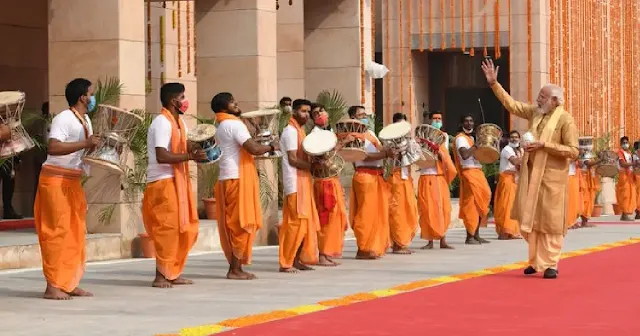 |
| Modi at Kashi Vishwanath |
Aurangzeb executed renowned Sufi saint, Sarmad in the precinct of Jama Masjid of Delhi. It is also true that there were countless cases when Hindus and their religious places were violently targetted during Aurangzeb’s despotic rule. However, there are contemporary records available of his patronizing Hindu and Jain religious places. [Trushke, Audrey, "Aurangzeb: The Man and the Myth", Penguin, Gurgaon, 2017, pp. 99-106.] Reducing all his crimes to the repression of Hindus only will tantamount to reducing the gravity of his crimes.
The linking of Aurangzeb’s crimes or a king/ruler in the pre-modern times of India to his/her religion is going to create serious consequences even for ‘Hindu’ version of history as narrated by the RSS. Take for example, Ravana, the king of Lanka who according to again Hindu’ narrative committed unspeakable crimes against Mother Sita, her husband Lord Rama and his companions during 14 years long vanvaas or exile.
Ravana was a learned Brahman who also happened to be one of the greatest worshippers of Lord Shiva who is worshipped at Kashi Vishwanath Temple. If like Aurangzeb Ravana’s criminal deeds are linked to his religion then PM Modi will have to wage war against all Brahmins and Shivites!
It is tragic for democratic-secular polity of India that its PM who is legally bound to uphold the all-inclusive and joint heritage of the Indian nation is religiously working to polarize the people of India on the basis of subjective and fabricated history. While inaugurating the renovation of the temple complex at Kashi he willfully disregarded the fact of modern India that morning prayers at the Kashi Temple used to begin with the playing of shehnai (an instrument played at auspicious occasions) by Ustad Bismillah Khan (1914-2006), a practising Muslim who was awarded the highest national civilian award, Bharat Ratna.
Khan in his autobiographical descriptions stated proudly that his mesmerizing shehnai skill was due to the blessings of Vishwanath, the eternal Shiva. It is to be noted that it was not only Kashi Vishwanath Temple where morning prayers used to start with musical rendering by a Muslim musician. The prayers at Maa Sharda Temple at Maihar in Madhya Pradesh used to start with the playing of sarod by Ustad Alauddin Khan (1862-1972) who also founded Maihar Gharana of the Indian music.
It is hoped that PM of India will keep in check his Hindutva impulses and not facilitate the agenda of enemies of India to undo it succeed.
---
*Formerly with Delhi University, click here for Prof Islam's writings and video interviews/debates and here books. Facebook: https://facebook.com/shamsul.islam.332. Twitter: @shamsforjustice. Blog: http://shamsforpeace.blogspot.com/
Obsolutely historical and true !
ReplyDeleteVery well researched articles. Puts the facts in true perspective and gives a complete picture smashing the selective narrative to boost the nefarious agenda of Hindu zealots
ReplyDeleteThe article is gold. The deeply researched historical facts are shown here. We need more articles like this.
ReplyDeleteThis comment has been removed by the author.
ReplyDeleteSorry, you missed the point, jaisingh gave his daughters to Auragzeb....still was poisoned to death by Aurangzeb...when u give refrence of books who consider Aurangzeb as hero...u r wrong...you keep on talking n pointing towards different hindu casetes...this is sick secular mind..which works in one direction,.
ReplyDeleteIf Aurangzeb had mejority hinduea in his court,did he have a choice? Jaisingh is a black sheep for Rajput clan of he has given away his daughter to save his ass.
ReplyDeleteAurangzeb ruled in 1857??? Which book of history you are reading sir.
ReplyDeleteIf shaivities and Brahmins start identifying themselves with Ravana and use him as an example to target Hindus, I am sure even such shaivities will be then criticised.
Aurangzeb ruled through Hindu high caste - then even British ruled through Hindus ? What parallels are you drawing. Everyone who was part of Mughal administration were first defeated by Mughals and enslaved and in return of their life and kingdom/jaagir were required to pledge loyalty to Mughal throne.
Killing a Muslim or Hindu for political rivalry is one thing. And destroying a temple only to humiliate a religion is another issue. By your logic I am sure Taliban is justified in demolishing bamyan Buddha statues.
Mr Anonymous, please read the article, it never says Aurangzeb ruled in 1857. It merely cites what was written in 1857 about Aurangzeb. Don't spread fakery.
ReplyDelete