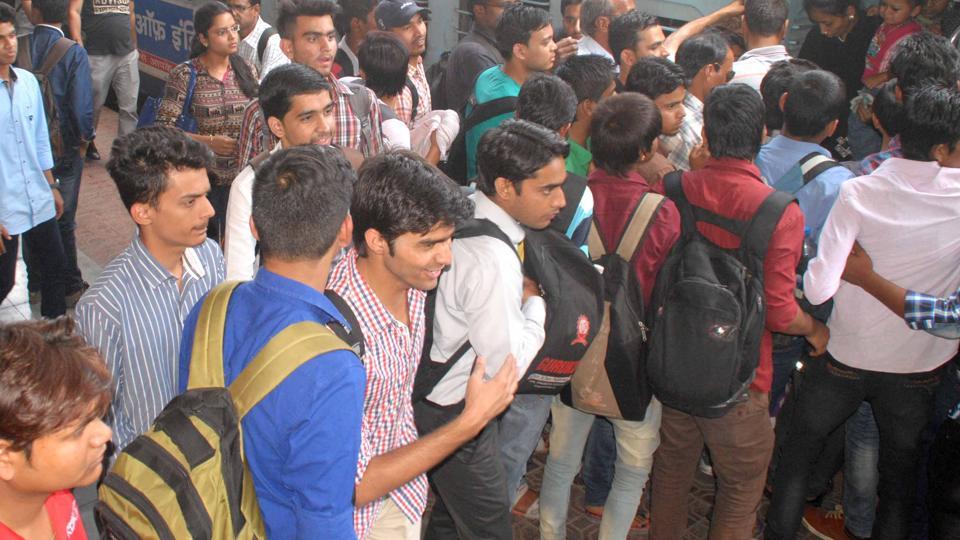
More unemployed persons registered in employment exchanges, but few get jobs, hardest hit are workers in unorganized sector
This is the fourth article in the series “One Can Not Keep Mum Now!” sponsored by the non-political organization, Save Democracy Movement, and prepared by former Gujarat chief minister Suresh Mehta, People’s Union for Civil Liberties (Gujarat) general secretary Gautam Thaker, environmental expert Mahesh Pandya, and economists Prof Rohit Shukla and Prof Hemantkumar Shah:
***
In the year 2001-02, 2.52 lakh fresh jobless were registered; during 2910-11, 4.11 lakh fresh jobless were registered. In the year 2015, 4.74 lakh jobless were registered, but only 3.37 lakh people got employment. Thus, year after year, more and more jobless people were registered.
During 2001-11, 29.86 lakh fresh jobless were registered and only 13.38 lakh people got jobs in Gujarat. Thus, during this period, 16.48 lakh people remained unemployed. Taking into account the span of 2004-15, 43.44 lakh fresh unemployed people registered their names in Employment Exchanges, but only 24.41 lakh people got employment, and 19.09 lakh people could not get employment. In this way, there has been consistent rise in the number of unemployed registered persons in the state. In the year, 2015, the number of registered jobless people was 6.11 lakh, including both educated and uneducated unemployed persons.
It is a fact that all the recommended persons from the Employment Exchanges do not get job. During the period of first six months of the year 2015-16, recommendations were made for employing 5.12 lakh people but only 1.77 lakh people, i.e. only 35%, got employment.
The unemployment level of skilled and highly educated persons in Gujarat has created a havoc. Almost 80% of engineers in the state are jobless. Because of such large unemployment, there are some 200 to 500 applicants for only one vacancy as and when announced by the state government. Even for the vacancy of the post of talati (village revenue official), lakhs of people apply. Similar is the predicament for the jobs of pharmacists, dentists etc.
During 2001-11, 29.86 lakh fresh jobless were registered and only 13.38 lakh people got jobs in Gujarat. Thus, during this period, 16.48 lakh people remained unemployed. Taking into account the span of 2004-15, 43.44 lakh fresh unemployed people registered their names in Employment Exchanges, but only 24.41 lakh people got employment, and 19.09 lakh people could not get employment. In this way, there has been consistent rise in the number of unemployed registered persons in the state. In the year, 2015, the number of registered jobless people was 6.11 lakh, including both educated and uneducated unemployed persons.
It is a fact that all the recommended persons from the Employment Exchanges do not get job. During the period of first six months of the year 2015-16, recommendations were made for employing 5.12 lakh people but only 1.77 lakh people, i.e. only 35%, got employment.
The unemployment level of skilled and highly educated persons in Gujarat has created a havoc. Almost 80% of engineers in the state are jobless. Because of such large unemployment, there are some 200 to 500 applicants for only one vacancy as and when announced by the state government. Even for the vacancy of the post of talati (village revenue official), lakhs of people apply. Similar is the predicament for the jobs of pharmacists, dentists etc.

The policy of offering 85% employment to local people in industries, including Tatas' Nano Project, has not been implemented. The Government is offering relief in land, water and power supply to the tune of crores of rupees, even then the Government remains contented merely by issuing notices to such defaulter industries.
One of the reasons for tremendous rise in unemployment in Gujarat is attributed to thoughtless, sudden, haphazard and abrupt demonetization and GST. Over 90% of the workers in the State are employed in the unorganized sector. Major portion of rural and urban population of the state is engaged in sectors such as construction, transport, home-based industries, small and tiny sectors etc. These people were producing 61 % products for the state’s GDP in the year 1997-98. Presently, its share has come down to 50 %.
One of the reasons for tremendous rise in unemployment in Gujarat is attributed to thoughtless, sudden, haphazard and abrupt demonetization and GST. Over 90% of the workers in the State are employed in the unorganized sector. Major portion of rural and urban population of the state is engaged in sectors such as construction, transport, home-based industries, small and tiny sectors etc. These people were producing 61 % products for the state’s GDP in the year 1997-98. Presently, its share has come down to 50 %.
Due to blows of demonetization and GST, 2% reduction is observed in the GDP growth rate. As per one calculation, reduction of 1% in the GDP reflects into 0.75% reduction in employment. If one takes this into account, it will reveal that reduction of 2% in the GDP has resulted into 1.5% decline in the unorganise sector, which accommodate over 90% of the work force in the state of Gujarat.
Tall claims of employment generation were made in the Vibrant Gujarat Investment Summits organized with the expenditure of crores of rupees, but that much employment potential has not been realized at all. In the Vibrant Gujarat Summits of the years 2003, 2005, 2013, 2015 and 2017 no announcements were made on the employment potential of the prospective capital investment.
Tall claims of employment generation were made in the Vibrant Gujarat Investment Summits organized with the expenditure of crores of rupees, but that much employment potential has not been realized at all. In the Vibrant Gujarat Summits of the years 2003, 2005, 2013, 2015 and 2017 no announcements were made on the employment potential of the prospective capital investment.
The summit of the year 2007 announced an employment potential of 13,12,436 persons, while the summit of 2009 employment potential of 29,81,021 persons was announced. In the 2011 Vibrant Gujarat Summit, too, employment potential of 60 lakh jobs was anticipated.
In the Budget of 2017-18, under the MNREGA scheme, the Government has made a provision for Rs 380 crore, and stated that 6.1 lakh families would get employment. This means that in each of these famies there are jobless persons. If two unemployed persons are assumed per family, there are 12.20 lakh persons are jobless in the rural areas of the state. All these are uneducated families who do not get their names registered with the Employment Exchanges.
During the period of 2007-12 the Central Government allocated Rs 2,236 crore to the State Government for the implementation of MNREGA, but the Gujarat Government provided employment only to 3 to 6 % workers demanding employment to the Job Card holder families for 100 days. Thus, the fund allocated by the Central Government remained unutilized.
In the budget speech, the Finance Minister of Gujarat announced that 6.1 lakh families would be provided employment in the year 2017-18, and 340 lakh mandays employment would be generated. If employment for 100 days is to be provided to one family under MNREGA, then employment potential works out to 610 lakh of mandays. Thus, the Government decided in advance to give employment for only 44 days as against 100 days.
In Gujarat, 38.45 lakh rural families obtained job cards under MNREGA. Even then, the State Government states that in the year 2017-18 it will give employment to only 6.10 lakh families. Then how will the remaining 32.35 lakh families get the employment? Moreover, the office of the Gujarat Rural Development Commissioner says that 7.50 lakh families had demanded job under MNREGA, but jobs were offered to only 6.80 lakh families. Thus, 70,000 families did not get employment though they demanded for the same under MNREGA. In Gujarat, daily average wage of Rs. 130.81 is given under the MNREGA, whereas the rate of daily wage is Rs 153 in Bihar, Rs 142 in UP, Rs 159 in Maharashtra and Rs 180 in Kerala.
Under the MNREGA, during 2016-17, 3,46,608 people of Gujarat had demanded work but only 1,35,112 persons, i.e. 39%, were provided employment. During the entire year, 25.23 lakh mandays employment was provided. Thus, merely 7.22% target was achieved. Under the law, employment for 100 days is to be provided to each family but employment was provided only for 18.76 days. If this is the situation for the last year, then how would 340 lakh mandays employment would be provided during this year?
The situation for the year 2015-16 was also bad. Number of people seeking employment was 5,70,509 but only 4,17,670 people could get job. Thus, 27% could not get the employment even though they had demanded for the job. On an average, only 35 days employment was given and merely 10,418 families got 100 days employment.
The condition of workers engaged on contractual basis in Gujarat is worse than that in other state. Out of 1,000 contractual workers, only 78 workers get leave with wages, and in that, the rank of Gujarat is at No 7. The benefit of social security schemes' reach is only 166 workers out of 1000, and in it Gujarat ranks at 16th.
Among those who get regular salary, the condition of such workers in respect of social security is no good in Gujarat. Out of every 1,000 workers only 422 workers get leave with wages. Here, among 36 states and Union Territories, Gujarat is ahead of only Telangana and Chandigarh. The workers of Gujarat are far behind in availing benefits of social security schemes. Against 1,000 workers, only 362 workers get benefits of social security schemes, and Gujarat ranks at 3 from the end rank only with Diu-Daman and Andhra Pradesh.
In Gujarat, there are 12 lakh workers from Gujarat and 8 lakh from other states, aggregating 20 lakh engaged in construction business. For their social security, Parliament had passed two Acts in the year 1996. Under those laws, cess at the rate of 2% is levied on the construction of buildings and other constructions. As a result, an amount of more than Rs 1,600 crore has been accumulated in the coffers of the state.
Very Few People get Employment under MNREGA
The Mahatma Gandhi National Rural Employment Guarantee Act (MNREGA) was promulgated by Parliament in the year 2005, but the Modi Government in Gujarat implemented it only in the year 2006.In the Budget of 2017-18, under the MNREGA scheme, the Government has made a provision for Rs 380 crore, and stated that 6.1 lakh families would get employment. This means that in each of these famies there are jobless persons. If two unemployed persons are assumed per family, there are 12.20 lakh persons are jobless in the rural areas of the state. All these are uneducated families who do not get their names registered with the Employment Exchanges.
During the period of 2007-12 the Central Government allocated Rs 2,236 crore to the State Government for the implementation of MNREGA, but the Gujarat Government provided employment only to 3 to 6 % workers demanding employment to the Job Card holder families for 100 days. Thus, the fund allocated by the Central Government remained unutilized.
In the budget speech, the Finance Minister of Gujarat announced that 6.1 lakh families would be provided employment in the year 2017-18, and 340 lakh mandays employment would be generated. If employment for 100 days is to be provided to one family under MNREGA, then employment potential works out to 610 lakh of mandays. Thus, the Government decided in advance to give employment for only 44 days as against 100 days.
In Gujarat, 38.45 lakh rural families obtained job cards under MNREGA. Even then, the State Government states that in the year 2017-18 it will give employment to only 6.10 lakh families. Then how will the remaining 32.35 lakh families get the employment? Moreover, the office of the Gujarat Rural Development Commissioner says that 7.50 lakh families had demanded job under MNREGA, but jobs were offered to only 6.80 lakh families. Thus, 70,000 families did not get employment though they demanded for the same under MNREGA. In Gujarat, daily average wage of Rs. 130.81 is given under the MNREGA, whereas the rate of daily wage is Rs 153 in Bihar, Rs 142 in UP, Rs 159 in Maharashtra and Rs 180 in Kerala.
Under the MNREGA, during 2016-17, 3,46,608 people of Gujarat had demanded work but only 1,35,112 persons, i.e. 39%, were provided employment. During the entire year, 25.23 lakh mandays employment was provided. Thus, merely 7.22% target was achieved. Under the law, employment for 100 days is to be provided to each family but employment was provided only for 18.76 days. If this is the situation for the last year, then how would 340 lakh mandays employment would be provided during this year?
The situation for the year 2015-16 was also bad. Number of people seeking employment was 5,70,509 but only 4,17,670 people could get job. Thus, 27% could not get the employment even though they had demanded for the job. On an average, only 35 days employment was given and merely 10,418 families got 100 days employment.
Gujarat is trailing behind in social security of workers
In Gujarat, the Government does not pay enough attention to the social security of workers. Against every 1000 workers, only 419 of urban men and 604 of urban women have received any benefit of the social security schemes. Here, respectively, Gujarat ranks at 32nd and 22nd in the country. In the same way, in the rural areas, for every 1,000 persons, 521 men and 450 women received benefit of social security schemes. In both the matters, Gujarat ranks at No 22 in India as a whole.The condition of workers engaged on contractual basis in Gujarat is worse than that in other state. Out of 1,000 contractual workers, only 78 workers get leave with wages, and in that, the rank of Gujarat is at No 7. The benefit of social security schemes' reach is only 166 workers out of 1000, and in it Gujarat ranks at 16th.
Among those who get regular salary, the condition of such workers in respect of social security is no good in Gujarat. Out of every 1,000 workers only 422 workers get leave with wages. Here, among 36 states and Union Territories, Gujarat is ahead of only Telangana and Chandigarh. The workers of Gujarat are far behind in availing benefits of social security schemes. Against 1,000 workers, only 362 workers get benefits of social security schemes, and Gujarat ranks at 3 from the end rank only with Diu-Daman and Andhra Pradesh.
In Gujarat, there are 12 lakh workers from Gujarat and 8 lakh from other states, aggregating 20 lakh engaged in construction business. For their social security, Parliament had passed two Acts in the year 1996. Under those laws, cess at the rate of 2% is levied on the construction of buildings and other constructions. As a result, an amount of more than Rs 1,600 crore has been accumulated in the coffers of the state.
A Board constituted under the Act for the welfare of the construction workers, however, was handed over only Rs 700 crore by the State Government. The Government spends the remaining amount in its budget funds. In fact, this sum has no relation at all with the general budget. Even then, the Government takes up this amount to the credit in the Consolidated Fund and spends it . Until the year 2014 the Government had not spent almost any sum from the income of such cess.
The situation of contractual workers in Gujarat is very serious, and out of 1000 urban workers, 948 workers are employed without any kind of written agreement. Gujarat ranks14th in such unfair work condition. In the rural areas, only 6 out of 1,000 workers get jobs with the written contractual agreement, and in among 36 states and Union Territories, Gujarat ranks at 6th from the bottom.
The Central Government runs many schemes for employment generation, including MNREGA. Their benefits reached to only 40 out of 1,000 persons. In that respect, Gujarat is ranking at last, with the sole exception of Diu-Daman.
The situation of contractual workers in Gujarat is very serious, and out of 1000 urban workers, 948 workers are employed without any kind of written agreement. Gujarat ranks14th in such unfair work condition. In the rural areas, only 6 out of 1,000 workers get jobs with the written contractual agreement, and in among 36 states and Union Territories, Gujarat ranks at 6th from the bottom.
The Central Government runs many schemes for employment generation, including MNREGA. Their benefits reached to only 40 out of 1,000 persons. In that respect, Gujarat is ranking at last, with the sole exception of Diu-Daman.
Comments