 By Fr. Cedric Prakash sj*
It is not always that one has the opportunity to gaze at a Supermoon. One was warned not to miss this spectacle – the first one after 68 years, and apparently the next one will be only in 2034.An amazing phenomenon indeed- to see the moon so close, so bright, so radiant. One can only give thanks to the Creator of this Universe, to praise Him and to thank Him at this moment- for the many graces and blessings which he showers down upon us constantly. At the same time, we need to question ourselves on the way we destroy his creation; the way we allow hate and violence to govern our lives- not bothered at all, about the generations to come after us!
“Those who have loved are those who have found God”, says Guru Nanak, the founder of Sikhism, whose birth anniversary we celebrate today. His followers do all they can to serve others in tangible ways. Several Sikhs who live in Lebanon, have come together to open a welcome centre for Syrian refugees coming into Lebanon; they provide them with a hot meal and other essentials. It is a great day to remind ourselves of the need and importance of love and why we need to find God in loving and serving others.
There are certainly many across the ages, who have manifested their love for others in deed! It is the 107th birth anniversary of Fr. Pedro Arrupe. He was truly a man for others; he witnessed the horrors of the nuclear attack on Hiroshima, and was convinced that love not war was the answer to the problems of the world. He was also the Superior General of the Society of Jesus when the Jesuit General Congregation (GC 32) mandated that true faith is in the promotion of a more humane and just society. Among Arrupe’s immortal words are, “fall in love, stay in love, and it will decide everything”.
Arrupe was convinced that one had to respond to the cries of the ‘boat people’ who were desperately fleeing war and persecution in South East Asia. The plight of these refugees was tragic. On November 14th 1980, he founded the Jesuit Refugee Service (JRS) to accompany, to serve and to defend the rights of refugees/IDPs.Thanks to the vision of Arrupe, today JRS serves thousands of refugees/IDPs in some of the most difficult places in the world, truly ensuring that love is made fruitful in service!
We also celebrate today the memory of St Joseph Pignatelli, a Spanish Jesuit (1737-1811) who is regarded as the Second Founder of the Society of Jesus. He was largely responsible for the restoration of the Society which ultimately took place in 1814.He was frail in health and suffered much; but because of his candour, courage and commitment, he was able to weather many storms and hostilities. As a Jesuit he was convinced that his main work and that of his fellow Jesuits was to be of service to others.
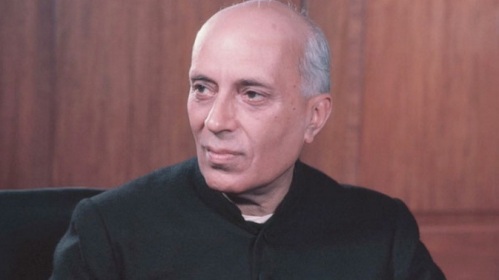
It is also the birth anniversary of Pandit Jawaharlal Nehru, India’s first Prime Minister. Nehru gave the country the vision and leadership it needed, after years of colonial rule. He was determined that the rights and freedoms guaranteed in the Constitution of India would belong to all Indians. He desired that India truly becomes a secular and socialist country. India will always cherish his statesmanship and the rich legacy he gave the country.
Nehru loved children. Very appropriately his birthday is celebrated as Children’s Day in India. Nehru believed that since children were the future of the country, we needed to invest in them, to protect them, to nurture them. Several years ago Nehru said, “Grown-ups have a strange way of putting themselves in compartments and groups. They build barriers… of religion, caste, colour, party, nation, province, language, customs and of rich and poor. Fortunately, children do not know much about these barriers, which separate. They play and work with each other and it is only when they grow up that they begin to learn about these barriers from their elders.”
I once was a child: cared for, loved by and nurtured by my Mother Cynthia. On this day in 2010 she went to her eternal reward. I remember her today in a very special way and thank God for the gift of her to me and to my siblings. She was truly a woman of substance: who put her children and family at the centre of her life. Every mother is indeed very special and so was mine.
In Syria today! And as I look back at November 14th 2016, it was indeed a Superday, for the reasons above and many more! It is late night and I have just returned after a walk outside, in a country torn and divided by almost six years of war and strife. An eerie and heavy silence permeates the night. As I gazed lovingly at the Supermoon – I thought of the many children who have been killed or deprived of their childhood for no fault of theirs; I remembered the many mothers who have suffered no end these years. And I remember the Supermen of the ages: Guru Nanak, Arrupe, Pignatelli, Nehru, and my own mother (who was a Superwoman) and the many others who have tried to make this world a better place.
And I pray that the light, the radiance, the benignity of the Supermoon may touch with love and heal the brokenness of our world and truly transform the lives of all!
(Syria, November 14th 2016.)
—
*Indian human rights activist, currently with Jesuit Refugee Service (JRS) MENA Region, Beirut, Lebanon
Comments