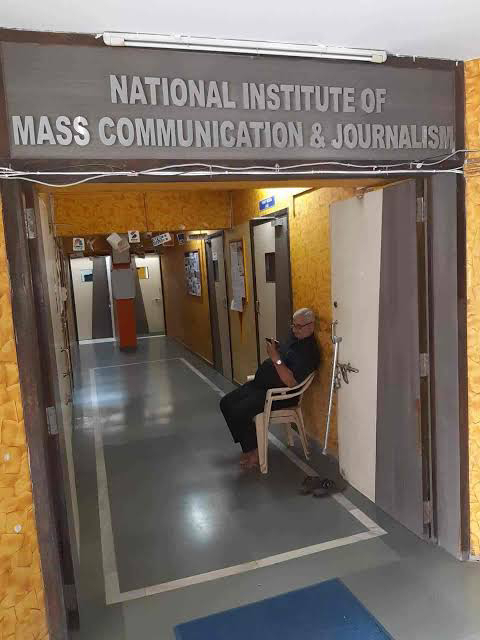
Only 25% of mass communication students become journalists, even they are unstable

By Rajiv Shah 
I have never studied in a journalism school, though I find that today only those who graduate (or post-graduate) in what is now termed as mass communication are taken as journalists in all top papers and other news outfits. In fact, there is no separate journalism course today.
So what are produced in what is called mass communication courses? "Journalism is just one subject out of many in the mass communication course", I was told by one of the senior teachers -- a professor -- in a private university at a workshop organised by Google News in Ahmedabad. So what does the course teach? And what kind of professionals does it produce?
This is what I learned: only 25% of the students are interested in going to journalism, while others would like to pursue their communication skills as public relations person, or work in advertising industry, or elsewhere where you require communication expertise. Surely, journalism is no more a lucrative choice. 
And what are they taught? How to write and communicate in front of different media, perhaps without telling them why journalism is opposite to PR job, which requires you to sell a product or do what the corporate boss tells, while journalism requires you to tell people what the establishment does not want to reveal. 
And what happens to a student who chooses to be a journalist? She or he, after joining a news outfit, often moves over to be a PR officer or even a receptionist! This happens because they are told and taught to be always on the side of the establishment, that news flows from the established alone!
Sad state of affairs!

Comments

TRENDING

Modi’s Israel visit strengthened Pakistan’s hand in US–Iran truce: Ex-Indian diplomat

By Jag Jivan   M. K. Bhadrakumar , a career diplomat with three decades of service in postings across the former Soviet Union, Pakistan, Iran, Afghanistan, South Korea, Sri Lanka, Germany, and Turkey, has warned that the current truce in the US–Iran war is “fragile and ridden with contradictions.” Writing in his blog India Punchline , Bhadrakumar argues that while Pakistan has emerged as a surprising broker of dialogue, the durability of the ceasefire remains uncertain.

Incarceration of Prof Saibaba 'revives' the question: What is crime, who is criminal?

By Kunal Pant* In 2016, a Supreme Court Judge asked the state of Maharashtra, “Do you want to extract a pound of flesh?” The statement was directed against the state for contesting the bail plea of Delhi University Professor GN Saibaba. Saibaba was arrested in 2014, a justification for which was to prevent him from committing what the police called “anti-national activities.”

Why Indo-Pak relations have been on 'knife’s edge' , hostilities may remain for long

By Utkarsh Bajpai*  The past few decades have seen strides being made in all aspects of life – from sticks and stones to weaponry. The extreme case of this phenomenon has been nuclear weapons. The menace caused by nuclear weapons in the past is unforgettable. Images of Hiroshima and Nagasaki from 1945 come to mind, after the United States dropped two atomic bombs on the cities.

Manufacturing, services: India's low-skill, middle-skill labour remains underemployed

By Francis Kuriakose* The Indian economy was in a state of deceleration well before Covid-19 made its impact in early 2020. This can be inferred from the declining trends of four important macroeconomic variables that indicate the health of the economy in the last quarter of 2019.

Food security? Gujarat govt puts more than 5 lakh ration cards in the 'silent' category

By Pankti Jog* A new statistical report uploaded by the Gujarat government on the national food security portal shows that ensuring food security for the marginalized community is still not a priority of the state. The statistical report, uploaded on December 24, highlights many weaknesses in implementing the National Food Security Act (NFSA) in state.

The soundtrack of resistance: How 'Sada Sada Ya Nabi' is fueling the Iran war

​ By Syed Ali Mujtaba*  ​The Persian track “ Sada Sada Ya Nabi ye ” by Hossein Sotoodeh has taken the world by storm. This viral media has cut across linguistic barriers to achieve cult status, reaching over 10 million views. The electrifying music and passionate rendition by the Iranian singer have resonated across the globe, particularly as the high-intensity military conflict involving Iran entered its second month in March 2026.

Lata Mangeshkar, a Dalit from Devdasi family, 'refused to sing a song' about Ambedkar

By Pramod Ranjan*  An artist is known and respected for her art. But she is equally, or even more so known and respected for her social concerns. An artist's social concerns or in other words, her worldview, give a direction and purpose to her art. History remembers only such artists whose social concerns are deep, reasoned and of durable importance. Lata Mangeshkar (28 September 1929 – 6 February 2022) was a celebrated playback singer of the Hindi film industry. She was the uncrowned queen of Indian music for over seven decades. Her popularity was unmatched. Her songs were heard and admired not only in India but also in Pakistan, Bangladesh and many other South Asian countries. In this article, we will focus on her social concerns. Lata lived for 92 long years. Music ran in her blood. Her father also belonged to the world of music. Her two sisters, Asha Bhonsle and Usha Mangeshkar, are well-known singers. Lata might have been born in Indore but the blood of a famous Devdasi family...

School closures across states raise concerns amid Govt of India claims of improved access

By A Representative   A recent report has raised concerns over the closure and merger of government schools in several Indian states, particularly in Bihar, where a significant number of institutions have reportedly been shut down or earmarked for closure.

Health activist group raises concerns over HPV vaccination drive, seeks temporary halt

By A Representative   Swasthya Adhikar Manch, a public health advocacy group, has urged the Union government to ensure greater accountability and transparency in the ongoing Human Papillomavirus (HPV) vaccination campaign, and called for its temporary suspension pending a comprehensive review. In a letter addressed to the Ministry of Health and Family Welfare, Government of India, the group flagged what it described as unresolved concerns surrounding the nationwide rollout of the HPV vaccine, which began on February 28, 2026. The campaign targets 14-year-old girls and involves administering Gardasil, a quadrivalent vaccine intended to protect against certain strains of HPV linked to cervical cancer.