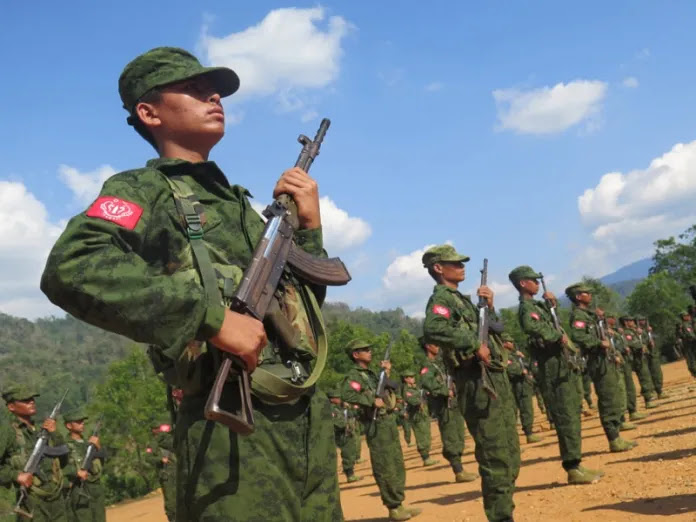
Myanmar has blamed the Arakan Army and the Arakan Rohingya Salvation Army or ARSA for the mortar attack on the border. At the same time, they claimed that the base of these organizations is in Bangladesh.
According to media reports, Myanmar Foreign Ministry Director General U Jau Phyu Win summoned Bangladeshi Ambassador Manjurul Karim Khan Chowdhury on Monday and explained his position regarding the mortar attack inside the border of Bangladesh.
Win called the ambassador of Bangladesh and blamed the Arakan Army and the Arakan Rohingya Salvation Army (Arsa) for the mortar attack on the border. At the same time, he accused Arakan Army and Arsa of having 'bases' inside Bangladesh and demanded to take quick steps to investigate and remove them.
Although Dhaka has followed the diplomatic path since the beginning to find a solution to the shootings and casualties on the border, Myanmar on Tuesday blamed the Arakan Army and the Arakan Rohingya Salvation Army or ARSA. At the same time, they claimed that the base of these organizations is in Bangladesh. In response, the Ministry of Foreign Affairs said that whenever Bangladesh protests something related to the Rohingya, Myanmar tries to turn the tide of the situation by making "mischievous" false statements. Bangladesh has also claimed that these incidents in Myanmar are not 'new'. In such a situation, Myanmar's shelling continued yesterday at Tambru, Palongkhali and Ukhia borders.
Amidst this accusation of Myanmar, the Ministry of Foreign Affairs briefed the ambassadors and high commissioners of various countries on the border situation of Bangladesh-Myanmar at the State Guest House Padma on Tuesday. the previous day, Dhaka informed the diplomats of the ASEAN countries about the border situation.
Bangladesh said, such statements of Myanmar are 'traditional. Dhaka has officially rejected the allegations of Rohingya Salvation Army (ARSA) and Arakan Army (AA) bases in Bangladesh.
ARSA is fighting against Myanmar in the name of protecting the rights of Rohingya in Rakhine. And the Arakan Army continues to fight for the rights of different ethnic groups. Recently, Myanmar accused Rohingya Salvation Army (ARSA) and Arakan Army (AA) of having bases in Bangladesh. Myanmar also claims that insurgents are working together in the border region of Bangladesh to establish control in various regions of Myanmar.
But it isn't true that none of these organizations are operating in Bangladesh and Bangladesh is also "not harboring any militant group on its soil. This allegation is completely false and baseless. It is not possible for any militant base to be operated in Bangladesh amid the high level of vigilance and effective countermeasures of the security forces in Bangladesh as the Bangladesh government follows the policy of zero tolerance against these militant groups.
The Arakan Army has been fighting the Myanmar government for the past few years to establish a federal state system. The organization has intensified its military activities since last month. They recently attacked allegedly security posts. On the other hand, ARSA attacked some border posts in Rakhine State in 2017, claiming to protect the rights of Rohingya Muslims. Under the pretext of that attack, the Myanmar army strengthened organized and structured counter-insurgency operations in Rakhine.
In 2012 and 2017, more than 100,000 Rohingya fled to Bangladesh after suffering ethnic cleansing and genocide. Myanmar is making various efforts to drive the rest out of Rakhine. While the entire international world has been demanding to recognize the Rohingya as citizens of Myanmar, Myanmar is trying to establish the people of that community as 'citizens of Bangladesh'. Besides, since long Myanmar has been trying to blame ARSA members on Bangladesh by calling them 'Bengali'. Naypyidaw complained about the presence of ARSA and AA bases in Bangladesh.
In this regard, anybody can recall the Bangladesh government's zero-tolerance policy against terrorism. Bangladesh must protest strongly and take action against Myanmar for such allegations.
Bangladesh has never had any intention to destabilize Myanmar by accommodating any other country or groups in Bangladesh. Not yet and will not be in the future.
It is not possible to conduct activities of militant and insurgent groups in any area of Bangladesh. Because the government led by Bangladesh Prime Minister Sheikh Hasina has completely adopted a zero-tolerance policy against militancy. Bangladesh is committed that no militant group will be allowed to operate on its soil. The current unrest in Myanmar is due to internal political and social problems. Bangladesh will express satisfaction only if the responsibility of Myanmar's internal problems is not put on Bangladesh.
Bangladesh is working to prevent terrorism and extremism nationally, regionally and globally. At the same time, they are ready to work with Myanmar to prevent terrorism and militancy.
Myanmar will naturally now blame Bangladesh for the border situation. They say that the Arakan Army and Arakan Rohingya Salvation Army (ARSA) are involved in the border situation. At the same time, let them prove the allegations that there are bases of Arakan Army and Arsa inside Bangladesh. If you complain without evidence, it will not happen. A UN team should be deployed if necessary. But they are not allowing the UN to enter. The UN team should be allowed to enter Arakan if there is evidence to support their allegations. Bangladesh's Prime Minister has also urged that they give the UN team an opportunity to work in Arakan.
The incident of mortar shells fired repeatedly by the Myanmar army on the Bangladesh border should be taken to the international arena. Myanmar claims that Arakan Army and ARSA have bases inside Bangladesh. If there is, then give an opportunity to allow the United Nations to work with a friendly state of Myanmar. Such accusations of Myanmar show that they have failed to protect the internal peace of their country. If it fails, it can seek help from the United Nations. Because the United Nations has multiple peacekeeping mechanisms. But they are not doing that. Instead, it is creating tension on the border.
Myanmar deliberately wants Bangladesh to fight with them. But the path of patience that Bangladesh has chosen is better. There is no other alternative in the current situation. It would not be appropriate for Bangladesh to engage in war with them in any way. Myanmar will benefit if the war is involved. Because if there is a war, Myanmar will have the opportunity to say that the Rohingyas are not theirs, but the Rohingyas of Bangladesh. In that case, the patience that Bangladesh is holding now is a gain for the country. Bangladesh should increase diplomatic activity in the international arena.
When Bangladesh is working to ensure the security for the region including Indian North Eastern part from terrorism, extremism, separatism etc., a recent inappropriate false claim by Myanmar can hamper the regional situation. When Bangladesh is working to curb the extremism, terrorism, separatism to bring peace in the region, Myanmar's such claim at this time which is very inappropriate because it will jeopardize the Rohingya repatriation process. The contribution of Bangladesh against countering terrorism and insurgency is well known to the world. Bangladesh ensured the region including Indian North Eastern part from terrorism, extremism, separatism etc. Bangladesh has established an example in the whole world to deal or counter with separatism, terrorism and extremism (ULFA terrorists and separatists, Holy Artisan incidents, JMB terrorists for the region).
Former director-general of Indian NSG (National Security Guard), Jayanto Narayan Choudhury said recently that the security challenges India faced in its northeastern region have been controlled and managed, in part thanks to the enormous assistance Bangladesh has provided. It is true that Bangladesh played major role in ensuring peace in northeast India.
Bangladesh is responsible for laying the foundation for a tranquil North East India. Bangladesh has been crucial in the region’s efforts to reduce terrorism and insurgency movements. North East India especially Assam has been liberated from separatism and extremism thanks to Bangladesh’s transfer of ULFA fighters to India. Bangladesh wants its neighbors to live in peace and harmony. Bangladesh rejects anarchy and turmoil. As a result, Bangladesh deserves to receive eternal gratitude from North East India and Myanmar. Conflicts on either the domestic or international front are disliked in Bangladesh. In order to achieve this, Bangladesh and the CHT militants signed the “Chittagong Hill Tract Peace Accord” in 1997.
Bangladesh strictly forbade the activity of these terrorist and rebel organizations that receive support from abroad. Bangladesh truly wishes North East India and Myanamr well. This should be understood by Myanmar and all the North-East Indian states.
It is Bangladesh that paved the way to build a peaceful North East India. As a regional state, India is benefitting from that. Bangladesh has played a vital role in curbing terrorism and separatism for the region. Bangladesh's handing over ULFA militants to India has freed Assam from separatism and extremism. Bangladesh wants peace and harmony with its neighbours. Bangladesh doesn't believe in anarchy, chaos.
---
*Researcher and Security Affairs Analyst, Dhaka
Comments