
Rajasthan cops 'halt' Gujarat Dalit women's rally: homage to untouchability victim boy

Counterview News   
In a surprise move, the Rajasthan police stopped a Dalit women's rally from Gujarat on the borders after it crossed Gujarat alleging that it would "disturb peace" in village Surana, Jalore district, where the gruesome incident of death of a Dalit boy took place on August 13 after he was brutally beaten up by his teacher on touching the drinking water pot.
Sources said, while the Gujarat government had "no objection" in allowing the rally, which originated from the Dalit Shakti Kendra (DSK), an empowerment-cut-technical institute for teens founded by human rights leader Martin Macwan, on September 24 morning, the Rajasthan police stopped it for two and a half hours before allowing it to proceed to Surana.
The decision to take out a women's rally was taken at a DSK meeting on September 5 following a condolence meeting of the NGO Navsarjan Trust, also founded by Macwan, activists committed to work against caste-based discrimination, organised to offer condolences to Dalit boy Indra Kumar Meghwal.
Claimed an NGO communique, simultaneous condolences were held in 1508 villages of 12 states of India, where people also donated Rs 2,77,229 to support the parents of the Dalit. The condolence meetings also discussed the "brutal mindset of teachers discriminating Dalit students in the school, and instead of building a strong nation, they are segregating children based on caste", the NGO said.
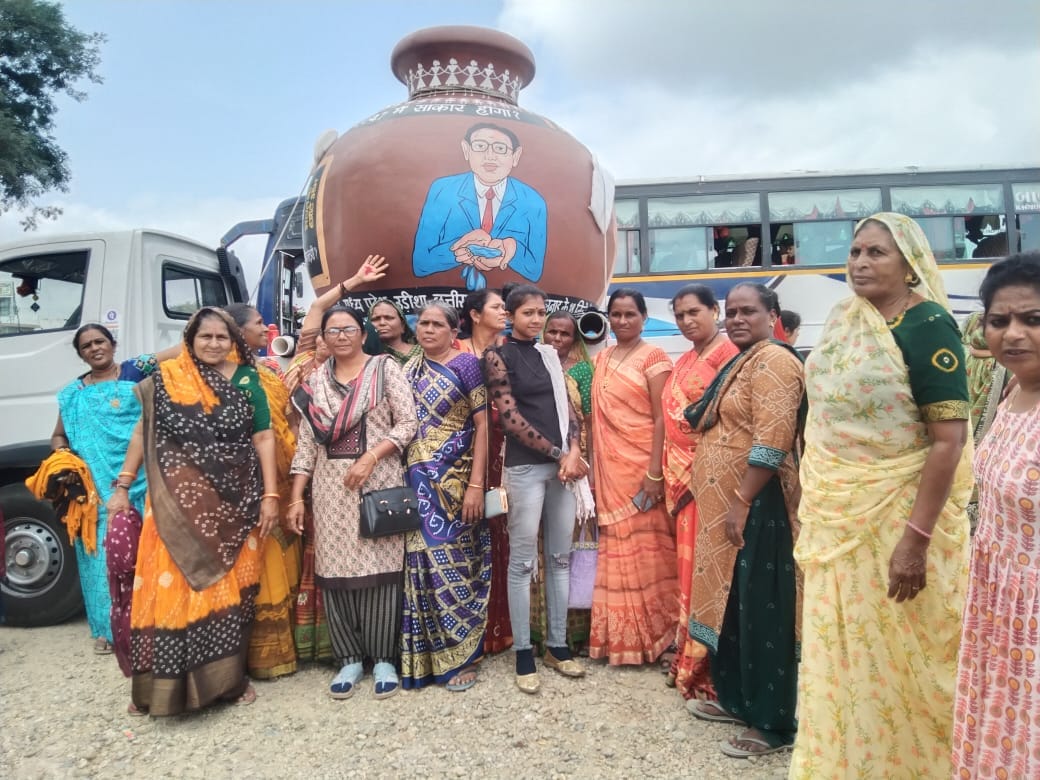
According to the NGO, the rally, which consisted of just 275 women, was held on September 24, which also happens to be the 90th anniversary of the Poona Pact, where Mahatma Gandhi promised an untouchability free India to Dr BR Ambedkar. In exchange, Ambedkar gave up his demand for separate electorate for the Dalits.
The 275 women were stopped by Rajasthan police near Raniwara village on the border of Gujarat and Rajasthan. They carried with them a 7 feet pot having the public donation of Rs 2,77,229 to the parents of Meghwal. All 275 women sat on a dharna on the road against the act of police and "for violating the fundamental right of peaceful protest."
The 7 feet tall drinking water pot was especially built with the painted images of Indra Kumar Megwal and Ambedkar, who took water from Chavdar lake of Mahad as a mark of symbolic protest against untouchability. "The pot was finally allowed be kept in the old village house of the Dalit boy as a memorial, and also to understand the reality of Dalit children", the source said.

Comments

TRENDING

New global framework calls for systemic regulation of ultra-processed foods: India urged to act

Counterview News    A landmark study  published in Obesity Reviews has for the first time applied ecological regulation theory to food policy design, offering a systemic blueprint for curbing ultra-processed foods (UPFs). The paper, co-authored by Dr. Arun Gupta, Founder of the Breastfeeding Promotion Network of India (BPNI) and Convenor of Nutrition Advocacy for Public Interest (NAPi), synthesized evidence from a systematic review of 2,706 academic sources and 39 reports from major global food policy organizations, ultimately analyzing 418 academic papers and 23 reports in depth. 

India’s gaming market grows 17% after money-game ban, but loot boxes remain unregulated

By Jyoti Prakash Pujari, Hoideiniang Zou  At midnight on 19 November, Grand Theft Auto VI went on sale in India at ₹5,999, available only on PlayStation 5 and Xbox Series X|S; no PC version has been announced. For most young Indians, the most anticipated game in years will be something to watch on YouTube rather than play. The games they actually play cost nothing to install and earn their money in small, constant purchases. On 28 October, Garena relaunched Free Fire in India, four years after the government banned the original game; players under 18 now need a parent’s consent and can play for three hours a day. Garena says minors also face a spending cap, but it did not publish the figure at launch. The limits answer a problem the Hyderabad Police described in June. In an unusual advisory to parents , the force said most of the fraud complaints reaching its cybercrime cell involved no hacker at all. Instead, children had been buying in-game items with a family membe...

Disability, discrimination and poverty: The struggles of visually impaired women

By N.S. Venkataraman*  The United Nations General Assembly proclaimed December 3 as the International Day of Persons with Disabilities through a resolution adopted in 1992. The annual observance provides an opportunity to highlight the challenges faced by persons with disabilities, raise public awareness and encourage efforts to improve their living conditions. Men and women with different types of disabilities live in all parts of the world, and many countries observe this day by focusing on their welfare and rights. Over the years, several initiatives have been undertaken to understand and address the difficulties faced by persons with disabilities. Technological advances and proactive government measures have also helped reduce some of the hardships they experience. Disabilities include visual impairment, physical disabilities, hearing and speech impairments, intellectual disabilities and learning difficulties. While persons with disabilities face numerous challenges...