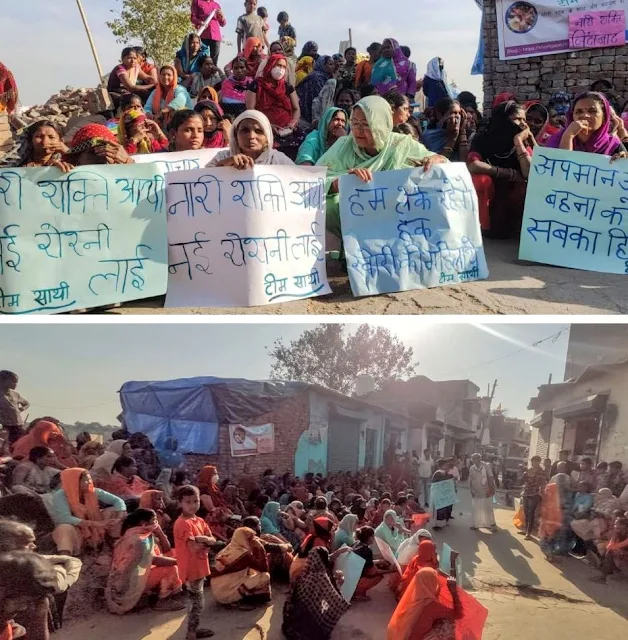
"We will take what is our rightful due through struggle"; "we seek accountability for the jail and unlawful displacement from the government"; "women of the world are all together in their struggle": These were some of the slogans which reverberated at the women’s day programme celebrated at the Khori village, at the Delhi-Haryana border.
Organized at Chungi No. 3 Lal Kuan, Delhi, right on the Delhi-Haryana border on the road to Delhi, with the demolished Khori village in the background, those who spoke about "eviction and atrocities" since July 14, 2021 included Rekha Behen, Samina Khatoon, Sitara, Radha Devi, Najma Khatoon, Sumitraji, Gurdeep Kaur and Usha Behen.
They said, March 8 is a day of respect for women. But they cannot forget how they were forcibly evicted from their homes. They were constantly being attacked. In Faridabad even today there are 122 sites illegally occupied but no action is taken by the government. The inhuman evictions that started from July 14, 2021. The police lathi-charged even on women and girls. Some of them were hit with sticks, caught and put in jail.
According to them, women were tortured by the police. Due to broken houses, pregnant, handicapped, old women and young girls suffered a lot. Forced to defecate in the open, they were bothered every day. The hungry and thirsty people of Khori village were left to fend for themselves in the rain. Nothing was thought about the education of girls. There is a slogan across the country “beti padhao beti bachao”, but for whom? The reality of the slogan in Khori is "deti ujado" (displace daughter).
According to them, they have the right to celebrate the women's day. But how do they celebrate? They have no home, they are homeless. The atrocities committed in Khori village will not be forgotten. They will take account of this from the government and carry forward their struggle, they pledged.
Rekha Bahen sang "Komal hai kamjor nahi -- shakti ka naam hi naari hai" at the end of the programme. The Women also sang the famous struggle song "Isiliye raah sangarsh ki hum chale". The youth of the Team Saathi, which is supporting the struggle, repeated young poet Pash's poem “Hum ladehenge saathi” (We will fight together) by linking it to the demolition of Khori village.
Comments