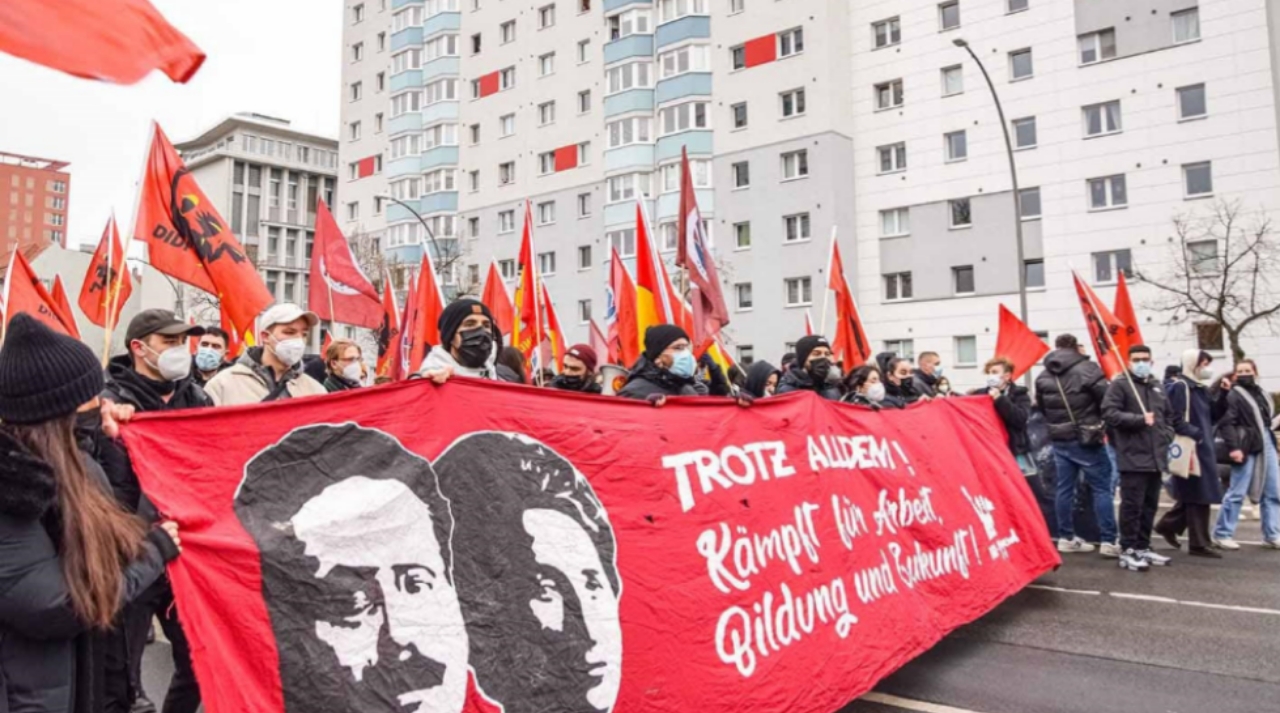
On the Sunday, January 14, the traditional “the three Ls” demonstration was held, commemorating Karl Liebknecht, Rosa Luxemburg and Lenin in the city of Berlin. Among many groups, the Red League and Partizan participated in the march with slogans upholding the heroic Palestinian National Resistance (slogans prohibited in Germany for “anti-Semitism”) and red flags. Also slogans for the International Communist League could be heard.
The two founders of the Communist Party of Germany (KPD) were assassinated by right-wing paramilitaries (on the orders of a social democratic government) on January 15, 1919. For over a century, demonstrators have commemorated their memory every second Sunday in January, marching to the Socialist Cemetery and planting huge piles of red carnations on the graves.
The police brutally assaulted the protesters and detained the speaker of the Palestinian Bloc, which caused a 45-minute tussle where the revolutionaries retaliated the fascist aggression of the police. The combat resulted in 16 protesters arrested, 21 police officers injured and an attempted murder of a “65-year-old man”, who was denied medical attention when he was bleeding profusely, from the nose, ear and mouth and the police tried to smash his head against the floor. Very positive that a man who was called the “65-year old man” in most of the reports is no longer in a a critical condition, recovering in the hospital .He overcame the attempted murder by the police and thereby he had shown that he is a die hard veteran of the revolutionary movement.
The Red League (Roter Bund) analyzed this and wrote in its call:
“This year’s Lenin-Liebknecht-Luxemburg demonstration took place in a scenario in which the liberation struggle of the people of Palestine has once again spearheaded the international and national class struggle. It manifests or unfolds that the most important contradiction in the world is that between imperialism and the oppressed nations.. The effects of the aggression of imperialism and the Israeli state against the people of Palestine and the imperative protest of important sections of the people here in Germany against it .The fascist attacks of the German state and its repressive authorities unleashed against them, which involves the demonization of entire parts of the population in order to break the working class into domestic and foreign workers and to disrupt the construction of the anti-imperialist movement, has made this question the most important aspect today for every communist and revolutionary.”
This year, the LLL demonstration was again mercilessly attacked by the Berlin police.. The policemen kept barging into the crowd, deliberately made punches at the level of the head, attacked individual people by groups, beat and mercilessly kicked those lying on the ground. Bystanders on the sidewalk were tossed around for no reason. Several people were seriously injured, who then had to be treated in the hospital. The Berlin police purposely sabotaged medical relief for injured people by intimidating the paramedics in their work and police officers refused to request ambulances. Press was also threatened with dire consequences from reporting and documenting the police violence.
From the very beginning, riot cops were surveying or patrolling the Palestine Bloc that had been organized by groups like Jüdische Stimme and Palestine Speaks, alongside socialist groups like Klasse Gegen Klasse, Revolutionäre Linke, and Sozialismus von unten. Halfway through the demonstration — right next to the former headquarters of East Germany’s Ministry for State Security — they arrested a speaker.
The police claimed he was guilty of “supporting a terrorist organization” because he had sung d “from the river to the sea.” This slogan, police say, is a clear endorsement of Hamas which is absurd: The slogan “from the river to the sea” was popular among supporters of Palestinian liberation since at least the 1970s, nearly two decades before Hamas’s founding.
The results of this year’s LLL-Demonstration testified that everyone who is morally on the side of the oppressed and exploited in Germany and the world has to be unconditionally prepared to be confronted with the most ruthless repression by the State. The comrades in the block of Partizan and the Red League illustrated that they would relentlessly, unfurl the banner of combat and resistance.
In the demonstration Partizan (Germany) and Red League as well as some new and old comrades and friends from Germany and abroad marched together under the slogan “Long live the heroic liberation struggle of the people of Palestine” submerged by the slogans “Long live the International Communist League” and “Let us follow in the footsteps of Luxemburg, Liebknecht and Lenin, the great master of Marxism-Leninism-Maoism, to overthrow the ‘giant with feet of clay’!”. Here the banners of Partizan, the Red League and the International Communist League shimmered alongside the flags of the Palestinian Liberation Struggle.
That the support for the Liberation Struggle of the People of Palestine in the class struggle, , is of utmost importance, was not only exhibited by the large amount of Palestinian flags that waved all along the demonstration, but when the police detained a speaker from the Palestine block. Broad solidarity developed immediately for the first prisoner of the day, in which the block of Partizan (Germany) and the Red League also participated. A big part of the demonstration that already marched past the place of the detention showed its solidarity and turned around. Subsequently the police forces became submerged by demonstrators, and they immediately tried to evade punishment by fleeing in the rear and attacking some parts of the demonstration. Still this invited a reprisal from broader parts of the demonstration. It was in this juncture when the police tried to kill the so-called “65-year old man” by banging his head against the street, and even though he was bleeding profusely, from his nose, ear and mouth, denied medical treatment. Only the sustained efforts of the demonstration medics paved for a treatment to take place. This attempted murder immediately was condemned vociferously by the surrounding demonstrators who shouted loudly “blood, blood, blood on your hands!” at the culprits who tried to camouflage or mask their crime before the eyes and cameras of the surrounding crowd.
At the conclusion of the clashes the cops were only able to arrest 16 demonstrators but suffered 21 injured cops. The merciless violence they used, even trying to beat a veteran comrade to death, expressed the tendency of the police state. Anti-fascist resistance and anti-imperialist spirit climbed a superlative height in the demonstration. It built base for genuine anti-imperialist polarisation.
What was commendable is the solidarity and retaliatory stance the KGÖ, RJ, the Class Struggle block, and other revolutionary forces took when they confronted the police and thereby prevented further arrests. On the other hand the MLPD and other revisionists and opportunists did not move a finger, exhibiting a capitulationist approach. The MLPD defended their imperialist-chauvinist positions against the resistance of the oppressed peoples. “We must distance ourselves from the slogan that was supposedly shouted from the Palestinian block ‘Yemen, Yemen, make us proud, turn another ship around!’ That is a reactionary slogan. The Houti militias are acting on demand of the new-imperialist Iran. Their action has nothing to do with the solidarity with the Palestinian Liberation Struggle”.
---
*Freelance journalist
Comments
Post a Comment
NOTE: Hateful, abusive comments won't be published. -- Editor