
ONGC, State Bank of India 'stakeholders' in junta-supported Myanmar-China pipelines

By Henrieke Butijn* 

Some banks are comfortable financing atrocities, as is clear with the financiers that are bankrolling the fossil fuel giants that run the Myanmar-China pipelines. The Myanmar junta, who began an illegal attempted coup in February 2021, receives revenue from oil and gas projects and profits from the Myanma Oil and Gas Enterprise (MOGE) shares in projects.
MOGE is a state agency illegally under military control. The oil & gas sector has earned the Myanmar junta 800 million US dollars in April to July 2022 alone, according to the junta’s own figures. A significant portion of these earnings are from the Shwe gas project and connected Myanmar-China oil and gas pipelines. These projects are run by fossil fuel giants linked to banks covered by the Banking on Climate Chaos report which was published last week.
A junta that has killed over 3,200 people and arrested over 21,000 more since its illegal coup attempt unsurprisingly uses violence to protect the funding that enables its international crimes.
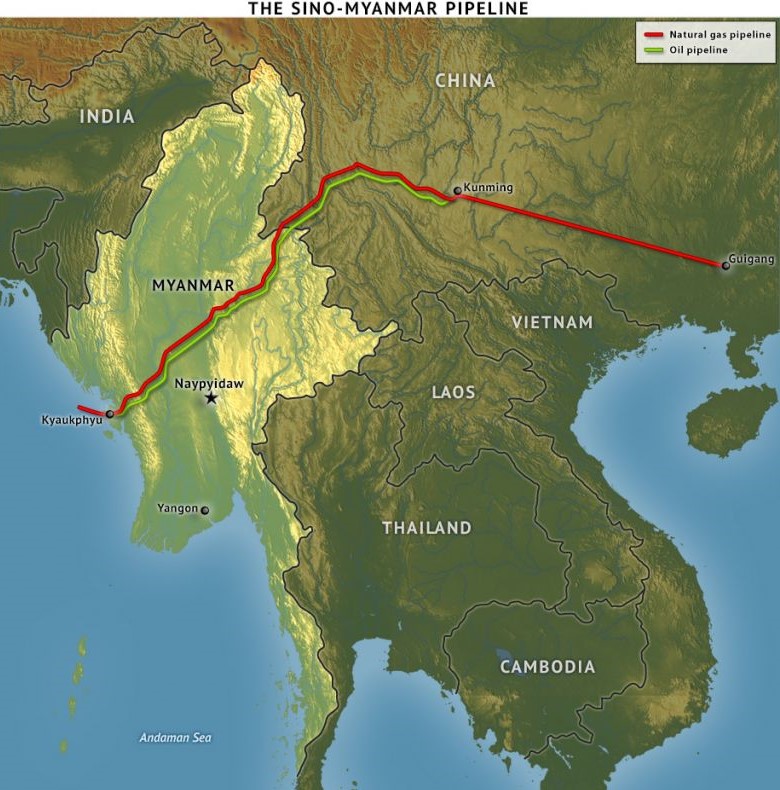
A Banking on Climate Chaos frontline story by Rainforest Action Network, BankTrack, and local partners follows the Myanmar-China oil and gas pipelines which start in Rakhine State (southwest Myanmar) and transverses the country’s heartland to enter Yunnan, China, from northeastern Shan State.
It shows people, who were displaced by the junta, in the path of this pipeline and land soured by pipeline construction, practically destroying farming that sustained communities for generations.
The study reports on entire villages in fear of pipeline explosions and environmental destruction. Military installations monitor farmers everyday, and just last year, the military laid landmines near the pipelines -- making people risk death daily for walking on their own lands.
At its coastal southern hub of another pipeline, on Ma-De Island, the pipeline resulted in land confiscation that affected the majority of residents. Fearing repression by the former military regime, many remained silent. The Myanmar China Pipeline Watch Committee (MCPWC) reports that this pipeline project caused environmental damage in 21 townships. “We know who is to blame for destroying the lives of people in the path of these pipelines", it said.
Among the main shareholders of the Myanmar-China pipelines are CNPC, POSCO, Oil & Natural Gas Corporation (ONGC) and KOGAS, bankrolling the military junta’s atrocities. In 2022 alone, these four companies together received nearly US$ 7.3 billion in corporate finance, with CNPC receiving the most with US$ 6.7 billion.
Their biggest and most recent financiers are ICBC, Bank of China, Agricultural Bank of China, KB Financial, UBS, Citi, State Bank of India, SMBC and BNP Paribas.
Construction of the pipelines began during Myanmar's military-controlled political and economic reforms, which ended when the military began its illegal attempted coup. Since then, the junta has waged a nationwide campaign of terror, backed by the flow of funds from the Myanmar-China pipelines, and other oil and gas projects.
Brave people are speaking out against the pipeline and how it destroys their way of life; ecologically and politically. They are showing undeniable proof of how the fossil fuel giants and the military junta profits off of their loss of life and lands that banks cannot ignore. 
The story shows a video of the pipeline threatening food sovereignty, people terrified for their lives, and a military attempting to control people for the sake of pipelines and to keep the blood money flowing.
The OECD Guidelines for multinational enterprises and the UN Guiding Principles on Business and Human Rights both clearly set out that international investors, including banks, have a responsibility to use their leverage to ensure their clients act to prevent or mitigate human rights abuses. 
Big financiers must consider that investing in or financing fossil fuel companies that military juntas rely on for funding violence is not worth whatever the financial gain.
---
Climate campaigner & researcher, BankTrack. Source: BankTrack email alert

Comments

TRENDING

From plagiarism to proxy exams: Galgotias and systemic failure in education

By Sandeep Pandey*   Shock is being expressed at Galgotias University being found presenting a Chinese-made robotic dog and a South Korean-made soccer-playing drone as its own creations at the recently held India AI Impact Summit 2026, a global event in New Delhi. Earlier, a UGC-listed journal had published a paper from the university titled “Corona Virus Killed by Sound Vibrations Produced by Thali or Ghanti: A Potential Hypothesis,” which became the subject of widespread ridicule. Following the robotic dog controversy coming to light, the university has withdrawn the paper. These incidents are symptoms of deeper problems afflicting the Indian education system in general. Galgotias merely bit off more than it could chew.

The 'glass cliff' at Galgotias: How a university’s AI crisis became a gendered blame game

By Mohd. Ziyaullah Khan*  “She was not aware of the technical origins of the product and in her enthusiasm of being on camera, gave factually incorrect information.” These were the words used in the official press release by Galgotias University following the controversy at the AI Impact Summit in Delhi. The statement came across as defensive, petty, and deeply insensitive.

Farewell to Saleem Samad: A life devoted to fearless journalism

By Nava Thakuria*  Heartbreaking news arrived from Dhaka as the vibrant city lost one of its most active and committed citizens with the passing of journalist, author and progressive Bangladeshi national Saleem Samad. A gentleman who always had issues to discuss with anyone, anywhere and at any time, he passed away on 22 February 2026 while undergoing cancer treatment at Dhaka Medical College Hospital. He was 74. 

From ancient wisdom to modern nationhood: The Indian story

By Syed Osman Sher  South of the Himalayas lies a triangular stretch of land, spreading about 2,000 miles in each direction—a world of rare magic. It has fired the imagination of wanderers, settlers, raiders, traders, conquerors, and colonizers. They entered this country bringing with them new ethnicities, cultures, customs, religions, and languages.

Conversion laws and national identity: A Jesuit response response to the Hindutva narrative

By Rajiv Shah  A recent book, " Luminous Footprints: The Christian Impact on India ", authored by two Jesuit scholars, Dr. Lancy Lobo and Dr. Denzil Fernandes , seeks to counter the current dominant narrative on Indian Christians , which equates evangelisation with conversion, and education, health and the social services provided by Christians as meant to lure -- even force -- vulnerable sections into Christianity.

Sergei Vasilyevich Gerasimov, the artist who survived Stalin's cultural purges

By Harsh Thakor*  Sergei Vasilyevich Gerasimov (September 14, 1885 – April 20, 1964) was a Soviet artist, professor, academician, and teacher. His work was posthumously awarded the Lenin Prize, the highest artistic honour of the USSR. His paintings traced the development of socialist realism in the visual arts while retaining qualities drawn from impressionism. Gerasimov reconciled a lyrical approach to nature with the demands of Soviet socialist ideology.

Thali, COVID and academic credibility: All about the 2020 'pseudoscientific' Galgotias paper

By Jag Jivan*    The first page image of the paper "Corona Virus Killed by Sound Vibrations Produced by Thali or Ghanti: A Potential Hypothesis" published in the Journal of Molecular Pharmaceuticals and Regulatory Affairs , Vol. 2, Issue 2 (2020), has gone viral on social media in the wake of the controversy surrounding a Chinese robot presented by the Galgotias University as its original product at the just-concluded AI summit in Delhi . The resurfacing of the 2020 publication, authored by  Dharmendra Kumar , Galgotias University, has reignited debate over academic standards and scientific credibility.

Development at what cost? The budget's blind spot for the environment

By Raj Kumar Sinha*  The historical ills in the relationship between capital and the environment have now manifested in areas commonly referred to as the "environmental crisis." This includes global warming, the destruction of the ozone layer, the devastation of tropical forests, mass mortality of fish, species extinction, loss of biodiversity, poison seeping into the atmosphere and food, desertification, shrinking water supplies, lack of clean water, and radioactive pollution. 

Public money, private profits: Crop insurance scheme as goldmine for corporates

By Vikas Meshram   The farmer in India is not merely a food provider; he is the soul of the nation. For centuries, enduring natural calamities and bearing debt generation after generation while remaining loyal to the soil, this community now finds itself trapped in a different kind of crisis. In February 2016, the Modi government launched the Pradhan Mantri Fasal Bima Yojana (PMFBY) with the stated objective of freeing farmers from the shackles of debt. It was an ambitious attempt to provide a strong safety net to cultivators repeatedly devastated by excessive rainfall, drought, and hailstorms.