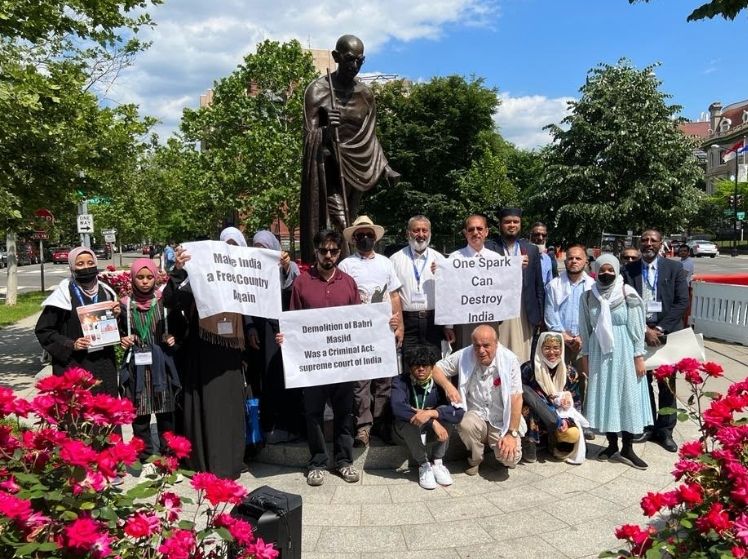
'Not just Gyanvapi, other mosques too face demolition': US Indian Muslims protest

By A Representative 

The Indian American Muslim Council (IAMC), claiming to be the largest advocacy organization of Indian Muslims, which organised a protesters near the Embassy of India in Washington, DC, has apprehended that the fate of hundreds of Indian mosques, such as the Gyanvapi masjid in Varanasi, might end up in the courts for many years.
Claiming that India’s Muslims, the country’s largest minority group with more than 200 million adherents, "have received the brunt of the persecution, including demolitions of their homes, businesses and places of worship by local authorities, acts of deadly violence and calls for genocide", IAMC said, "Mosques around the country, including those that have stood for centuries, are at risk of demolition."
Calling for an end to "human rights abuses and assaults on religious freedom in India", IAMC said in a statement following the protest, the participants included people of multiple faiths, pleading restoration India to a secular democracy in India, where people of many faiths live together.
Pointing out that "Christians also face persecution, such as assaults and mob violence at houses of worship, IAMC called the current state an "autocracy governed by the far-right Hindu extremist BJP", citing reports of sharp rise in "persecution of Muslims, Christians, Dalits and other minority groups".
The protest took place at the base of the statue of Mahatma Gandhi in Gandhi Memorial Plaza. The Indian embassy along Massachusetts Avenue was in the background, even as people took part in a Muslim prayer service, chanted and gave speeches.

Comments

TRENDING

From Kerala to Bangladesh: Lynching highlights deep social faultlines

By A Representative   The recent incidents of mob lynching—one in Bangladesh involving a Hindu citizen and another in Kerala where a man was killed after being mistaken for a “Bangladeshi”—have sparked outrage and calls for accountability.  

Gram sabha as reformer: Mandla’s quiet challenge to the liquor economy

By Raj Kumar Sinha*  This year, the Union Ministry of Panchayati Raj is organising a two-day PESA Mahotsav in Visakhapatnam, Andhra Pradesh, on 23–24 December 2025. The event marks the passage of the Panchayats (Extension to Scheduled Areas) Act, 1996 (PESA), enacted by Parliament on 24 December 1996 to establish self-governance in Fifth Schedule areas. Scheduled Areas are those notified by the President of India under Article 244(1) read with the Fifth Schedule of the Constitution, which provides for a distinct framework of governance recognising the autonomy of tribal regions. At present, Fifth Schedule areas exist in ten states: Andhra Pradesh, Chhattisgarh, Gujarat, Himachal Pradesh, Jharkhand, Madhya Pradesh, Maharashtra, Odisha, Rajasthan and Telangana. The PESA Act, 1996 empowers Gram Sabhas—the village assemblies—as the foundation of self-rule in these areas. Among the many powers devolved to them is the authority to take decisions on local matters, including the regulation...

When a city rebuilt forgets its builders: Migrant workers’ struggle for sanitation in Bhuj

Khasra Ground site By Aseem Mishra*  Access to safe drinking water and sanitation is not a privilege—it is a fundamental human right. This principle has been unequivocally recognised by the United Nations and repeatedly affirmed by the Supreme Court of India as intrinsic to the right to life and dignity under Article 21 of the Constitution. Yet, for thousands of migrant workers living in Bhuj, this right remains elusive, exposing a troubling disconnect between constitutional guarantees, policy declarations, and lived reality.

Policy changes in rural employment scheme and the politics of nomenclature

By N.S. Venkataraman*  The Government of India has introduced a revised rural employment programme by fine-tuning the Mahatma Gandhi National Rural Employment Guarantee Act (MGNREGA), which has been in operation for nearly two decades. The MGNREGA scheme guarantees 100 days of employment annually to rural households and has primarily benefited populations in rural areas. The revised programme has been named VB-G RAM–G (Viksit Bharat Guarantee for Rozgar and Ajeevika Mission – Gramin). The government has stated that the revised scheme incorporates several structural changes, including an increase in guaranteed employment from 100 to 125 days, modifications in the financing pattern, provisions to strengthen unemployment allowances, and penalties for delays in wage payments. Given the extent of these changes, the government has argued that a new name is required to distinguish the revised programme from the existing MGNREGA framework. As has been witnessed in recent years, the introdu...

Aravalli at the crossroads: Environment, democracy, and the crisis of justice

By  Rajendra Singh*  The functioning of the Ministry of Environment, Forests and Climate Change has undergone a troubling shift. Once mandated to safeguard forests and ecosystems, the Ministry now appears increasingly aligned with industrial interests. Its recent affidavit before the Supreme Court makes this drift unmistakably clear. An institution ostensibly created to protect the environment now seems to have strayed from that very purpose.

'Structural sabotage': Concern over sector-limited job guarantee in new employment law

By A Representative   The advocacy group Centre for Financial Accountability (CFA) has raised concerns over the passage of the Viksit Bharat – Guarantee for Rozgar and Ajeevika Mission (VB–G RAM G), which was approved during the recently concluded session of Parliament amid protests by opposition members. The legislation is intended to replace the Mahatma Gandhi National Rural Employment Guarantee Act (MGNREGA).

'Festive cheer fades': India’s housing market hits 17‑quarter slump, sales drop 16% in Q4 2025

By A Representative   Housing sales across India’s nine major real estate markets fell to a 17‑quarter low in the October–December period of 2025, with overall absorption dropping 16% year‑on‑year to 98,019 units, according to NSE‑listed analytics firm PropEquity. This marks the weakest quarter since Q3 2021, despite the festive season that usually drives demand. On a sequential basis, sales slipped 2%, while new launches contracted by 4%.  

Safety, pay and job security drive Urban Company gig workers’ protest in Gurugram

By A Representative   Gig and platform service workers associated with Urban Company have stepped up their protest against what they describe as exploitative and unsafe working conditions, submitting a detailed Memorandum of Demands at the company’s Udyog Vihar office in Gurugram. The action is being seen as part of a wider and growing wave of dissatisfaction among gig workers across India, many of whom have resorted to demonstrations, app log-outs and strikes in recent months to press for fair pay, job security and basic labour protections.

Public responses to the niqab incident and Iltija Mufti’s legal complaint

By Raqif Makhdoomi*  Following an incident in which the Chief Minister of Bihar was seen pulling aside the niqab of a Muslim woman doctor during a public interaction, the episode drew widespread attention and debate across India. Public reactions were divided, with some defending the action and others criticising it as an infringement on personal autonomy and dignity. The incident was widely circulated on social media and reported by national and international media outlets.