Rhino poaching in Assam amidst claim the gigantic animal has been 'fully protected'

By Nava Thakuria* 

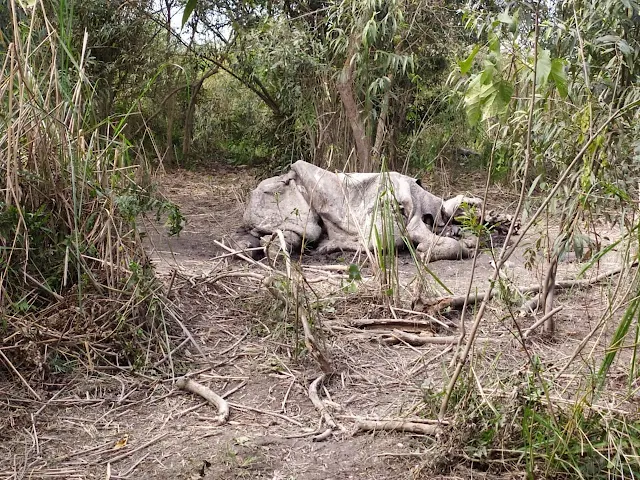
With one solitary incident of poaching of endangered one-horned rhinoceros at Kaziranga National Park and Tiger Reserve in Assam of northeast India last year, bad news broke in the first month of 2022, as the forest authority recovered the decomposed carcass of a full-grown (around 30 years old) female rhino in the world-famous forest reserve recently.
As apprehended, the precious horn was missing, for which the gigantic animal was seemingly hunted some days back. Ironically, only some hours earlier, cricket commentator and conservationist Kevin Pietersen appreciated Prime Minister Narendra Modi-led Union government in New Delhi on reduction of incidents related to rhino poaching.
“Bravo Narendra Modi and bravo to all the men and women who sacrifice their lives in protecting the animals in India too. I've met lots of them and I respect you immensely!”, Pietersen had said.
The South Africa born British celebrity responded to an input by a newsweekly on January 18, which quoted Assam’s anti-rhino poaching task force chief GP Singh, who made the claim on January 15 that only one incident of rhino poaching had taken place in April 2021 till date.
The special Assam police chief termed the containment of poaching of one-horned rhinos as a major achievement of the task force constituted by the State government appreciating the team work shown by various concerned district police forces.
Assam chief minister Himanta Biswa Sarma was quick to responded to Pietersen on a digital platform on January 19 thanking for the “acknowledgement.”
“Inspired by our PM Narendra Modi, we’ve launched aggressive programmes to curb poaching. We’re proud to have burnt & destroyed a stockpile of rhino horns, largest ever in the world, on World Rhino Day to send a stern message to poachers & syndicate,’ he tweeted.
Statistics reveal that Assam, which claims a success story for conserving two-thirds of world one-horned rhino population, has lately reduced the number of rhinos related poaching in the last few years, where it was lowest during 2021 in the last two decades.
Two previous years witnessed only five incidents of rhino-poaching in Kaziranga and other protected reserves of Assam, where two rhinos were poached in 2020 (three in 2019). It was relatively larger in number during 2018 (6 killed), followed by 2017 (7), 2016 (12), 2015 (17), 2014 (27), 2013 (27), etc.
---
*Senior journalist based in North-East

Comments

TRENDING

Plastic burning in homes threatens food, water and air across Global South: Study

By Jag Jivan  In a groundbreaking  study  spanning 26 countries across the Global South , researchers have uncovered the widespread and concerning practice of households burning plastic waste as a fuel for cooking, heating, and other domestic needs. The research, published in Nature Communications , reveals that this hazardous method of managing both waste and energy poverty is driven by systemic failures in municipal services and the unaffordability of clean alternatives, posing severe risks to human health and the environment.

From protest to proof: Why civil society must rethink environmental resistance

By Shankar Sharma*  As concerned environmentalists and informed citizens, many of us share deep unease about the way environmental governance in our country is being managed—or mismanaged. Our complaints range across sectors and regions, and most of them are legitimate. Yet a hard question confronts us: are complaints, by themselves, effective? Experience suggests they are not.

Economic superpower’s social failure? Inequality, malnutrition and crisis of India's democracy

By Vikas Meshram  India may be celebrated as one of the world’s fastest-growing economies, but a closer look at who benefits from that growth tells a starkly different story. The recently released World Inequality Report 2026 lays bare a country sharply divided by wealth, privilege and power. According to the report, nearly 65 percent of India’s total wealth is owned by the richest 10 percent of its population, while the bottom half of the country controls barely 6.4 percent. The top one percent—around 14 million people—holds more than 40 percent, the highest concentration since 1961. Meanwhile, the female labour force participation rate is a dismal 15.7 percent.

Kolkata event marks 100 years since first Communist conference in India

By Harsh Thakor*   A public assembly was held in Kolkata on December 24, 2025, to mark the centenary of the First Communist Conference in India , originally convened in Kanpur from December 26 to 28, 1925. The programme was organised by CPI (ML) New Democracy at Subodh Mallik Square on Lenin Sarani. According to the organisers, around 2,000 people attended the assembly.

From colonial mercantilism to Hindutva: New book on the making of power in Gujarat

By Rajiv Shah  Professor Ghanshyam Shah ’s latest book, “ Caste-Class Hegemony and State Power: A Study of Gujarat Politics ”, published by Routledge , is penned by one of Gujarat ’s most respected chroniclers, drawing on decades of fieldwork in the state. It seeks to dissect how caste and class factors overlap to perpetuate the hegemony of upper strata in an ostensibly democratic polity. The book probes the dominance of two main political parties in Gujarat—the Indian National Congress and the BJP—arguing that both have sustained capitalist growth while reinforcing Brahmanic hierarchies.

Urgent need to study cause of large number of natural deaths in Gulf countries

By Venkatesh Nayak* According to data tabled in Parliament in April 2018, there are 87.76 lakh (8.77 million) Indians in six Gulf countries, namely Bahrain, Kuwait, Oman, Qatar, Saudi Arabia and the United Arab Emirates (UAE). While replying to an Unstarred Question (#6091) raised in the Lok Sabha, the Union Minister of State for External Affairs said, during the first half of this financial year alone (between April-September 2018), blue-collared Indian workers in these countries had remitted USD 33.47 Billion back home. Not much is known about the human cost of such earnings which swell up the country’s forex reserves quietly. My recent RTI intervention and research of proceedings in Parliament has revealed that between 2012 and mid-2018 more than 24,570 Indian Workers died in these Gulf countries. This works out to an average of more than 10 deaths per day. For every US$ 1 Billion they remitted to India during the same period there were at least 117 deaths of Indian Workers in Gulf ...

The greatest threat to our food system: The aggressive push for GM crops

By Bharat Dogra  Thanks to the courageous resistance of several leading scientists who continue to speak the truth despite increasing pressures from the powerful GM crop and GM food lobby , the many-sided and in some contexts irreversible environmental and health impacts of GM foods and crops, as well as the highly disruptive effects of this technology on farmers, are widely known today. 

History, culture and literature of Fatehpur, UP, from where Maulana Hasrat Mohani hailed

By Vidya Bhushan Rawat*  Maulana Hasrat Mohani was a member of the Constituent Assembly and an extremely important leader of our freedom movement. Born in Unnao district of Uttar Pradesh, Hasrat Mohani's relationship with nearby district of Fatehpur is interesting and not explored much by biographers and historians. Dr Mohammad Ismail Azad Fatehpuri has written a book on Maulana Hasrat Mohani and Fatehpur. The book is in Urdu.  He has just come out with another important book, 'Hindi kee Pratham Rachna: Chandayan' authored by Mulla Daud Dalmai.' During my recent visit to Fatehpur town, I had an opportunity to meet Dr Mohammad Ismail Azad Fatehpuri and recorded a conversation with him on issues of history, culture and literature of Fatehpur. Sharing this conversation here with you. Kindly click this link. --- *Human rights defender. Facebook https://www.facebook.com/vbrawat , X @freetohumanity, Skype @vbrawat

Transgender Bill testimony of Govt of India's ‘contempt’ for marginalized community

Counterview Desk India’s civil society network, National Alliance of People’s Movements (NAPM)* has said that the controversial transgender Bill, passed in the Rajya Sabha on November 26, which happened to be the 70th anniversary of the Indian Constitution, is a reflection on the way the Government of India looks at the marginalized community with utter contempt.