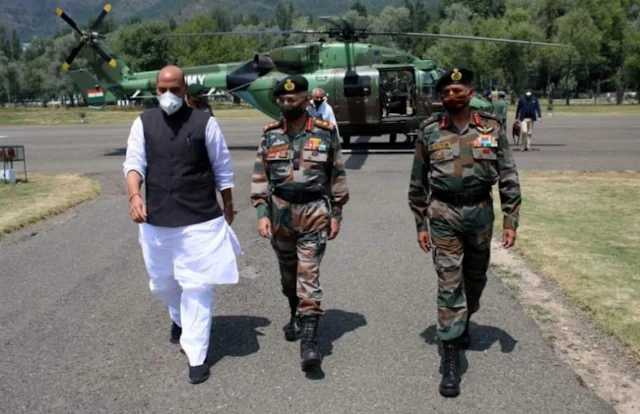
Being gay still illegal in Indian Army, 'high time' military gets in sync with times

Counterview Desk 

An online petition has been floated, addressed to Rajnath Singh, Defence Minister of India, stating that, in a landmark judgement handed down in 2018, the Supreme Court overturned a colonial-era law that criminalizes homosexual activities.
"After all these years, it’s high time the military gets in sync with the spirit of the time", the petition insists, pointing towards how his ministry is "censoring a film that shows a gay soldier", calling it "a major blow to the creativity of an industry India should be proud of."
"Mr Singh, we call on you to reverse the Ministry of Defence’s decision to reject a film about a gay man in the Army", adding, "The ministry should rethink its stand on this issue, which is inspired by a real-life struggle."

Text:

In India, any film showing content relating to the defence forces is required to get clearance from the Ministry of Defence.
That’s why, on December 16, 2021, Indian award-winning filmmaker and gay rights advocate Onir submitted to the Ministry of Defence the script of his new film, inspired by the story of a gay Major who quit the service.
After working freely on movies portraying queer lives and showing police abuse of gay characters, even when same-sex relationships were criminalized in India, he couldn’t expect that a fictitious story about a gay man in the Army, would be met with censorship in 2022.
But that is what has happened, despite the script being very respectful of the Army: On January 20, 2022, the Ministry of Defence communicated to the filmmaker that the script “has been analysed in detail. It is regretted to inform that the script has not been cleared by IHQ of MoD (Army).”
On questioning, Onir was told on a call that there was no specific problem with the script, but it cannot be cleared as being gay is “illegal” in the army.
Despite the Indian Supreme Court decriminalizing consensual same-sex relationships in 2018, it looks like the Indian Army have not recognized it yet and still treat anyone from the queer community as illegal.
This story has already been in the public domain for over two years, since Major J Suresh, who has retired now, gave an interview to New Delhi Television (NDTV) about his not being able to be himself in the Army and, therefore, having to quit it, to be honest to himself.
This story has to be told because it’s unacceptable that being queer still does not allow someone to serve the nation that they love by joining the Army.
---
Click here to sign the petition 

Comments

TRENDING

From plagiarism to proxy exams: Galgotias and systemic failure in education

By Sandeep Pandey*   Shock is being expressed at Galgotias University being found presenting a Chinese-made robotic dog and a South Korean-made soccer-playing drone as its own creations at the recently held India AI Impact Summit 2026, a global event in New Delhi. Earlier, a UGC-listed journal had published a paper from the university titled “Corona Virus Killed by Sound Vibrations Produced by Thali or Ghanti: A Potential Hypothesis,” which became the subject of widespread ridicule. Following the robotic dog controversy coming to light, the university has withdrawn the paper. These incidents are symptoms of deeper problems afflicting the Indian education system in general. Galgotias merely bit off more than it could chew.

Covishield controversy: How India ignored a warning voice during the pandemic

Dr Amitav Banerjee, MD *  It is a matter of pride for us that a person of Indian origin, presently Director of National Institute of Health, USA, is poised to take over one of the most powerful roles in public health. Professor Jay Bhattacharya, an Indian origin physician and a health economist, from Stanford University, USA, will be assuming the appointment of acting head of the Centre for Disease Control and Prevention (CDC), USA. Bhattacharya would be leading two apex institutions in the field of public health which not only shape American health policies but act as bellwether globally.

The 'glass cliff' at Galgotias: How a university’s AI crisis became a gendered blame game

By Mohd. Ziyaullah Khan*  “She was not aware of the technical origins of the product and in her enthusiasm of being on camera, gave factually incorrect information.” These were the words used in the official press release by Galgotias University following the controversy at the AI Impact Summit in Delhi. The statement came across as defensive, petty, and deeply insensitive.

Farewell to Saleem Samad: A life devoted to fearless journalism

By Nava Thakuria*  Heartbreaking news arrived from Dhaka as the vibrant city lost one of its most active and committed citizens with the passing of journalist, author and progressive Bangladeshi national Saleem Samad. A gentleman who always had issues to discuss with anyone, anywhere and at any time, he passed away on 22 February 2026 while undergoing cancer treatment at Dhaka Medical College Hospital. He was 74. 

Growth without justice: The politics of wealth and the economics of hunger

By Vikas Meshram*  In modern history, few periods have displayed such a grotesque and contradictory picture of wealth as the present. On one side, a handful of individuals accumulate in a single year more wealth than the annual income of entire nations. On the other, nearly every fourth person in the world goes to bed hungry or half-fed.

From ancient wisdom to modern nationhood: The Indian story

By Syed Osman Sher  South of the Himalayas lies a triangular stretch of land, spreading about 2,000 miles in each direction—a world of rare magic. It has fired the imagination of wanderers, settlers, raiders, traders, conquerors, and colonizers. They entered this country bringing with them new ethnicities, cultures, customs, religions, and languages.

Thali, COVID and academic credibility: All about the 2020 'pseudoscientific' Galgotias paper

By Jag Jivan*    The first page image of the paper "Corona Virus Killed by Sound Vibrations Produced by Thali or Ghanti: A Potential Hypothesis" published in the Journal of Molecular Pharmaceuticals and Regulatory Affairs , Vol. 2, Issue 2 (2020), has gone viral on social media in the wake of the controversy surrounding a Chinese robot presented by the Galgotias University as its original product at the just-concluded AI summit in Delhi . The resurfacing of the 2020 publication, authored by  Dharmendra Kumar , Galgotias University, has reignited debate over academic standards and scientific credibility.

'Serious violation of international law': US pressure on Mexico to stop oil shipments to Cuba

By Vijay Prashad   In January 2026, US President Donald Trump declared Cuba to be an “unusual and extraordinary threat” to US security—a designation that allows the United States government to use sweeping economic restrictions traditionally reserved for national security adversaries. The US blockade against Cuba began in the 1960s, right after the Cuban Revolution of 1959 but has tightened over the years. Without any mandate from the United Nations Security Council—which permits sanctions under strict conditions—the United States has operated an illegal, unilateral blockade that tries to force countries from around the world to stop doing basic commerce with Cuba. The new restrictions focus on oil. The United States government has threatened tariffs and sanctions on any country that sells or transports oil to Cuba.

Conversion laws and national identity: A Jesuit response response to the Hindutva narrative

By Rajiv Shah  A recent book, " Luminous Footprints: The Christian Impact on India ", authored by two Jesuit scholars, Dr. Lancy Lobo and Dr. Denzil Fernandes , seeks to counter the current dominant narrative on Indian Christians , which equates evangelisation with conversion, and education, health and the social services provided by Christians as meant to lure -- even force -- vulnerable sections into Christianity.