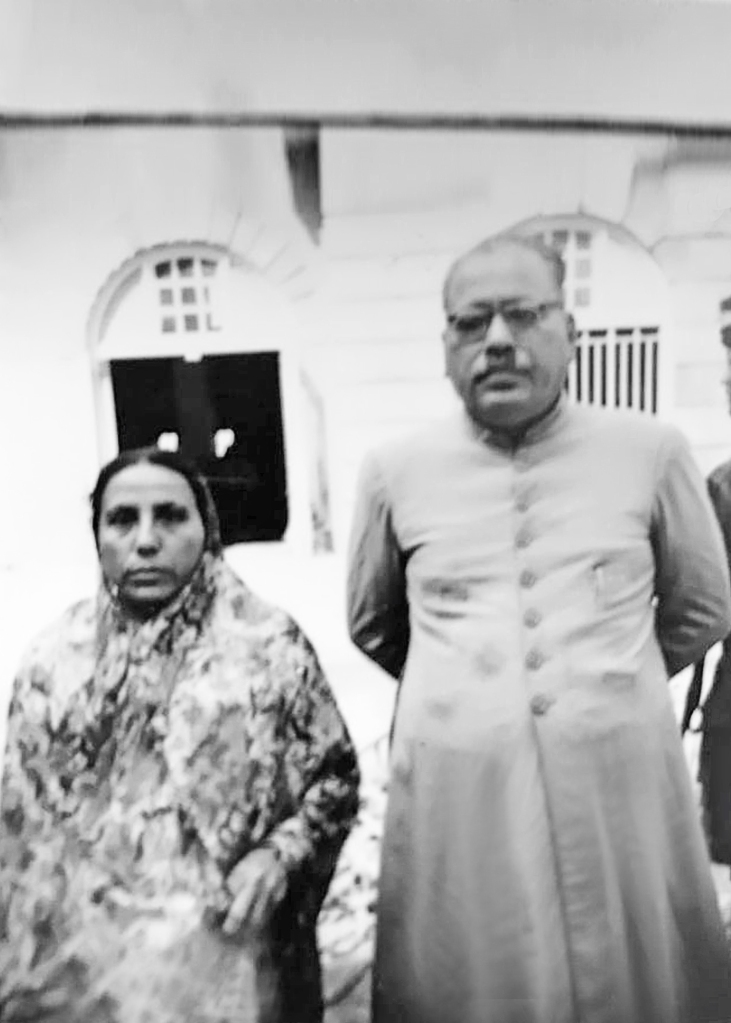
Kazi Karimuddin, who wanted to make right to privacy fundamental right

By Moin Qazi*
Vidarbha has been a fertile soil for many social reformers and intellectuals. It has played an active role in the nation’s destiny and its social, cultural and political rivulets have flown into and enriched the great sea of national civilization. One such luminary who emerged from Yavatmal was Kazi Syed Karimuddin. He rose to be a great criminal lawyer of the region and played a critical role in the drafting of the Indian constitution.
Kazi Karimuddin was born on 19 July 1899, at Darwah in Yavatmal district of Maharashtra to Kazi Syed Nasiruddin and Dayanath Begum. He had his school education at Mohamedan High School, Amravati. He graduated from Morris College, Nagpur and obtained his postgraduate degree in economics from Aligarh Muslim University. He later qualified for law. He married Qadirunnisa Begum (May 24, 1926) .
Kazi Karimuddin had an active presence in social, legal, judicial and political circles in Yavatmal. He was Vice Chairman, District Council (1924-28) Sub-judge (1928-31) President, Anjuman Middle School (1932-37) and Public Prosecutor (1939-45). He was member of Constituent Assembly (1947-50) and of Madhya Pradesh Assembly (1947-52) (at that time Madhya Pradesh was known as the Central Province). Following that, he was a member of the Rajya Sabha (the upper house of the Indian Parliament) from 1954 to 1958. He died on 14 September 1977.
Kazi Karimuddin moved an amendment in the Constituent Assembly on the lines of American Constitution to make right to privacy a fundamental right but Dr. B.R. Ambedkar gave it only reserved support. Article 20 provides that no person shall be convicted of any offence except for violation of a law in force at the time of the commission of the act; that no person shall be prosecuted and punished for the same offence more than once; and that no person accused of any offence shall be compelled to be a witness against himself.
Endowed with rare forensic skills, Kazi Karimuddin’s vast experience and insights gave him an uncanny knack for unraveling the anatomy and pathology of crimes. He was always apprehensive of the pervasive scope of the intrusive lens of the state as well as private agents. He considered privacy a vital constituent of a healthy constitutional polity since India’s large population of minorities had become vulnerable due to the emerging communal situation. He wanted that the following be added as clause (4) in article 20:
“The right of the people to be secure in their persons, houses, papers and effects against unreasonable searches and seizures shall not be violated and no warrants shall issue but upon probable cause supported by oath or affirmation and particularly describing the place to be searched and the person or things to be seized.”
He said: “This is very important amendment. You will be pleased to find that this finds place as article 4 in the American Constitution and in the Irish Constitution there are clauses (2) and (5) which are similar and in the German Constitution there are article 114 and 115 on the same lines. In the book of Dr. Ambedkar—Minorities and States—on page 11, item No. 10, a similar provision has been made. What is the situation in India today? …Arrests are made without warrant and searches without justification. We are being governed by lawless laws and there is no remedy for the redress of grievances on account of unauthorized arrests and searches.”
Dr. Ambedkar pointed out that this clause was already in the Criminal Procedure Code, and was therefore a part of Indian law, but also acknowledged that it may be desirable in the interests of personal liberty to ‘place these provisions beyond the reach of the legislature’. Despite Ambedkar’s support the amendment was negatived.
However the Karimuddin amendment in the Constituent Assembly re-emerged through the process of judicial engineering in Kharak Singh v. State of U.P where the court discussed the relationship between surveillance and personal liberty (personal liberty being guaranteed by the Constitution) and found that unauthorised intrusion into a person’s home would interfere with her right to personal liberty. The court recognised “the right of the people to be secure in their persons, houses, papers, and effects” and declared that their right against unreasonable searches and seizures was not to be violated.
Kazi Karimuddin was also the key persona in the deliberations on the Uniform Civil Code in the Constituent Assembly. He argued:
“The people outside and the members of the Constituent Assembly must realize that a Muslim regards the personal law as part of the religion and I really assure you that there is not a single Muslim in the country—at least I have not seen one—who wants a change in the mandatory provision of religious rights and personal laws, and if there is anyone who wants a change in the mandatory principle, or religion as a matter of personal law, then he cannot be a Muslim.”
Kazi Karimuddin had three sons and five daughters. Though he was a staunch opponent of the UCC, he was a very progressive and forward-looking Muslim who educated his children at the country’s premier educational institutions. Since Yavatmal did not have adequate facilities for higher learning, he sent his daughters to Hyderabad to pursue postgraduate courses at Osmania University which was a renowned educational hub for women. His sons-in-law also excelled in their respective fields: Nizamuddin Ahmed (LLM) was trained in UK in Labour Law and retired as Deputy Commissioner- Labour, Maharashtra; Syed Mukassir Shah was former Chairman of the Andhra Pradesh Legislative Council; Justice M.M. Qazi was former Chairman of the Maharashtra Administrative Tribunal and retired judge of Bombay High Court; and Dr Mirza Basheer Baig was an orthopedic surgeon (FRCS) in UK.
The life of Kazi Karimuddin serves as a beacon to modern day Muslims who are now at the most challenging crossroads in history.

*Development expert

Comments

TRENDING

India's chemical industry: The missing piece of Atmanirbhar Bharat

By N.S. Venkataraman*  Rarely a day passes without the Prime Minister or a cabinet minister speaking about the importance of Atmanirbhar Bharat . The Start-up India scheme is a pillar in promoting this vision, and considerable enthusiasm has been reported in promoting start-up projects across the country. While these developments are positive, Atmanirbhar Bharat does not seem to have made significant progress within the Indian chemical industry . This is a matter of high concern that needs urgent and dispassionate analysis.

A comrade in culture and controversy: Yao Wenyuan’s revolutionary legacy

By Harsh Thakor*  This year marks two important anniversaries in Chinese revolutionary history—the 20th death anniversary of Yao Wenyuan, and the 50th anniversary of his seminal essay "On the Social Basis of the Lin Biao Anti-Party Clique". These milestones invite reflection on the man whose pen ignited the first sparks of the Great Proletarian Cultural Revolution and whose sharp ideological interventions left an indelible imprint on the political and cultural landscape of socialist China.

Urgent need to study cause of large number of natural deaths in Gulf countries

By Venkatesh Nayak* According to data tabled in Parliament in April 2018, there are 87.76 lakh (8.77 million) Indians in six Gulf countries, namely Bahrain, Kuwait, Oman, Qatar, Saudi Arabia and the United Arab Emirates (UAE). While replying to an Unstarred Question (#6091) raised in the Lok Sabha, the Union Minister of State for External Affairs said, during the first half of this financial year alone (between April-September 2018), blue-collared Indian workers in these countries had remitted USD 33.47 Billion back home. Not much is known about the human cost of such earnings which swell up the country’s forex reserves quietly. My recent RTI intervention and research of proceedings in Parliament has revealed that between 2012 and mid-2018 more than 24,570 Indian Workers died in these Gulf countries. This works out to an average of more than 10 deaths per day. For every US$ 1 Billion they remitted to India during the same period there were at least 117 deaths of Indian Workers in Gulf ...

Remembering a remarkable rebel: Personal recollections of Comrade Himmat Shah

By Rajiv Shah   I first came in contact with Himmat Shah in the second half of the 1970s during one of my routine visits to Ahmedabad , my maternal hometown. I do not recall the exact year, but at that time I was working in Delhi with the CPI -owned People’s Publishing House (PPH) as its assistant editor, editing books and writing occasional articles for small periodicals. Himmatbhai — as I would call him — worked at the People’s Book House (PBH), the CPI’s bookshop on Relief Road in Ahmedabad.

Swami Vivekananda's views on caste and sexuality were 'painfully' regressive

By Bhaskar Sur* Swami Vivekananda now belongs more to the modern Hindu mythology than reality. It makes a daunting job to discover the real human being who knew unemployment, humiliation of losing a teaching job for 'incompetence', longed in vain for the bliss of a happy conjugal life only to suffer the consequent frustration.

History, culture and literature of Fatehpur, UP, from where Maulana Hasrat Mohani hailed

By Vidya Bhushan Rawat*  Maulana Hasrat Mohani was a member of the Constituent Assembly and an extremely important leader of our freedom movement. Born in Unnao district of Uttar Pradesh, Hasrat Mohani's relationship with nearby district of Fatehpur is interesting and not explored much by biographers and historians. Dr Mohammad Ismail Azad Fatehpuri has written a book on Maulana Hasrat Mohani and Fatehpur. The book is in Urdu.  He has just come out with another important book, 'Hindi kee Pratham Rachna: Chandayan' authored by Mulla Daud Dalmai.' During my recent visit to Fatehpur town, I had an opportunity to meet Dr Mohammad Ismail Azad Fatehpuri and recorded a conversation with him on issues of history, culture and literature of Fatehpur. Sharing this conversation here with you. Kindly click this link. --- *Human rights defender. Facebook https://www.facebook.com/vbrawat , X @freetohumanity, Skype @vbrawat

As 2024 draws nearer, threatening signs appear of more destructive wars

By Bharat Dogra  The four years from 2020 to 2023 have been very difficult and high risk years for humanity. In the first two years there was a pandemic and such severe disruption of social and economic life that countless people have not yet recovered from its many-sided adverse impacts. In the next two years there were outbreaks of two very high-risk wars which have worldwide implications including escalation into much wider conflicts. In addition there were highly threatening signs of increasing possibility of other very destructive wars. As the year 2023 appears to be headed for ending on a very grim note, there are apprehensions about what the next year 2024 may bring, and there are several kinds of fears. However to come back to the year 2020 first, the pandemic harmed and threatened a very large number of people. No less harmful was the fear epidemic, the epidemic of increasing mental stress and the cruel disruption of the life and livelihoods particularly among the weaker s...

Muslim women’s rights advocates demand criminalisation of polygamy: Petition launched

By A Representative   An online petition seeking a legal ban on polygamy has been floated by Javed Anand, co-editor of Sabrang and National Convener of Indian Muslims for Secular Democracy (IMSD), inviting endorsements from citizens, organisations and activists. The petition, titled “Indian Muslims & Secular Progressive Citizens Demand a Legal Ban on Polygamy,” urges the Central and State governments, Parliament and political parties to abolish polygamy through statutory reform, backed by extensive data from the 2025 national study conducted by the Bharatiya Muslim Mahila Andolan (BMMA).

Bangladesh alternative more vital for NE India than Kaladan project in Myanmar

By Mehjabin Bhanu*  There has been a recent surge in the number of Chin refugees entering Mizoram from the adjacent nation as a result of airstrikes by the Myanmar Army on ethnic insurgents and intense fighting along the border between India and Myanmar. Uncertainty has surrounded India's Kaladan Multimodal Transit Transport project, which uses Sittwe port in Myanmar, due to the recent outbreak of hostilities along the Mizoram-Myanmar border. Construction on the road portion of the Kaladan project, which runs from Paletwa in Myanmar to Zorinpui in Mizoram, was resumed thanks to the time of relative calm during the intermittent period. However, recent unrest has increased concerns about missing the revised commissioning goal dates. The project's goal is to link northeastern states with the rest of India via an alternate route, using the Sittwe port in Myanmar. In addition to this route, India can also connect the region with the rest of India through Assam by using the Chittagon...