
A new report, released by the People’s Union for Civil Liberties-Maharashtra, Fridays for Future-Karnataka, and Bahutva Karnataka has sought to contrast claims versus realities on the environment and climate change during the last ten years of NDA’s governance.
Titled ‘Guarantee check: State of India’s environment over the last decade – An exacerbating crisis’, during the online report release, Rohit Prajapati, noted environmentalist and founder, Paryavaran Suraksha Samiti, said that rivers in Gujarat are getting into a state of irreversible environmental damage due to industrial effluents being let in.
Prajapati said, while the highest permissible limit for Chemical Oxygen Demand (COD) are 250 mg/l as per Central Pollution Control Board (CPCB) standards, it's as high as 2500 in Gujarat’s groundwater in some locations, adding, this has happened due to a wilful neglect and inaction on industrial pollution. This has also caused ground water to get polluted and is therefore affecting farmers and farm produce as well.
Manshi Asher, Himachal based environment justice activist and researcher, spoke of the concerns with the environmental destruction in the Himalayan region, stating, while this region had been witnessing climate change, the policies and actions of the last ten years caused immense environmental damage due to the rapid change in the land use of the Himalayas.
Common lands and forests have been taken over for infrastructure development, mining is rampant. All of this has caused disasters like the Joshimath land subsidence, the Char Dham Tunnel collapse etc she said. Manshi also condemned the Uttarakhand government for neglecting the environmental disasters while employing distraction politics to promote polarisation and create a communal narrative in the state, Asher added.
Henri Tiphagne, National Working Secretary, Human Rights Defenders Alert-India, highlighted how 16 environmental defenders were killed in police firing in Thoothukudi, Tamil Nadu, to shut the Vedanta plant. Regretting that the National Human Rights Commission (NHRC), closed that case in just 6 months, he shared how in Jharkhand, Chhattisgarh and Odisha environmental activists face illegal arrests, have their phones and devices taken away and in some cases - custodial death. He bemoaned the fact that the NHRC has no guidelines for protecting activists working to protect the right to the environment.
Disha Ravi, Youth Climate Activist with FridaysForFuture India, speaking on the manifestos of different parties and what they say about the environment, highlighted how the BJP which has caused large scale deforestation and diluted laws affecting the rights of Adivasis, doesn't even mention forest rights in its manifesto.
While the BJP manifesto outlines its commitment to meet India’s still-unclear carbon sink target, it is silent on the forest rights of indigenous communities, unlike Congress, which promises to set up a national mission to guarantee their rights and to stem deforestation, Ravi said, adding, while the BJP’s manifesto pledges to support India’s automobile industry transition to electric vehicle manufacturing, it fails to mention coal even once or to outline how heavy industry will be decarbonised or to present any solutions to reduce carbon emissions beyond its existing Green Credit Programme.
Excerpts:
The NDA government has fulfilled a few of its guarantees or manifesto promises. However, on the issue of the environment, the government has acted in complete contradiction to the Prime Minister’s claims on international and domestic platforms. The BJP, led by the Prime Minister, promised to protect the coasts, forests, forest dwellers, Himalayas and all our natural resources.But under him, laws and policies concerning the environment have been diluted in a manner that has enabled a plunder of natural resources like never before, in India. Under his rule, India’s rank in the Environmental Performance Index has slid from 125/180 in 2012 to 180/180 in 2022.
At the same time, India’s ranking in the World Bank’s Doing Business Report jumped up from 142 in 2014 to 63 in 2019. The destruction of the environment is directly linked to a model of development that puts private profit over public goods, destructive development over sustainability.
Indiscriminate granting of clearances to projects and activities
The total number of clearances by the Environment Ministry increased 21 times, from 577 in 2018 to 12,496 in 2022 (Environmental +Forest + Wildlife + Coastal Regulation Zone clearances). Soon after coming into power in 2014, the current government fulfilled its commitment to industrialists, by approving at least 230 projects.For instance, providing a boost to the infrastructure and development companies, the government increased capital expenditure allocation for infrastructure projects to a remarkable 269.82% from FY 2018-19 to FY 2024-25. Meanwhile environmental laws were diluted to facilitate infrastructure projects and evade environmental impact assessment and public consultation processes.
Diluting and evading mandatory environmental impact assessment
The protections under the Environment Impact Assessment (EIA) Notification, 2006[1] were greatly watered down by a spate of amendments -- for example moving requirement for environmental clearances for certain projects/activities, exempting public consultation for certain projects/activities -- such as linear infrastructure projects, providing a window for regularising violating industries who had not obtained prior EC etc.Even in the midst of the Covid-19 lockdown, when public participation had been restricted, the government brought in a law like the Draft EIA Notification to overhaul the impact assessment process and ease grant of clearances.
Rampant diversion of forests / deforestation
Forest Conservation Act, 1980 was amended in 2023 to change the definition of forests and remove several forested areas from the scope of protection granted under the law (the definition however was later read down by the SC), thereby placing approximately 25% of India's forested areas at risk of urbanization, mining, and infrastructure expansion.This would severely impact the rights of indigenous tribes and forest-dwelling communities to be mandatorily consulted before granting approval for diverting forest land for non-forestry activities, and to self-govern as outlined in the Forest Rights Act of 2006 and under the Provisions of the Panchayats (Extension to Scheduled Areas) Act, 1996 - rights already diluted considerably by this regime. 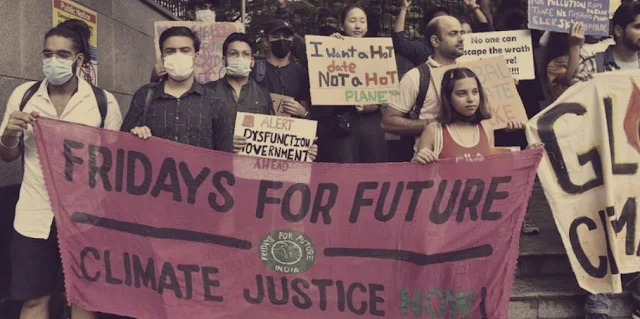 Even as extreme climate events are affecting the coastal areas, development projects such as the Rs. 72,000 crore Great Nicobar Mega Project, have been fast-tracked by the current government; It aims to divert 130 square kms of forest area in the Nicobar island towards a series of infrastructure projects including a township, transhipment terminal and an airport.
Between 2014 to 2020, less than one percent forest clearances (allowing forest diversion for non-forestry activities i.e. facilitating deforestation) were rejected by the government. The total forest land lost between 2014 to 2023 is almost 1.5 lakh hectares.
Green washing
By introducing the Green Credits Program, the government has enabled industries and mines to destroy age-old forests, allowing them to do tree plantation in so-called ‘degraded’ land parcels instead. This would destroy both the natural forest cover and the open forests, shrublands, grasslands irresponsibly termed as ‘degraded’ lands.Meanwhile, the government has also notified the Carbon Credit Trading Scheme in 2023, revised to include the voluntary market in 2024, which instead of limiting emissions will only further business interest to make profit out of the lucrative carbon market.
Permitting destruction of coasts and coastal ecology
The Coastal Regulation Zone (CRZ) Notification 2011 which was introduced to ensure livelihood security to coastal communities and to conserve coastal stretches, was amended several times to bring in major dilutions. A new CRZ Notification was introduced in 2019 ignoring the overwhelming public objections from the fishing communities, which weakened the safeguards under the 2011 notification.The 2019 notification reduces the No Development Zone along the seacoast to 50 metres from the earlier 200 metres, thereby opening up the coasts for commercial constructions. On the one hand where protections have been relaxed, several of the country’s 1382 islands face serious threat with multiple development projects, rising sea levels and unseasonal cyclonic storms taking a toll on their stability and existence.

A dangerous situation in the Himalayas
The last year saw extreme disasters linked to destructive developmental decisions, including the land subsidence in Joshimath and tunnel collapse on the Char Dham Road, and glacial floods and dam burst in Sikkim.The NDA government is however going ahead with the Char Dham project which will require extensive tunnelling. It has approved hundreds of hydroelectric projects. When Ladakhis recently raised their voices to protect the environment, that is under imminent threat in Ladakh, they have been subject to clampdown.
Unbridled mining
The Covid-19 crisis was used as an opportunity by this government to privatize coal mining.The government brought in further amendments to the Mines and Minerals Act in 2023, to ease out mining clearances and licences opening up opportunities for private sector involvement.The eastern states of Odisha, Chhattisgarh and Jharkhand have witnessed a massive onslaught on account of mining, affecting the rights of the Adivasis living there and destroying age-old forests.Odisha accounted for 73.13% of the total output of bauxite during 2021-22, with the largest share in mineral production in the country at 44.11%. In Chhattisgarh, 1000s of trees were cut in the ancient and lush forest in Hasdeo Chhattisgarh to mine for coal, while also displacing lives of Adivasis who depended on forest resources.
Uncontrolled pollution
This government has rendered the pollution control boards toothless. An IndiaSpend analysis of Government reports and plans from 2014 to 2017 shows, between early 2015 and late 2017, State Pollution Control Boards (SPCBs), on instructions from the Centre, have exempted 146 of 206 classes of polluting industries from routine inspections. Industrial units in these categories can now self-certify their compliance status or obtain ‘third-party certification’.As a result of this government’s policies on pollution, the 2023 World Air Quality Report published by IQAir, ranks India as the third most polluted country in the region and world in 2023. 9 out of 10 top most polluted cities in the world are situated in India. Rivers continue to stay polluted. According to the Central Pollution Control Board (CPCB)’s 2022 report, almost half of 603 rivers in India still remain polluted.
No action on Climate Change
The government has not taken any steps towards climate change mitigation. Increased diversion of forests, unbridled mining, unchecked pollution and rampant industrialisation have worsened the problem. Additionally, by diverting common lands for compensatory afforestation and large scale renewable energy projects; by decreasing the no-development zones around coasts, the government has also made it difficult for vulnerable communities to adapt to climate change.Silencing of environmental activists
Neither has this government moved towards sustainability nor has it allowed those who fight for the environment to raise their voice. India was ranked as the fourth deadliest country by environmental activists as per the Defenders of the Earth report released by Global Witness in 2017.The report attributes the worsening situation in India to the vilification of environmental activists, including Adivasi groups, as ‘anti-development’ criminals, increasing police brutality and a clampdown on civil society using the Foreign Contributions Regulation Act (FCRA).
Comments
Post a Comment
NOTE: Hateful, abusive comments won't be published. -- Editor