Counterview Desk
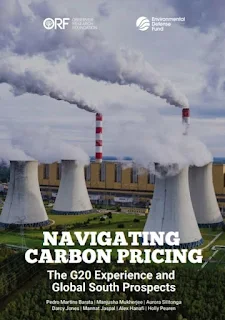
The joint report by Environmental Defense Fund and Observer
Research Fund, "Navigating Carbon Pricing: The G20 Experience and Global
South Prospects", delves into the complex landscape of carbon pricing,
examining its application within the G20 nations and the potential
implications for emerging economies in the Global South. The report
claims to provide insights and recommendations for effective carbon pricing
strategies in diverse economies.
A note:
The
Environmental Defense Fund (EDF) and Observer Research Foundation (ORF) have launched the Navigating Carbon Pricing: The G20 Experience and Global
South Prospects” report. The report delves into the complex
landscape of carbon pricing, examining its application within the G20
nations and the potential implications for emerging economies in the
Global South.
The report offers a comprehensive analysis of
various carbon pricing instruments currently in existence, providing
valuable insights into their socio-economic challenges and how they can
be most effective in climate change mitigation within both
industrialized and emerging economies. By exploring the experiences of
G20 nations, it highlights the diverse approaches to carbon pricing and
identifies key lessons that can inform effective policy development in
other regions.
Carbon pricing mechanisms are evolving as a
prominent instrument in the fiscal policy toolkit of governments to
reduce emissions as well as augment government revenues. This growth in
its wider usage, from its early adoption within European climate policy,
mirrors the increasing commitment from major economies, particularly in
developing mitigation instruments that can be supportive of domestic
mitigation.
“Within this context, the report provides an
overview of the experience of carbon pricing across the world. It
focuses on the benefits of these instruments, the challenges that impede
wider adoption, and the solutions that can lead to the faster uptake of
these tools by emerging economies. In particular, two sets of issues
can slow down the implementation or impact of carbon taxes or emissions
trading systems: lack of capacity to design and implement the
instruments, and the need to understand and protect vulnerable
communities from potentially negative social impacts of their adoption,”
Pedro Martins Barata, AVP, Carbon Markets & Private Sector
Decarbonisation at EDF, and the lead author of the report, said.
The
report also reviews existing evidence, which indicates that the social
impacts of existing carbon pricing regimes have largely been overstated
and that, where such impacts are evident, there are design elements that
can mitigate and reverse any negative social and income effects of the
proposed carbon pricing instruments.
Implementing carbon pricing will need substantial capacities and resources
Further,
the report sheds light on ongoing capacity-building initiatives aimed
at supporting the implementation and enforcement of carbon pricing
policies. It identifies best practices and opportunities for
collaboration to enhance the effectiveness and equity of carbon pricing
frameworks worldwide.
“The report looks at existing
capacity-building efforts and initiatives and argues for more
coordination across initiatives and a focus on sharing lessons across
the Global South. This is particularly important given the growing
interest and momentum in Latin America, Africa, and Asia on carbon
taxes, emissions trading, and crediting mechanisms,” said Hisham Mundol,
EDF’s Chief Advisor in India.
The report highlights the gaps in the prevalent capacity-building initiatives as:
a) weak coordination between such initiatives resulting in fragmented approach and inconsistent quality standards,
b) lack of sustainability of capacity or no institutionalization of capacities,
c) lack of efficient stakeholder engagement mechanisms, particularly inadequate engagement of the private sector.
Effective
capacity-building efforts require a champion entity within each country
that is tasked with the development of a carbon pricing instrument, the
report states.
The success of carbon pricing policies relies
in part on participating countries’ capacities to embed such approaches
within existing domestic policy, legal, regulatory, taxation and finance
frameworks. While the infrastructural capacity needs (Registry, MRV,
etc.) can be identical across nations, capacity needs for implementing
particular policies will need country-specific economic analysis, like
emissions modelling, stakeholder engagement, market-based policy design,
financing, legal frameworks, and institutional arrangements.

The next wave of carbon markets
While
lessons from Global North regarding the social and economic dimensions
of carbon pricing are valuable. there is an exciting prospect of
South-South engagement in mutual learning and sharing of experience, the
report states. Global South will have both challenges and advantages in
accelerating its move into the carbon markets space.
On one hand these
countries will have to overcome the lack of resources, data poverty,
issue of incipient electricity and overall energy market liberalization,
lack of access to capital, and focus on universal energy access, while
on the other hand Global South economies are growth engines and as they
build out their economy and infrastructure, they have the opportunity to
do so in low-carbon fashion and break the link between emissions and
growth, including through leapfrogging technologies.
Carbon pricing - an important discussion often un-percolated
The
concept of carbon pricing essentially means internalising the external
costs of carbon emissions. While the attempts to address the
environmental externalities dates back to 1920s, its evolution over time
has given us the contemporary carbon pricing mechanisms. Of which
mandatory carbon pricing is primarily practiced through carbon taxes and
cap-and-trade or emissions trading systems.
Though these
instruments have gained prominence in recent decades, particularly in
response to growing concerns about climate change and the need for
low-carbon transition of economies, only a handful of countries could
successfully implement these instruments in place, the numbers are much
lesser amongst the emerging economies.
The first carbon tax was
introduced in Finland in 1990 and the first large-scale cap-and-trade
system for carbon emissions (EU Emissions Trading System) was
established in the European Union in 2005. Yet the three decades of
carbon pricing still has limited knowledge in the public domain and
limited experiential evidence for diverse economies, particularly the
emerging economies. Hence, the case of carbon pricing remains curious
and challenging for countries with limited capacities and resources.
Carbon pricing is important and useful for the following benefits:
a)
Correcting market failures or enhancing economic efficiency by placing a
price on carbon which incentivises entities to reduce emissions,
b) Stimulate investment in low-carbon and energy-efficient developments, and
c)
Generate substantial revenue for governments which can be reallocated
to support climate-related initiatives and social and economic
transitions.
However, these benefits come with a complex
tapestry of socio-economic challenges. These range from the equity
concerns of disproportionate burdening of vulnerable or marginalised
populations, to the loss of competitiveness in carbon-intensive industry
sectors, or the differential impacts in different geographies, like
rural vs. urban or regions with different energy mix or resource
profiles, etc.
For example, regressivity of a carbon pricing policy can
exacerbate energy poverty by trapping the energy-poor households (still
relying on traditional biofuels) in their current state of lack of
access to electricity or improved cooking fuel or transport services. These impacts are highly dependent on the unique features of a given
jurisdiction, including economic development status, circumstantial
factors, like, the income or energy consumption patterns, regional
disparities, and re-investment policies.
Hence, it is crucial
for governments to evaluate their national circumstance and complement
carbon pricing policies with other fiscal policies and mitigation
instruments. The report talks about the tools to address such
challenges, like revenue recycling through direct transfer to vulnerable
populations or revenue distribution in clean technological or
infrastructural investments, etc.
Comments
Post a Comment
NOTE: Hateful, abusive comments won't be published. -- Editor