 |
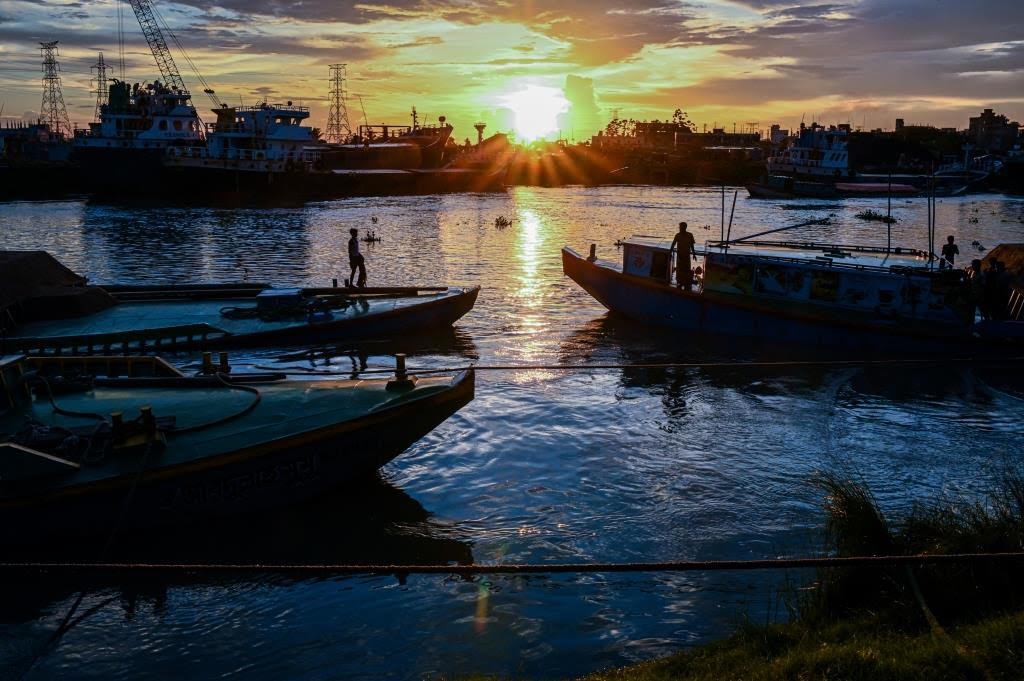
| River Buri Ganga, lifeline of Dhaka, and the port at Gatboli |
Earlier this month I was in Dhaka to attend a one on one photography workshop with an extremely talented Bangladeshi photographer GMB Aakash. As I was set to leave for Dhaka a student of mine remarked – “Comrade, tussi abroad challe ho” (comrade, you are going abroad)? Nothing could have been more tragic for me than to feel like being ‘abroad’ in Bangladesh. I told my student friend – “I would just like to feel like being at home in Dhaka; like an overdue homecoming.”
My affliction here does not owe to any reason endogenous to me; it simply is for the reason that we are the same people either across our western border or the eastern border, united by a shared history extending over thousands of years. The borders albeit are only 75 years old and it is my belief that if people across the sub-continent could have their way, the borders, as a barrier to free intermingling of the people, would be gone sooner than later.
I need to admit here that Bangladesh did not disappoint me even in the least. Upon arrival as the immigration official at the airport saw my passport a smile crossed his face. “Welcome to Bangladesh Sir. You are from JNU! It’s a great university; at least the greatest in South Asia and you are in a great profession.” This was no coincidence, for on my return another officer at the immigration said much the same thing.
.jpg)
But this was not the first time that I earned plaudits from a Bangladeshi in Bangladesh for simply being part of the Jawaharlal Nehru University (JNU). There is a small village ‘Dawki’ on Indo-Bangladesh border in south-east Meghalaya where the Umngot river forms a lake on the Indian side before flowing across the border into Bangladesh. It is a picnic spot where the common people seemed to have sway over the paramilitary Border Guards right on the border, both in India and Bangladesh. I had been to the place in December 2017.
A rather modest nylon rope, stretched across the river to mark the border, seemed to bear the audacity of dividing thousands of years of our shared history into India and Bangladesh. But the people were equally intent, quite spontaneously rather than by design, upon mitigating the ‘audacity of the rope.’ Even as the hawkers on either side did brisk business by selling snacks to customers from either side, selfies were being clicked by picnickers from the two countries on either side of the ‘rope’, inside each other’s country.It is there that I met a group of Bangladeshi students and some lawyers practicing in Bangladesh Supreme Court. Mere mention of being a professor at JNU earned me generous plaudits instantly along with an invite for a selfie in Bangladesh. The ‘rope’ was only a hapless witness to the will of the people.
I would let the plaudits rest here.
.jpg)
We went almost exclusively to working class areas and among the workers during the workshop. They welcomed me with generous smiles and rarely declined a pose for the camera. Moreover, that I was from India elicited a measure of excitement and a lot of respect on their part – something, I believe, we in India need to learn from.
Here I have displayed some more impressions I have carried back with me. I just wish that these manage to nudge our opinions a little.
***
Opposite old Dhaka, across the Buri Ganga river there is this shipyard where old ships are refurbished and some smaller ones are forged anew from metal retrieved from breaking down old ships. I do not know the scale of it, but like India, Bangladesh is also a recipient of old ships from across the world to be broken down.
.jpg)
.jpg)
.jpg)
.jpg)
.jpg)
.jpg)
.jpg)
.jpg)
.jpg)
.jpg)
.jpg)
The breaking down happens in Chittagong and the retrieved metal is then shipped to Dhaka by trawler boats and smaller ships where these labourers offload it. From what I saw, I can assure you that doing so is no mean task.
What I saw here were the feet that tirelessly bear the burden of this world, soiled even though they are; the hands that can hold up the sky, even though bonded into slavery of circumstances they are; burden off loaded to begin another round and the process goes on for at least eight hours a day; and a working woman, she steals a nap her mate keeps a strict vigil.
.jpg)
.jpg)
.jpg)
.jpg)
.jpg)
I met Anara Begom at Karwan Bazaar wholesale vegetable market, Dhaka. Anara’s husband was killed in Rawalpindi at the time of Bangladesh liberation war. She raised her children single handedly, and now that they are all married, she is left alone to fend for herself as her offspring can themselves manage only a hand to mouth existence.
 |
| Anara Begom |
.jpg) |
| A headload worker |
Then, there was a worker ferrying a headload of goods in the Karwan Bazar wholesale vegetable market; a worker enjoying a refreshing bath after the day’s hard work at Gabtoli cattle market in Dhaka; and a man and his machine (as I stood angling for this shot, I was incidentally reminded of Ritwik Ghatak’s 1958 film ‘Ajaantrik’).
.jpg)
Nothing would exemplify better the adage -- ‘living by the sweat of the brow only to get browbeaten’ as these workers do. I captured lunch break at Gabtoli; Maimoona, who manages her tiny ‘dhaba’ (food stall) to provide cheapest possible food for the laborers at Gabtoli; an angry young man (I wonder, who will channelize his anger?); Rahimul and Khaleeda who ferry coal from the ships.
Each basket of coal they ferry carries around 40 kg of coal which is to be offloaded at the depot that is around 100 meters from the ship. Each round trip earns them 3 takas and the count of the trips is kept by plastic tokens handed to them after each trip. Just calculate how many trips they would be making to earn a daily wage between 500 to 800 takas. It’s a sheer feat. Isn’t it humbling that they still managed a smile to make a great photograph. One can motice the kohl in Khaleeda’s eyes.
Then there was the proletarian Rambo, and a worker with flashy smile. You would have heard of descriptions like ‘Colgate smile’, ‘Binaca smile’ and ‘Cibaca smile’. His smile was twice as glorious as all three of them put together. Also, there was genial Hercules, Bilal Hossein, tall and muscular with broad shoulders on which rests the weight of many responsibilities.
 |
| Maimoona, Rahimul, Khaleeda |
Then there was the proletarian Rambo, and a worker with flashy smile. You would have heard of descriptions like ‘Colgate smile’, ‘Binaca smile’ and ‘Cibaca smile’. His smile was twice as glorious as all three of them put together. Also, there was genial Hercules, Bilal Hossein, tall and muscular with broad shoulders on which rests the weight of many responsibilities.

As dusk cast its deep shadow over Gabtoli it was time to bid adieu.

---
*MD, MPH, PhD, Assistant Professor, Centre for Social Medicine and Community Health, Jawaharlal Nehru University New Delhi
*MD, MPH, PhD, Assistant Professor, Centre for Social Medicine and Community Health, Jawaharlal Nehru University New Delhi
Comments