
Elementary education a fundamental right? Not in this Jharkhand village

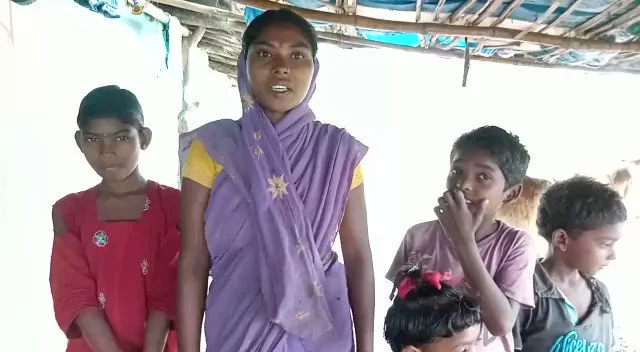
Nemi Devi
Freelance scholars and student volunteers interested in action-oriented research, socio-economic rights and related issues have carried out a survey on primary school children in a village in Jharkhand. A small writeup based on Road Scholarz’s twitter thread:
***
We did a house-to-house survey of primary-school children in Dumbi, a fairly typical Dalit-Adivasi hamlet of Jharkhand. Out of 36 children, 30 could not read a single word. Many parents feel that their children are lapsing into illiteracy. Nemi Devi explains.
Online learning is a fiction in Dumbi. With the village closed in the last 16 months, primary education is at a standstill. Most children are just milling around, some are working in the fields.
Kusmi Devi
In almost every house there was a sad story of poor parents who are struggling to educate their children, but most have no smartphone and no money for tuitions. Kusmi Devi, mother of 4 illiterate children, explains.
One of Kusmi’s daughters, Chandni, is in Class 5. She is unable to read a single word in hindi but she is expected to read this thick English textbook, with sentences like “gravity speeds up communication means, it also explains why Pisa leans”.
Even in the few houses of Dumbi where there is a smartphone, it is rarely used for online studying. Children easily get side-tracked – here in a game of Ludo.
Bottom line: every single parent in Dumbi wants the local school to re-open as soon as possible. Who would guess that elementary education is a fundamental right in India?

Comments

TRENDING

Incarceration of Prof Saibaba 'revives' the question: What is crime, who is criminal?

By Kunal Pant* In 2016, a Supreme Court Judge asked the state of Maharashtra, “Do you want to extract a pound of flesh?” The statement was directed against the state for contesting the bail plea of Delhi University Professor GN Saibaba. Saibaba was arrested in 2014, a justification for which was to prevent him from committing what the police called “anti-national activities.”

If Maoist violence is illegitimate, how is Hindutva, state violence justified? Can right-wing wash off its sins?

By Swami Agnivesh* and Sandeep Pandey** There was major police action against Sudha Bhardwaj, Gautam Navlakha, Varvara Rao, Vernon Gonsalves and Arun Ferreira on 28 August, 2018. Before this police arrested Professor Shoma Sen, Adocate Sudhir Gadling, Sudhir Dhawle, Mahesh Raut and Rona Wilson on 6 June. Even before this Dr. Binayak Sen, Soni Sori, Ajay TG, Professor GN Saibaba and Prashant Rahi have been arrested and all these activists have been accused of having links with Maoists.

The soundtrack of resistance: How 'Sada Sada Ya Nabi' is fueling the Iran war

​ By Syed Ali Mujtaba*  ​The Persian track “ Sada Sada Ya Nabi ye ” by Hossein Sotoodeh has taken the world by storm. This viral media has cut across linguistic barriers to achieve cult status, reaching over 10 million views. The electrifying music and passionate rendition by the Iranian singer have resonated across the globe, particularly as the high-intensity military conflict involving Iran entered its second month in March 2026.