
***
The year 2016 has turned out to be one of the hottest year in the history of Gujarat. In May, when the Samerth team decided to visit various water structures that Samerth has supported to build in Rapar(Kutch district), temperatures were as high as 48 degrees Celsius. The distance from Ahmedabad to Gagodar town in Rapar is roughly 275 kms. Rapar is a little known block in Kutch district – the current flavor of Gujarat tourism. But Rapar is not a tourist hub. It is a dry, saline, arid zone – also known as the dark zone since the ground water extraction is as high as 90-100%. The ground is saline, due to its closeness to the desert. The environmental conditions are extreme, from 50 degree Celsius in summer to 2 degree Celsius in winter. Water is scarce and therefore no industry or enterprise has flourished.It is not surprising then, that 30% of the population in Rapar (total population is 2,17,315 according to the 2011 census) is from the marginalized communities – OBCs, SCs and STs (Rabari, Koli, Hairjan etc). Monsoon is erratic and though the average rainfall of Kutch is 377mm, it occurs within a span of few days, and less than 4% of the rainwater can be collected. Last year, it rained in Rapar for three days – yes the entire monsoon fit itself in a two and half day capsule – when it rained 317.5mm. Strictly going by the average, it was good, but it caused more harm than good in terms of immediate effects with entire farms, cattle homes, ponds being washed out.
The main livelihood option in Rapar is still agriculture – profitable to the upper caste rich Patels, who have their farms near natural ponds or have been able to dig a deep bore well to extract water from the land. In the past ten years, one can see that the influential ones have taken a direct illegal connection from the Narmada pipeline. The poorer population works as share croppers or laborers in their fields. The OBCs focus on cattle rearing as their main occupation, and on an average each home would have equal number of animals vis-a-vis humans amidst them.
The dry conditions would force them to migrate in search of greener pastures (literally), closest being the Banni grasslands (in Kutch – 188 kms from Rapar), with some returning with stories from faraway lands of Gujarat and Rajasthan, how they walked all the way. More often than not, the entire families migrate, keeping their houses locked for four months, till the monsoon arrives.
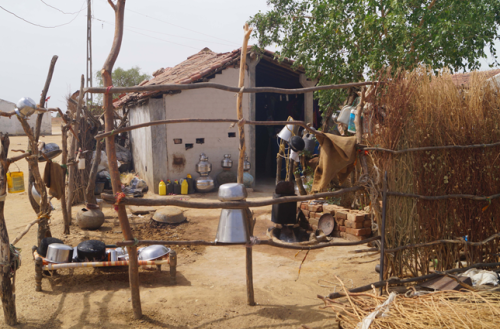
The SCs and STs, Harijans and Kolis, are the most impoverished of the entire population. They live in vandhs– settlements carved out of the village in deep desert lands. In an area like Rapar, with high salinity and poor rainfall, traditionally the land closest to water sources almost always belongs to the upper and the more powerful castes. The Kolis and Harijans feature last in the hierarchy and hence have lands in areas with no water source, far away from the main village. Coupled with the ridicule that they face in the village, Kolis since generations were forced to set up their homes near their farmlands.
As the family grows, a settlement is formed – and this is called a vandh. Vandhs are part of the panchayat – for voting purposes only and are more or less neglected by the administration. Most vandhs do not have access to piped water, aganwadi or health facilities and are poorly connected to the main village. To fulfill their water needs most vandh communities build a coarse dug well that sustains water for 4-5 months post monsoon.
That is also the time they can cultivate one rain-fed crop in their land. Post these early months of monsoon, women walk for kilometers each day to fetch drinking water, and men indulge in making illegal charcoal from the babul trees found in abundance near vandhs, or work as labourers in the farms of the more affluent Patels. Once the water source closest (at least three to eight kms from the vandh) dries, families migrate. They travel to other parts of Gujarat like Gandhidham and Himmatnagar, to work as labourers on construction sites, as brick kiln workers or as salt pan workers. All of which is back breaking work, undertaken in hazardous and extremely poor living conditions. Lack of stability also impacts their health; children’s education suffers. The local administration is full of excuse for their neglect – it expresses helplessness saying half the time people are not even there!
Samerth’s journey in participatory ground water management in Rapar has followed an interesting pattern. Vandhs were the first and obvious choice for intervention initiation and in the first phase from 2004 to early 2007. Several ponds, rain water harvesting structures, individual wells etc. were constructed with community contribution. In some cases they contributed through labor while in others raw material investment too. A Paani Samiti or water committee from the beneficiary household was formed for each structure, this ensured maintenance and fair distribution of water from the structure. This initiative could arrest migration to an extent of 40% from the vandhs, and immensely improved health and sanitation conditions of the community.
By 2007 the Sardar Sarovar Project had been implemented and the Narmada pipeline had reached Rapar. In the beginning, predictably, no pipeline construction was undertaken near any of the vandhs. Even today more than 50% do not have pipeline connection, while the rest receive sporadic water from the pipeline – if at all. Wherever available, the pipeline provides water for drinking and thus other major water intensive activities – agriculture and cattle rearing – still remained rain fed. In spite of the uncertainty of piped water, unfortunately, over a period of time it was observed that the onset of tap water brought in a kind of disregard for the traditional water structures. A rapid deterioration of community water structures could be seen. Those who could afford started digging their private bore wells – for agriculture as well as livestock rearing. Rampant extraction of water led to increase in the already high salinity of soil of the area.
In recent years, the Mahatma Gandhi National Rural Employment Generation Act (MGNREGA) was implemented in Kutch. Samerth saw MGNREGA as a great opportunity and actively started facilitating restoration of traditional water structures through it. MGNREGA also arrested the issue of forced migration of Kolis , Dalits and Rabaris and provided them an alternative form of livelihood in their own vicinity. Till date Samerth has been able to leverage Rs 36,610,255 through MGNREGA , and Rs 11 crore from the MLA’s fund. As many as 15,314 people have been supported in securing MGNREGA work.
Samerth has also supported in obtaining and renewal of job cards to 8508 people. The strategy on the field level was to appoint jaldoots (water messengers) in each village. These were young men/women from local communities who would then be trained under the MGNREG act and would then help people in obtaining job cards and ultimately plan with the villagers and help in execution of crucial water and other asset building projects for the village.
By 2009, an integrated strategy had emerged – working with the villagers and administration, leveraging MGNREGA to build assets for the village and vandhs. This strategy was strengthened by introducing micro planning – where the community along with technical experts are involved in designing and planning any intervention. Micro plans became the basis of an action plan to build any kind of water structure in the village.
The vandh community was also involved in making micro plans – which finally led to water security plans – a comprehensive plan so that enough water is available for cooking , drinking and other domestic needs to the communities at all times. Samerth has already made 97 water security plans – treating Gram Panchayat as a unit, out of which 20 have already been endorsed in the Gram Sabha and are now in its final form of implementation.
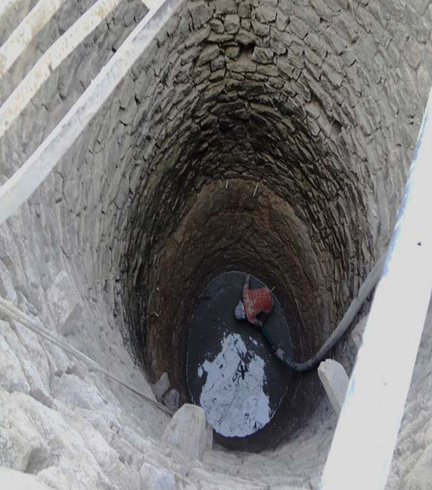
Though all of Samerth supported structures were fortified with geohydrological investigations and inputs, examining the unique soil, climatic, surface and groundwater situation of the region, it was imperative to train the local team, jaldoots, and interested villagers in a geogydrology to plan, retain and recharge their water resources better. In the last few years Samerth has focused on capacitating local communities on building their technical knowhow of their region, initiating better participation in gram sabhas, empowering women to conduct women gramsabhas and then getting their decisions endorsed at the panchayat. Five such women gram sabhas have already been held with women leaders preparing the list for basic amenities, sanitation, water and hygiene, development work, and women’s participation in decision making.
Samerth’s interventions have led to much direct and indirect impact in the lives of the communities of Rapar. Two evident impacts are:
- 57.34% decrease in migration – especially from the Koli, Harijan and Rabari communities. A recent research shows that as against 3,200 families in the year 2007-08, only 1,835 families migrated in 2014 -15 thanks to Samerth’s intervention in the area.
- Increase in water structures has provided water security for animals. This has led to an increase in the animals in the area and establishment of dairies like Sarhad dairy, National dairy and Sagar dairy in Rapar. The data from the last three years shows that poorer communities such as Kolis and Harijans have also started rearing animals, and thus have been able to diversify their livelihood strategy.
To be concluded
Comments