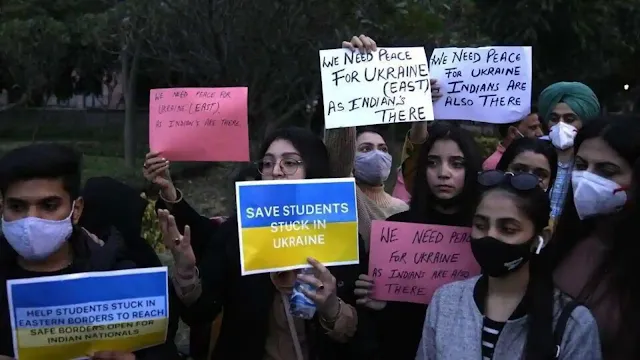
Punjab rallies against the war in Ukraine, condemns 'inter-imperialist' rivalry

By Harsh Thakor* 

A protest was organised by the Lok Sangram Morcha in Punjab at the Nature Park in Moga against the war in Ukraine. The front is a conglomeration of mass organizations. Around 400 persons participated in the protest comprising of farmers, agricultural workers, intellectuals, students and youth.
The participating organisations were Bharatiya Kisan Union (Krantikari), Lok Sangram Morcha,Grameen Mazdoor Sabha, and Association for Democratic Rights (AFDR). The main speech was made by Swaranjeet Singh of AFDR who highlighted the nature of imperialist contention and the mutual aggression.
The protestors marched through the market place shouting slogans and holding banners, culminating the rally at the bus stand. Resolutions were passed demanding Russian withdrawal of troops from Ukraine, supporting demands of farmers, removing corrupt elements from college managements and introducing positive and democratic aspects about progressive Sikh figures in history in school textbooks, who challenged feudalism.
Swaranjeet Singh condemned the Russian invasion of Ukraine but left no stone unturned in exposing the conspiracy of America and Western countries in patronising the fascist regime of Ukraine and expanding NATO.
He summarised how American and other western countries were banging every nail into the wall to subvert nations and sharpen contention for hegemony. He condemned Russia's imperialist designs and felt there was no justification of Russia's claim that it was forced into the act or its goal was to liberate Ukraine from fascist control.
He also condemned the utter insensitivity of Prime Minister Narendra Modi in not coming to the aid of the victimized Indian medical students by vacating them promptly and on the contrary blamed them for migrating to study.
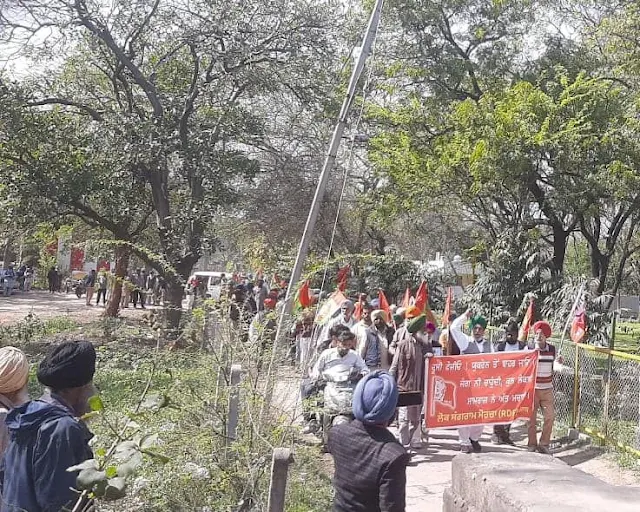
Speakers included Darshan Singh Tur, of the Lok Sangram MorchaTara Singh Moga, Krantikari Pendu Mazdoor Union secretary Lakhveer Singh Lakha, district secretary Parminder Singh Barad, Singh Nathuwala, Jaswinder Kaur, Bhartiya Kisan Union (Krantikari) district member Gurdip Varoke,women's leader Surinder Kaur Dhudike and district secretary Tahal Singh.
The Kirti Kisan Union in village Chakk Sadoka Jalalabad also held a rally protesting the Ukraine war, criticising the wrongs of both sides and condemning Modi. He condemned the inter-imperialist rivalry to grab profits, path towards obtaining hegemony and entrapping the world people in a cross fire.
Even if small, such a protest lit the first sparks in the anti-war resistance of Punjab. A father of a student in Ukraine Ranajeet Singh recounted the misery his daughter was facing, with basic amenities being denied.
---
*Freelance journalist

Comments

TRENDING

Gram sabha as reformer: Mandla’s quiet challenge to the liquor economy

By Raj Kumar Sinha*  This year, the Union Ministry of Panchayati Raj is organising a two-day PESA Mahotsav in Visakhapatnam, Andhra Pradesh, on 23–24 December 2025. The event marks the passage of the Panchayats (Extension to Scheduled Areas) Act, 1996 (PESA), enacted by Parliament on 24 December 1996 to establish self-governance in Fifth Schedule areas. Scheduled Areas are those notified by the President of India under Article 244(1) read with the Fifth Schedule of the Constitution, which provides for a distinct framework of governance recognising the autonomy of tribal regions. At present, Fifth Schedule areas exist in ten states: Andhra Pradesh, Chhattisgarh, Gujarat, Himachal Pradesh, Jharkhand, Madhya Pradesh, Maharashtra, Odisha, Rajasthan and Telangana. The PESA Act, 1996 empowers Gram Sabhas—the village assemblies—as the foundation of self-rule in these areas. Among the many powers devolved to them is the authority to take decisions on local matters, including the regulation...

MG-NREGA: A global model still waiting to be fully implemented

By Bharat Dogra  When the Mahatma Gandhi National Rural Employment Guarantee Act (MG-NREGA) was introduced in India nearly two decades ago, it drew worldwide attention. The reason was evident. At a time when states across much of the world were retreating from responsibility for livelihoods and welfare, the world’s second most populous country—with nearly two-thirds of its people living in rural or semi-rural areas—committed itself to guaranteeing 100 days of employment a year to its rural population.

Concerns raised over move to rename MGNREGA, critics call it politically motivated

By A Representative   Concerns have been raised over the Union government’s reported move to rename the Mahatma Gandhi National Rural Employment Guarantee Act (MGNREGA), with critics describing it as a politically motivated step rather than an administrative reform. They argue that the proposed change undermines the legacy of Mahatma Gandhi and seeks to appropriate credit for a programme whose relevance has been repeatedly demonstrated, particularly during times of crisis.

A comrade in culture and controversy: Yao Wenyuan’s revolutionary legacy

By Harsh Thakor*  This year marks two important anniversaries in Chinese revolutionary history—the 20th death anniversary of Yao Wenyuan, and the 50th anniversary of his seminal essay "On the Social Basis of the Lin Biao Anti-Party Clique". These milestones invite reflection on the man whose pen ignited the first sparks of the Great Proletarian Cultural Revolution and whose sharp ideological interventions left an indelible imprint on the political and cultural landscape of socialist China.

Rollback of right to work? VB–GRAM G Bill 'dilutes' statutory employment guarantee

By A Representative   The Right to Food Campaign has strongly condemned the passage of the Viksit Bharat – Guarantee for Rozgar and Ajeevika Mission (Gramin) (VB–GRAM G) Bill, 2025, describing it as a major rollback of workers’ rights and a fundamental dilution of the statutory Right to Work guaranteed under the Mahatma Gandhi National Rural Employment Guarantee Act (MGNREGA). In a statement, the Campaign termed the repeal of MGNREGA a “dark day for workers’ rights” and accused the government of converting a legally enforceable, demand-based employment guarantee into a centralised, discretionary welfare scheme.

Swami Vivekananda's views on caste and sexuality were 'painfully' regressive

By Bhaskar Sur* Swami Vivekananda now belongs more to the modern Hindu mythology than reality. It makes a daunting job to discover the real human being who knew unemployment, humiliation of losing a teaching job for 'incompetence', longed in vain for the bliss of a happy conjugal life only to suffer the consequent frustration.

Making rigid distinctions between Indian and foreign 'historically untenable'

By A Representative   Oral historian, filmmaker and cultural conservationist Sohail Hashmi has said that everyday practices related to attire, food and architecture in India reflect long histories of interaction and adaptation rather than rigid or exclusionary ideas of identity. He was speaking at a webinar organised by the Indian History Forum (IHF).

India’s Halal economy 'faces an uncertain future' under the new food Bill

By Syed Ali Mujtaba*  The proposed Food Safety and Standards (Amendment) Bill, 2025 marks a decisive shift in India’s food regulation landscape by seeking to place Halal certification exclusively under government control while criminalising all private Halal certification bodies. Although the Bill claims to promote “transparency” and “standardisation,” its structure and implications raise serious concerns about religious freedom, economic marginalisation, and the systematic dismantling of a long-established, Muslim-led Halal ecosystem in India.

From jobless to ‘job-loss’ growth: Experts critique gig economy and fintech risks

By A Representative   Leading economists and social activists gathered in the capital on Friday to launch the third edition of the State of Finance in India Report 2024-25 , issuing a stark warning that the rapid digitalization of the Indian economy is eroding welfare systems and entrenching "digital dystopia."