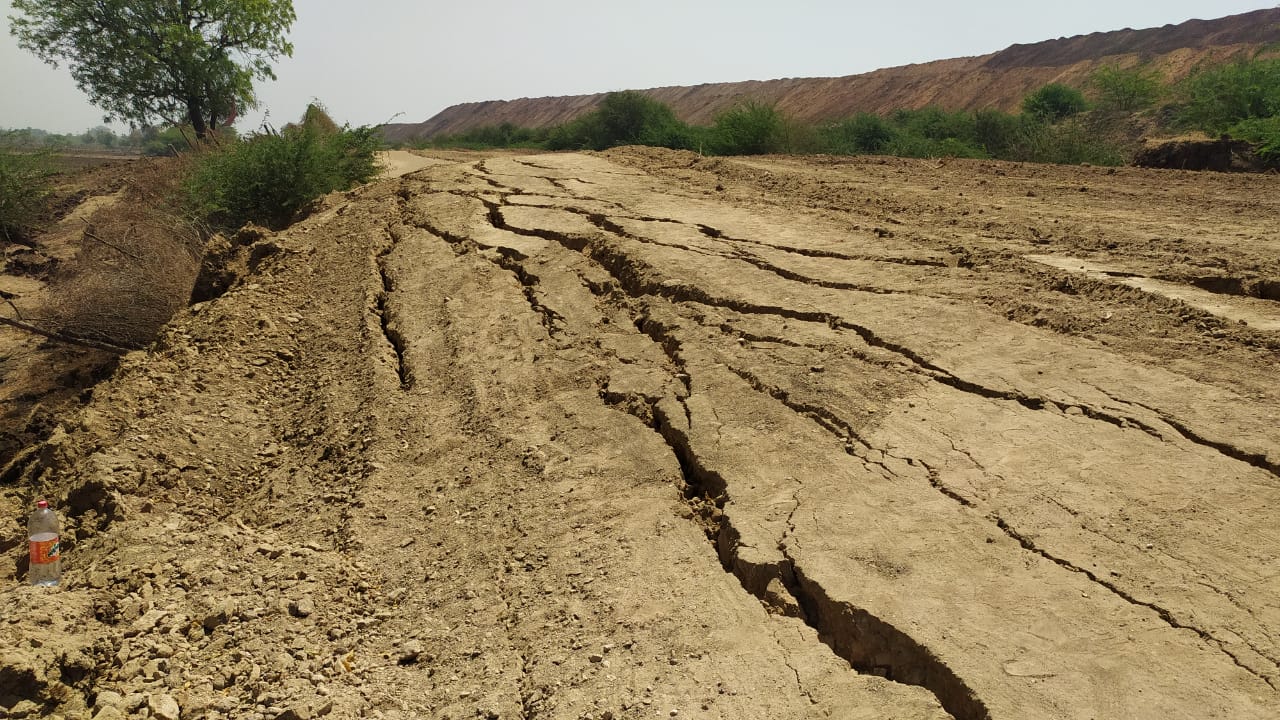
Observing land rise of land of approximately 10 metres and width of 700 meters for eight days, starting on March 9, at the state public sector undertaking Gujarat Mineral Development Corporation (GMDC) lignite mining site near the villages Bhuteshwar and Bhumbhali of Bhavnagar district, Gujarat environmentalists have sought immediate halt to all mining activities in the area.
Rohit Prajapati and Krishnakant of the Paryavaran Suraksha Samiti, a Vadodara-based NGO, have said that despite several pleas, the "unusual occurrence" has taken place in the GMDC district for the fourth time. Yet, the authorities concerned have done nothing to ameliorate the situation, devastating farmlands and water bodies.
In yet another letter to the Union and state government's top environment, mines and minerals and disaster management officials, they said, a "major disaster" is unfolding at Surkha lignite mining site, causing "major unexplainable geological changes."
According to the executive officials of the GPCL, a similar disaster took place in December 2019 at survey No 119/1 near the farm of Italia Vitthalbhai Lavejibhai in Thordi village. Here, the ground is elevated across a length of more than 100 meters, which can be seen even today. Rise of land at village Badi-Hoidad was viral on social media on November 17, 2020.
Along with the representatives of the affected villagers, were able to visit the area on November 24, 2020. On November 25, 2020, the then assistant collector Pushpa Lata, taluka mamlatdar of Ghogha AR Gadhvi, regional officer of Gujarat Pollution Control Board (GPCB) AG Oza, Gunjanbhai Sharma, officer of mining department, Devendra Khot, officer of the Gujarat Power Corporation Limited (GPCL), Rohit Prajapati of the Paryavaran Suraksha Samit (PSS) visited (1) villages Badi-Hoidad disaster site, survey No. 49/1, 49/2, 47, 48, 23 (Gauchar Land), (2) Badi-Hoidad mining cross roads, (3) Badi mining site, and (4) Thordi village disaster sites, of December 2019 at survey No. 119/1 Italia Vitthalbhai Lavejibhai's farmland.
In yet another letter to the Union and state government's top environment, mines and minerals and disaster management officials, they said, a "major disaster" is unfolding at Surkha lignite mining site, causing "major unexplainable geological changes."
Text:
Once again in the period 09.03.2022 – March 17, 2022 at the Gujarat Mineral Development Corporation’s lignite mining site at village Bhuteshwar – Bhumbhali land rise of land approximately 10 meters and width of 700 meters was observed. On March 9, 2022 it was slow in the beginning and then after people observed a sudden rise in the land.According to the executive officials of the GPCL, a similar disaster took place in December 2019 at survey No 119/1 near the farm of Italia Vitthalbhai Lavejibhai in Thordi village. Here, the ground is elevated across a length of more than 100 meters, which can be seen even today. Rise of land at village Badi-Hoidad was viral on social media on November 17, 2020.
Along with the representatives of the affected villagers, were able to visit the area on November 24, 2020. On November 25, 2020, the then assistant collector Pushpa Lata, taluka mamlatdar of Ghogha AR Gadhvi, regional officer of Gujarat Pollution Control Board (GPCB) AG Oza, Gunjanbhai Sharma, officer of mining department, Devendra Khot, officer of the Gujarat Power Corporation Limited (GPCL), Rohit Prajapati of the Paryavaran Suraksha Samit (PSS) visited (1) villages Badi-Hoidad disaster site, survey No. 49/1, 49/2, 47, 48, 23 (Gauchar Land), (2) Badi-Hoidad mining cross roads, (3) Badi mining site, and (4) Thordi village disaster sites, of December 2019 at survey No. 119/1 Italia Vitthalbhai Lavejibhai's farmland.
All observed the rise of land. Again on October 1, 2021, the 12 Gam Khedut Sangharsh Samiti, Badi Padva, and PSS activists visited the mining waste dumpsite 350 meters away (Location high hillock - 21.609352, 72.226347) from Residential area of the Badi Village.
We observed that the dumpsite was sinking since late night October 1, 20210 and again on October 3, 2021 we estimated it to have sunk by about 25-30 feet deep and around 150 meters length. At the same time (Location - 21.6063300, 72.2268610) the Maleshree River that flows 350 meters away from the residential area of the Badi Village and the village pastoral land (location - 21.6231430, 72.2264560) about 1.5 kilometres away from Badi village is contaminated due to the illegal mining waste flowing into it and is fast being rendered unfit for agriculture and animal husbandry needs. The river condition has worsened.
That means (1) in 2019 at Village Thordi, (2) in 2020 at Village Badi-Hoidad, (3) in 2021 at Village Badi, and now (4) at villages Bhuteshwar-Bhumbhali major geological unexplainable changes on the land of these villages are visible.
You knowingly or unknowingly failed to explain to us and the villagers about the repeated geological changes happening in the mining area of GPCL and GMDC lignite mining for the best reasons known to you.
It appears that the mining companies and the concerned authorities have decided to ignore the unfolding disaster. They seem to await a major disaster to take appropriate action on the ground.
It was expected from the mining companies and concerned departments to make the villagers aware about such geological activity and what are the official preparedness plans owing to mining activity in the region. There are more than 12 villages with around 33,000 population, barely 18 kms away from Bhavnagar city.
In our last letter dated October 3, 2021 we clearly mentioned:
“We demand the following actions from the concerned authorities on an immediate basis to assess, investigate and study the unfolding environmental disaster.
1. The competent authority should carry out a drone survey led by experts’ team to study and put on record the environment disaster and suggest short – medium – long term measures to tackle it.
2. As sought by the villagers earlier, we again reiterate our demand to stop the ongoing illegal mining activities, illegal dumping of mining waste and set an exemplary action against the company’s top officials, and all errant authorities who failed to take timely action against the offenders.”
As usual no response or reply was sent to us or to the villagers about the recent and past incidences.
The repeated occurrence of such geological disaster, and silence on the part of the mining companies and the concerned departments speaks volumes about your understanding and concern regarding a response to a situation of this severity.
No information, even the basic information, is shared with the local panchayats through advertisement in the newspaper or news channel or through press conference to the villagers staying next to the disaster sites as to what precautionary measures should be taken in case of such a mishap.
Even you may believe that these can be ignored, as these are relatively small disasters and major irreversible disasters may take more time. You do not seem to follow the universally accepted ‘Precautionary Principle’ for such anticipated disasters.
 Given the above facts, we again demand:
1. Immediately halt all the mining activities till the reason for this unusual occurrence is ascertained in the region, take an exemplary action against the company’s top officials, and all errant authorities who failed to take timely action against the offenders.
2. The competent authority should carry out a drone survey led by experts’ team to study and put on record the environment disaster and suggest short – medium – long term measures to tackle it.
3. Conduct a mock drill and awareness campaign in the area for disaster preparedness of this nature.
4. Take strict action against the GPCL and GMDC officials for their negligence and failure to inform the district and concerned authorities of these disasters.
5. Take exemplary action against the officials who did not duly report the disastrous incident despite it being in the news that went viral locally in social media. Why did the senior district officials remain unaware and uninformed for such a grave and criminal negligence?
6. Initiate action against GPCL and GMDC for the violations of the conditions of the Environment Clearance and Consent under the Environment (Protection) Act, 1986.
7. Fence off the affected area and bar entry with public warning notices to the effect that it is a disaster-prone zone.
8. Conduct the following surveys under independent expert guidance to find the causes for the disaster and also assess the possibility of sea water ingress due to raising of farmland:
We observed that the dumpsite was sinking since late night October 1, 20210 and again on October 3, 2021 we estimated it to have sunk by about 25-30 feet deep and around 150 meters length. At the same time (Location - 21.6063300, 72.2268610) the Maleshree River that flows 350 meters away from the residential area of the Badi Village and the village pastoral land (location - 21.6231430, 72.2264560) about 1.5 kilometres away from Badi village is contaminated due to the illegal mining waste flowing into it and is fast being rendered unfit for agriculture and animal husbandry needs. The river condition has worsened.
That means (1) in 2019 at Village Thordi, (2) in 2020 at Village Badi-Hoidad, (3) in 2021 at Village Badi, and now (4) at villages Bhuteshwar-Bhumbhali major geological unexplainable changes on the land of these villages are visible.
You knowingly or unknowingly failed to explain to us and the villagers about the repeated geological changes happening in the mining area of GPCL and GMDC lignite mining for the best reasons known to you.
It appears that the mining companies and the concerned authorities have decided to ignore the unfolding disaster. They seem to await a major disaster to take appropriate action on the ground.
It was expected from the mining companies and concerned departments to make the villagers aware about such geological activity and what are the official preparedness plans owing to mining activity in the region. There are more than 12 villages with around 33,000 population, barely 18 kms away from Bhavnagar city.
In our last letter dated October 3, 2021 we clearly mentioned:
“We demand the following actions from the concerned authorities on an immediate basis to assess, investigate and study the unfolding environmental disaster.
1. The competent authority should carry out a drone survey led by experts’ team to study and put on record the environment disaster and suggest short – medium – long term measures to tackle it.
2. As sought by the villagers earlier, we again reiterate our demand to stop the ongoing illegal mining activities, illegal dumping of mining waste and set an exemplary action against the company’s top officials, and all errant authorities who failed to take timely action against the offenders.”
As usual no response or reply was sent to us or to the villagers about the recent and past incidences.
The repeated occurrence of such geological disaster, and silence on the part of the mining companies and the concerned departments speaks volumes about your understanding and concern regarding a response to a situation of this severity.
No information, even the basic information, is shared with the local panchayats through advertisement in the newspaper or news channel or through press conference to the villagers staying next to the disaster sites as to what precautionary measures should be taken in case of such a mishap.
Even you may believe that these can be ignored, as these are relatively small disasters and major irreversible disasters may take more time. You do not seem to follow the universally accepted ‘Precautionary Principle’ for such anticipated disasters.

1. Immediately halt all the mining activities till the reason for this unusual occurrence is ascertained in the region, take an exemplary action against the company’s top officials, and all errant authorities who failed to take timely action against the offenders.
2. The competent authority should carry out a drone survey led by experts’ team to study and put on record the environment disaster and suggest short – medium – long term measures to tackle it.
3. Conduct a mock drill and awareness campaign in the area for disaster preparedness of this nature.
4. Take strict action against the GPCL and GMDC officials for their negligence and failure to inform the district and concerned authorities of these disasters.
5. Take exemplary action against the officials who did not duly report the disastrous incident despite it being in the news that went viral locally in social media. Why did the senior district officials remain unaware and uninformed for such a grave and criminal negligence?
6. Initiate action against GPCL and GMDC for the violations of the conditions of the Environment Clearance and Consent under the Environment (Protection) Act, 1986.
7. Fence off the affected area and bar entry with public warning notices to the effect that it is a disaster-prone zone.
8. Conduct the following surveys under independent expert guidance to find the causes for the disaster and also assess the possibility of sea water ingress due to raising of farmland:
- GPR -- Ground Penetrating Radar -- to ascertain neotectonics activities in the area to get an idea of impact due to mining activities in the area beneath land surface.
- Resistivity, Profiling Survey, and Seismological Surveys - to recognise and demarcate faults in the area and to ascertain tectonic activity and the impact of unusual geological phenomenon.
10. Clarify and explain publicly why such a disaster was not thought of in the Environment Impact Assessments (EIA) Report and Environment Management Plant (EMP).
11. Establish an empowered committee of experts to devise, guide, help execute, and monitor a comprehensive restoration plan of the raised land areas so that the villagers can begin to use their land for their regular livelihood activities and natural assets are enhanced.
We expect your prompt and positive response in the interest of life, livelihoods, and environment in the affected areas. If you fail in your mandatory duties, you as responsible authorities and as individuals, will be collectively liable for present conditions and future consequences.
Comments