Demolition drive off Delhi: Women protest 'eviction, atrocities', pledge to fight it out

By A Representative 

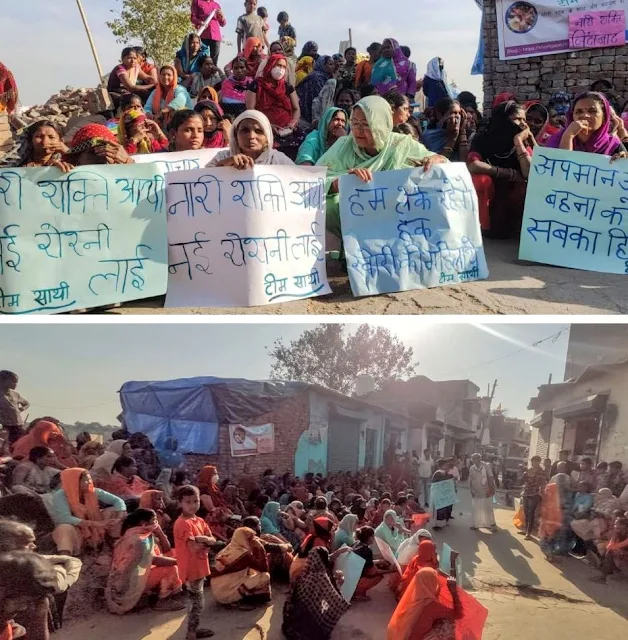
"We will take what is our rightful due through struggle"; "we seek accountability for the jail and unlawful displacement from the government"; "women of the world are all together in their struggle": These were some of the slogans which reverberated at the women’s day programme celebrated at the Khori village, at the Delhi-Haryana border.
Organized at Chungi No. 3 Lal Kuan, Delhi, right on the Delhi-Haryana border on the road to Delhi, with the demolished Khori village in the background, those who spoke about "eviction and atrocities" since July 14, 2021 included Rekha Behen, Samina Khatoon, Sitara, Radha Devi, Najma Khatoon, Sumitraji, Gurdeep Kaur and Usha Behen.
They said, March 8 is a day of respect for women. But they cannot forget how they were forcibly evicted from their homes. They were constantly being attacked. In Faridabad even today there are 122 sites illegally occupied but no action is taken by the government. The inhuman evictions that started from July 14, 2021. The police lathi-charged even on women and girls. Some of them were hit with sticks, caught and put in jail.
According to them, women were tortured by the police. Due to broken houses, pregnant, handicapped, old women and young girls suffered a lot. Forced to defecate in the open, they were bothered every day. The hungry and thirsty people of Khori village were left to fend for themselves in the rain. Nothing was thought about the education of girls. There is a slogan across the country “beti padhao beti bachao”, but for whom? The reality of the slogan in Khori is "deti ujado" (displace daughter).
According to them, they have the right to celebrate the women's day. But how do they celebrate? They have no home, they are homeless. The atrocities committed in Khori village will not be forgotten. They will take account of this from the government and carry forward their struggle, they pledged.
Rekha Bahen sang "Komal hai kamjor nahi -- shakti ka naam hi naari hai" at the end of the programme. The Women also sang the famous struggle song "Isiliye raah sangarsh ki hum chale". The youth of the Team Saathi, which is supporting the struggle, repeated young poet Pash's poem “Hum ladehenge saathi” (We will fight together) by linking it to the demolition of Khori village.

Comments

TRENDING

Gram sabha as reformer: Mandla’s quiet challenge to the liquor economy

By Raj Kumar Sinha*  This year, the Union Ministry of Panchayati Raj is organising a two-day PESA Mahotsav in Visakhapatnam, Andhra Pradesh, on 23–24 December 2025. The event marks the passage of the Panchayats (Extension to Scheduled Areas) Act, 1996 (PESA), enacted by Parliament on 24 December 1996 to establish self-governance in Fifth Schedule areas. Scheduled Areas are those notified by the President of India under Article 244(1) read with the Fifth Schedule of the Constitution, which provides for a distinct framework of governance recognising the autonomy of tribal regions. At present, Fifth Schedule areas exist in ten states: Andhra Pradesh, Chhattisgarh, Gujarat, Himachal Pradesh, Jharkhand, Madhya Pradesh, Maharashtra, Odisha, Rajasthan and Telangana. The PESA Act, 1996 empowers Gram Sabhas—the village assemblies—as the foundation of self-rule in these areas. Among the many powers devolved to them is the authority to take decisions on local matters, including the regulation...

MG-NREGA: A global model still waiting to be fully implemented

By Bharat Dogra  When the Mahatma Gandhi National Rural Employment Guarantee Act (MG-NREGA) was introduced in India nearly two decades ago, it drew worldwide attention. The reason was evident. At a time when states across much of the world were retreating from responsibility for livelihoods and welfare, the world’s second most populous country—with nearly two-thirds of its people living in rural or semi-rural areas—committed itself to guaranteeing 100 days of employment a year to its rural population.

Concerns raised over move to rename MGNREGA, critics call it politically motivated

By A Representative   Concerns have been raised over the Union government’s reported move to rename the Mahatma Gandhi National Rural Employment Guarantee Act (MGNREGA), with critics describing it as a politically motivated step rather than an administrative reform. They argue that the proposed change undermines the legacy of Mahatma Gandhi and seeks to appropriate credit for a programme whose relevance has been repeatedly demonstrated, particularly during times of crisis.

A comrade in culture and controversy: Yao Wenyuan’s revolutionary legacy

By Harsh Thakor*  This year marks two important anniversaries in Chinese revolutionary history—the 20th death anniversary of Yao Wenyuan, and the 50th anniversary of his seminal essay "On the Social Basis of the Lin Biao Anti-Party Clique". These milestones invite reflection on the man whose pen ignited the first sparks of the Great Proletarian Cultural Revolution and whose sharp ideological interventions left an indelible imprint on the political and cultural landscape of socialist China.

Rollback of right to work? VB–GRAM G Bill 'dilutes' statutory employment guarantee

By A Representative   The Right to Food Campaign has strongly condemned the passage of the Viksit Bharat – Guarantee for Rozgar and Ajeevika Mission (Gramin) (VB–GRAM G) Bill, 2025, describing it as a major rollback of workers’ rights and a fundamental dilution of the statutory Right to Work guaranteed under the Mahatma Gandhi National Rural Employment Guarantee Act (MGNREGA). In a statement, the Campaign termed the repeal of MGNREGA a “dark day for workers’ rights” and accused the government of converting a legally enforceable, demand-based employment guarantee into a centralised, discretionary welfare scheme.

Swami Vivekananda's views on caste and sexuality were 'painfully' regressive

By Bhaskar Sur* Swami Vivekananda now belongs more to the modern Hindu mythology than reality. It makes a daunting job to discover the real human being who knew unemployment, humiliation of losing a teaching job for 'incompetence', longed in vain for the bliss of a happy conjugal life only to suffer the consequent frustration.

Making rigid distinctions between Indian and foreign 'historically untenable'

By A Representative   Oral historian, filmmaker and cultural conservationist Sohail Hashmi has said that everyday practices related to attire, food and architecture in India reflect long histories of interaction and adaptation rather than rigid or exclusionary ideas of identity. He was speaking at a webinar organised by the Indian History Forum (IHF).

India’s Halal economy 'faces an uncertain future' under the new food Bill

By Syed Ali Mujtaba*  The proposed Food Safety and Standards (Amendment) Bill, 2025 marks a decisive shift in India’s food regulation landscape by seeking to place Halal certification exclusively under government control while criminalising all private Halal certification bodies. Although the Bill claims to promote “transparency” and “standardisation,” its structure and implications raise serious concerns about religious freedom, economic marginalisation, and the systematic dismantling of a long-established, Muslim-led Halal ecosystem in India.

From jobless to ‘job-loss’ growth: Experts critique gig economy and fintech risks

By A Representative   Leading economists and social activists gathered in the capital on Friday to launch the third edition of the State of Finance in India Report 2024-25 , issuing a stark warning that the rapid digitalization of the Indian economy is eroding welfare systems and entrenching "digital dystopia."