
On the farming map of Uttar Pradesh, Mahoba is generally considered a relatively backward district of Bundelkhand region, but thanks to a recent initiative called Bundelkhand Initiative for Water, Agriculture and Livelihoods (BIWAL), a model combining water conservation and natural farming, has given a new-found strength to many farmers and rural communities. Arunoday and Srijan voluntary organization have collaborated to take this model to several villages, with emphasis on women farmers and relatively weaker sections.
Chhitarwara village in Jaitpur block provides an example of a village that is humming with new creativity in the course of experimenting with natural farming. Arvind, a small farmer known for his many-sided skills, was quick to turn his creativity in this direction.
As we now have a very low-cost technology based on improved utilization of cow dung and urine plus other local free resources, Arvind asked himself, won’t it now become viable to tend the neglected piece of low productivity land more carefully? Once he and his family took up the challenge, to their delight they ended up increasing the production on this piece of land by almost 3 times, from 5 to around 14 quintals, using only organic inputs.
Several other farmers like Surtai and Chhadami have also achieved very encouraging results from natural farming. This as well as the steep decline in the costs of those farmers who have adopted natural farming has attracted other farmers and most other farmers are at least trying natural farming on a part of the land, or discussing about moving to this path soon. This important and very creative change within a short time has become a big discussion point in this area.
Another such village is Thurhat where Ramesh Dada leading this effort has set up a natural farming center which has become a hub for these activities and more specifically also a place where other farmers can buy low-cost organic manure ad pest repellant.
Ramesh Dada says that the first one or two years are difficult while shifting to natural farming but after this the yield stabilizes and can also increase. However the cost reduction and quality improvement of produce is achieved immediately. In fact so important is the quality improvement, Ramesh said, that he was able to obtain almost double the normal rate for the entirely organic wheat produced at his farm, so that despite a small decline in yield his income certainly went up.
There are several other enthusiastic farmers here who are happy with their shift to natural farming. Deendayal has achieved more in vegetable cultivation while Ghanshyam talks with pride about filling two trucks with watermelons grown on his small farm. The other side is that Ramesh has not yet been able to convince his own brother to make this change to natural farming. On the whole, however, the wind here is blowing much in favour of change towards natural farming.
In these two villages as well as in Baura village of this block this change has been facilitated by the removal of silt from tanks, leading further to deposition of fertile silt in fields and increase of rainwater retention capacity of tanks. In fact Baura village suffered from quite acute water scarcity earlier and it was only after sorting this out that the prospects for natural farming’s success also increased.
Another such village is Thurhat where Ramesh Dada leading this effort has set up a natural farming center which has become a hub for these activities and more specifically also a place where other farmers can buy low-cost organic manure ad pest repellant.
Ramesh Dada says that the first one or two years are difficult while shifting to natural farming but after this the yield stabilizes and can also increase. However the cost reduction and quality improvement of produce is achieved immediately. In fact so important is the quality improvement, Ramesh said, that he was able to obtain almost double the normal rate for the entirely organic wheat produced at his farm, so that despite a small decline in yield his income certainly went up.
There are several other enthusiastic farmers here who are happy with their shift to natural farming. Deendayal has achieved more in vegetable cultivation while Ghanshyam talks with pride about filling two trucks with watermelons grown on his small farm. The other side is that Ramesh has not yet been able to convince his own brother to make this change to natural farming. On the whole, however, the wind here is blowing much in favour of change towards natural farming.
In these two villages as well as in Baura village of this block this change has been facilitated by the removal of silt from tanks, leading further to deposition of fertile silt in fields and increase of rainwater retention capacity of tanks. In fact Baura village suffered from quite acute water scarcity earlier and it was only after sorting this out that the prospects for natural farming’s success also increased.
Now this village has formed a tank management committee to carry forward water conservation work and subsequently they have carried out removal of silt on their own also without the help of the two voluntary organizations. Now the process of cooperation among villagers has grown and even two rivals have been seen cooperating with each other to carry forward this work which benefits the entire village. In Thurhat village people want some repair work also in the tank to further improve water retention and recharge.
Elsewhere different solutions have emerged to tackle war shortage. In nearby Panna district’s Pipariya cluster ( Madhya Pradesh), where Srijan partner Hartika is working with small farmers to create several fruit orchards, electricity supply was so erratic in remote villages that irrigation had become a critical constraint.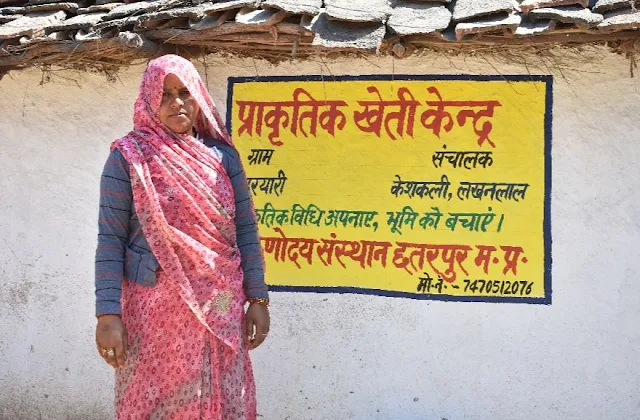

In such a situation the introduction of solar pumps appeared to be a savior and the fruit trees could be irrigated at the right time. However, Mangal Turbine is also very suitable for such difficult situations and should be considered, particularly as this has been invented by a Bundelkhand farmer scientist and is particularly suitable for parts of Bundelkhand such as Mahoba and Panna.
In Gaurihar block of Mahoba district the challenge is considered to be bigger as this has been generally considered one of the most backward blocks of Mahoba district. However here the work of BIWAL initiative, facilitated by a grant from Indus Ind Bank, has progressed well even in more difficult conditions. One example of this is Kheminkhera village. Traditional wisdom in water conservation is very visible in two ancient tanks here – the Behari Sagar tank of Chandel tmes is linked by overflow to serving Devi tank. The Behari Sagar has beautiful lotus flowers whose fragrance spreads far and wide. People can earn livelihood by freely collecting its stem used as a vegetable and makhana.
However, in recent years excess silt accumulation had become a problem in both of these tanks. Removal of this silt under BIWAL project and its deposition in fields improved land fertility as well as water conservation and recharge, and this turn prepared the base for the success of natural farming in the village resulting in improved production of vegetables and planting of new orchards while keeping down costs.
Keshkali of Churiyari village in this block is a good representative of women farmers who have come forward to make full use of new opportunities. She has set up a natural farming centre, taking up natural farming herself and motivating many others to do so. She says she had problems in the first year of natural farming, but now she is well established in this.
Vipin Tiwari is even more enthusiastic and says that he has been able to almost double production in some of his fields by carefully adopting natural farming practices. The progress in this village in this direction has been very encouraging and most farmers are now being attracted towards this.
At the same time some new concerns are also emerging. While the recent progress in this village was helped much by the silt removal from its tank, the introduction of exotic fish along with polluting feed has led to a situation in which the water has become badly polluted.
Keshkali of Churiyari village in this block is a good representative of women farmers who have come forward to make full use of new opportunities. She has set up a natural farming centre, taking up natural farming herself and motivating many others to do so. She says she had problems in the first year of natural farming, but now she is well established in this.
Vipin Tiwari is even more enthusiastic and says that he has been able to almost double production in some of his fields by carefully adopting natural farming practices. The progress in this village in this direction has been very encouraging and most farmers are now being attracted towards this.
At the same time some new concerns are also emerging. While the recent progress in this village was helped much by the silt removal from its tank, the introduction of exotic fish along with polluting feed has led to a situation in which the water has become badly polluted.
Villagers say that as long as fishing based on local naturally occurring fish existed, there was no problem at all but under a system of giving contracts of tanks this serious pollution has been caused. There was a struggle in another village against such pollution and perhaps a struggle will be needed here too, villagers say.
It is sad that while tanks are being cleaned, new and more dangerous sources of pollution are emerging. As I travelled towards Banda from here I became aware of another serious risk for water sources. There appeared to be an endless line-up of tricks carrying or waiting to carry sand mined from Ken river, legally as well as illegally.
It is sad that while tanks are being cleaned, new and more dangerous sources of pollution are emerging. As I travelled towards Banda from here I became aware of another serious risk for water sources. There appeared to be an endless line-up of tricks carrying or waiting to carry sand mined from Ken river, legally as well as illegally.
There were massive mounds of sand and the line of trucks destined to transport did not seem to end. So after seeing all the good work in several villages, I finally departed with deepened concern over much wider areas being opened up for ecological havoc.
---
*Honorary convener, Campaign to Save Earth Now. His recent books include ‘India’s Quest for Sustainable Farming and Healthy Food’, 'Protecting Earth for Children' and ‘A Day in 2071’
---
*Honorary convener, Campaign to Save Earth Now. His recent books include ‘India’s Quest for Sustainable Farming and Healthy Food’, 'Protecting Earth for Children' and ‘A Day in 2071’
Comments