.jpeg)
Care and home-making have traditionally been viewed as women's responsibilities in India. Despite the changing dynamics of society, women are still burdened with the responsibility of caring for the family and managing the household. There is a need to explore the challenges faced by women in caring for their families and the home and the need for a concerted effort to promote gender equality and women's empowerment.
The expectation that women will bear the primary responsibility for domestic duties and childcare is deeply ingrained in cultural norms and societal expectations. Women are often expected to prioritize their family obligations over their professional aspirations, which means that they are less likely to pursue their career goals or attain economic independence.
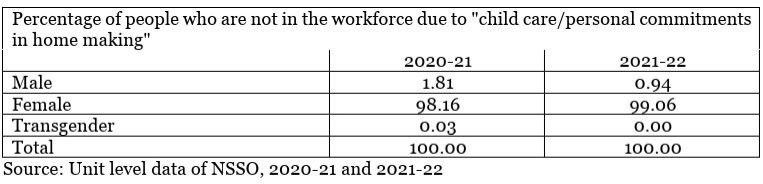
According to the latest data released by the National Sample Survey Office (NSSO), a significant proportion of individuals in India are not a part of the workforce due to "child care/personal commitments in home making".
The data highlights that this reason is particularly prevalent among females, with 98.16% of females citing it as the main reason for not being part of the workforce in 2020-21, which increased to 99.06% in 2021-22.
The NSSO data also shows that males are also affected by this reason, with 1.81% of them not being part of the workforce in 2020-21 due to child care/personal commitments in home making, which decreased to 0.94% in 2021-22. Meanwhile, the percentage of transgender individuals who are not part of the workforce due to this reason is negligible at 0.03% in 2020-21 and 0.00% in 2021-22.
The data suggests that a higher percentage of people from rural areas (65%) are not in the workforce due to childcare or personal commitments at home than people from urban areas (35%). This may be due to factors such as lower availability of childcare facilities or cultural expectations of gender roles in rural areas.
This perpetuates the cycle of poverty, particularly for women from marginalized communities who have fewer resources and support systems to help them balance their personal and professional responsibilities effectively.
Moreover, the burden of care and home-making also affects women's mental and physical health. Women who are responsible for caring for their families and managing the household are often overworked and stressed, which can lead to burnout and physical and mental health problems.
Challenges faced by women
The burden of care and home-making is particularly challenging for women in India due to the lack of support systems and policies that enable work-life balance. The absence of affordable and accessible childcare facilities, parental leave policies, and flexible work arrangements further exacerbate this situation.Women who wish to pursue their professional aspirations are often faced with a difficult choice between their family obligations and their career goals. This situation is particularly challenging for single mothers and women from marginalized communities, who have fewer resources and support systems to help them balance their personal and professional responsibilities effectively.
The lack of support systems for women also perpetuate gender-based stereotypes that limit women's opportunities and potential. Women are often viewed as homemakers and caregivers rather than as equal partners in the workforce, which limits their access to economic opportunities and professional growth.
Promoting gender equality, women's empowerment
Addressing the issue of the burden of care and home-making requires a concerted effort by all stakeholders, including the government, employers, and civil society. The government must invest in creating enabling environments that promote women's economic and social empowerment, including policies that enable work-life balance and provide support for affordable childcare facilities.High percentage of people from rural areas (65%) are not in the workforce due to childcare or personal commitments
Employers must also play their part by providing flexible work arrangements and implementing parental leave policies that enable women to balance their personal and professional responsibilities effectively. Civil society must also advocate for gender equality and women's rights, challenging cultural norms that perpetuate gender-based stereotypes and promote women's empowerment.
In addition, promoting gender equality and women's empowerment requires a shift in societal attitudes towards the role of women in society. Women must be viewed as equal partners in the workforce, with the same opportunities for economic and professional growth as men. This requires challenging gender-based stereotypes that limit women's potential and promoting a more inclusive and equitable society that values and respects women's contributions.
By promoting women's empowerment, we can unlock the full potential of women, enabling them to contribute to the country's development and achieve their aspirations. We must recognize the value of women's contributions to society, both in the home and in the workforce, and work towards creating a more inclusive and equitable society that values and respects women.
In conclusion, care and home-making are still predominantly viewed as women's responsibilities in India, which has significant implications for women's economic and social empowerment, as well as for the country's overall development.
Addressing this issue requires a concerted effort by all stakeholders to create enabling environments that promote women's economic and social empowerment, challenge gender-based stereotypes, and promote gender equality. By doing so, we can unlock the full potential of women, enabling them to contribute to the country's development and achieve their aspirations.
It is time to recognize and value women's contributions to society and work towards creating a more inclusive and equitable society for all.
---
*Consultant physiotherapist and home maker. Views are personal
In addition, promoting gender equality and women's empowerment requires a shift in societal attitudes towards the role of women in society. Women must be viewed as equal partners in the workforce, with the same opportunities for economic and professional growth as men. This requires challenging gender-based stereotypes that limit women's potential and promoting a more inclusive and equitable society that values and respects women's contributions.
Conclusion
The burden of care and home-making continues to be disproportionately borne by women in India. Addressing this issue requires a collective effort by all stakeholders to create enabling environments that promote women's economic and social empowerment, challenge gender-based stereotypes, and promote gender equality.By promoting women's empowerment, we can unlock the full potential of women, enabling them to contribute to the country's development and achieve their aspirations. We must recognize the value of women's contributions to society, both in the home and in the workforce, and work towards creating a more inclusive and equitable society that values and respects women.
In conclusion, care and home-making are still predominantly viewed as women's responsibilities in India, which has significant implications for women's economic and social empowerment, as well as for the country's overall development.
Addressing this issue requires a concerted effort by all stakeholders to create enabling environments that promote women's economic and social empowerment, challenge gender-based stereotypes, and promote gender equality. By doing so, we can unlock the full potential of women, enabling them to contribute to the country's development and achieve their aspirations.
It is time to recognize and value women's contributions to society and work towards creating a more inclusive and equitable society for all.
---
*Consultant physiotherapist and home maker. Views are personal
Comments